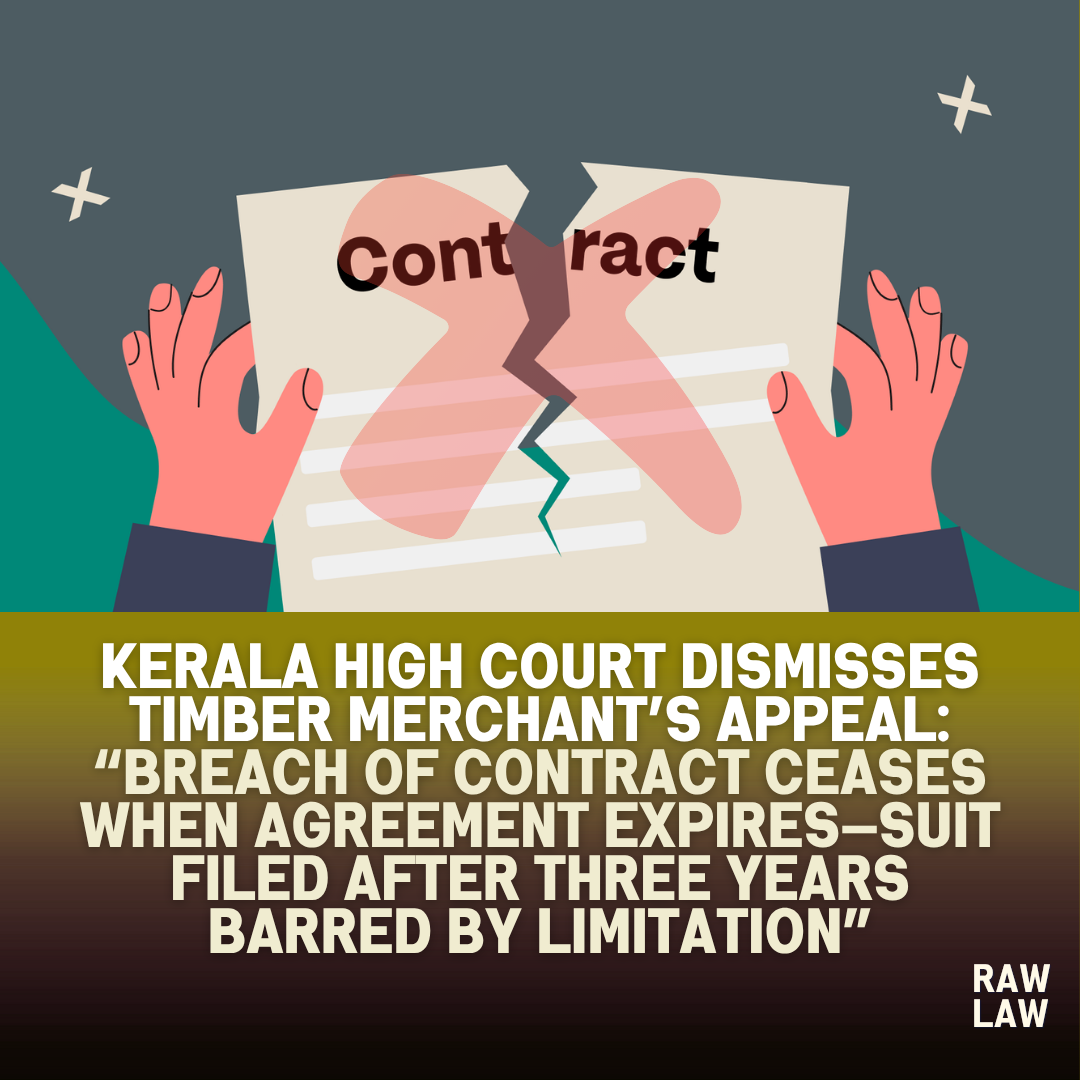
Kerala High Court Dismisses Timber Merchant’s Appeal: “Breach of Contract Ceases When Agreement Expires—Suit Filed After Three Years Barred by Limitation”

Court’s Decision
The Kerala High Court, comprising Justice Sathish Ninan and Justice P. Krishna Kumar, dismissed a timber merchant’s appeal seeking damages for alleged breach of contract against property owners who failed to obtain forest passes for tree felling operations. The Court affirmed the trial court’s finding that the suit was barred by limitation under Article 55 of the Limitation Act, 1963, and clarified the legal position on continuing breaches under Section 22 of the Limitation Act.
In a categorical finding, the Bench held:
“The breach was a continuing one during the currency of the contract. Once the period fixed by the parties expired, the breach ceased. A suit thereafter, filed beyond three years from expiry, is barred by limitation.”
The Court concluded that since the plaintiff had filed the suit nearly four years after the contract expired, the claim was legally untenable and rightly dismissed by the lower court.
Facts
The plaintiff, a timber merchant, entered into a contract dated 6 August 1998 with the defendants, the owners of a private estate, to cut and remove standing trees from their property. The total consideration under the agreement (Ext. A1) was fixed at ₹25 lakhs.
Under the terms of the agreement, the defendants were obligated to obtain passes from the Forest Department to enable transportation of the felled timber. The agreement also required the defendants to settle all labour claims of estate workers before allowing the removal of timber.
To facilitate the performance of the contract, the plaintiff constructed a 25-kilometre road through the property and invested significant amounts for sheds, labour, and machinery. The initial period of the contract was one year from 1 September 1998 to 1 September 1999.
According to the plaintiff, the defendants failed to secure the forest passes during this period. As a result, the agreement was allegedly extended up to 3 April 2001 by mutual consent. Despite the extension, the defendants allegedly did not fulfil their obligations, preventing the plaintiff from completing tree removal. The plaintiff claimed to have incurred heavy losses and, in January 2005, filed a suit seeking damages for breach of contract.
The defendants admitted the execution of the 1998 agreement but denied any extension. They argued that the agreement had been fully performed by 2000 and that a fresh agreement (Ext. B4) had been entered into for a separate property. They also pleaded that the suit was time-barred under the Limitation Act.
The trial court dismissed the suit, finding that the contract had been performed and, in any event, the claim was barred by limitation. The plaintiff then filed a Regular First Appeal before the High Court.
Issues
- Whether the suit for damages was barred by limitation under Article 55 of the Limitation Act, 1963.
- Whether the breach of the contract could be considered a continuing breach, extending the limitation period.
- Whether the plaintiff proved that the contract had been extended up to April 2001 as alleged.
Petitioner’s Arguments
The appellant-plaintiff argued that the defendants had failed to perform their obligation to obtain forest passes, and that such non-performance constituted a continuing breach under Section 22 of the Limitation Act. It was contended that the defendants’ default persisted even after the expiry of the original term, and therefore, the limitation period had not begun to run until the breach ceased.
The appellant submitted that the agreement was mutually extended till 3 April 2001, and since the defendants continued to default thereafter, the cause of action was recurring and continuous. Hence, the suit filed in January 2005 was within the permissible three-year period from the alleged extension date.
Counsel for the appellant emphasized that the defendants’ failure was not a one-time breach, but an ongoing failure to obtain statutory permissions necessary for performance, which persisted during and after the contract’s subsistence.
Respondent’s Arguments
The respondents denied any extension of the contract and maintained that the original agreement expired in September 1999. They asserted that even if an extension were assumed, it was limited to a definite term ending in April 2001, and therefore, any breach would have ceased by that date.
They further argued that the suit, filed in 2005, was clearly barred by limitation, since Article 55 of the Limitation Act prescribes a three-year period from the date of breach or cessation of breach.
The respondents contended that the plaintiff had suppressed the execution of a subsequent agreement (Ext. B4) dated 1 October 2000, executed after the completion of the earlier contract, which demonstrated that the plaintiff’s claims under Ext. A1 were already settled. They urged the Court to uphold the trial court’s decision, emphasizing that mere allegations of continuous breach cannot revive an expired cause of action.
Analysis of the Law
The Court examined Article 55 and Section 22 of the Limitation Act, 1963, which govern suits for breach of contract and continuing breaches.
Article 55 prescribes a limitation period of three years for “compensation for breach of any contract,” beginning from the date the contract is broken or, in cases of continuing breach, from the date the breach ceases.
Section 22 provides that in cases of continuing breaches, a fresh period of limitation begins to run “at every moment during which the breach continues.”
The Court clarified that not every failure to perform amounts to a continuing breach. A continuing breach arises only when the obligation itself is of a continuing nature and persists beyond the contractual term. Where the contract has a fixed duration, the breach cannot continue beyond its expiry.
Applying this principle, the Bench observed that the defendants’ obligation to obtain passes existed only during the subsistence of the contract. Once the contract period expired, the continuing nature of the breach ceased.
Precedent Analysis
The Court’s reasoning drew upon established judicial interpretations of limitation principles:
- Bengal Waterproof Ltd. v. Bombay Waterproof Manufacturing Co. (1997) 1 SCC 99, where the Supreme Court explained that the concept of continuing breach applies only when the wrongful act is of a recurring nature that gives rise to a fresh cause of action each day.
- Balakrishnan v. M.A. Krishnamurthy (1998) 7 SCC 123, reiterating that once a contract has expired, the limitation period begins from that date, and subsequent conduct cannot extend limitation.
- State of Punjab v. Gurdev Singh (1991) 4 SCC 1, which clarified that limitation begins when the right to sue accrues, and mere delay or continued non-performance does not postpone accrual of cause of action.
Following these precedents, the Court emphasized that the breach of Ext. A1 could not be termed continuing beyond its fixed duration.
Court’s Reasoning
The Court noted that Ext. A1 explicitly stipulated a one-year term beginning 1 September 1998 and ending 1 September 1999. Even assuming the alleged extension until 3 April 2001, the maximum contractual duration ended by that date.
The Bench held that the failure to obtain forest passes, while constituting a breach, ceased upon expiry of the contractual period. Thereafter, the plaintiff’s right to sue accrued immediately and had to be exercised within three years, i.e., by April 2004.
Since the suit was instituted only on 18 January 2005, it was clearly beyond the limitation period. The Court concluded that the trial court rightly dismissed the suit as time-barred, and the plaintiff’s argument of continuous breach was legally unsustainable.
Having found the suit barred by limitation, the Bench declined to examine other questions regarding breach or damages.
Conclusion
The Kerala High Court upheld the trial court’s decision, holding that the plaintiff’s claim for damages was barred by limitation. The Court dismissed the appeal, observing:
“When the period of the contract expired, the breach ceased. The plaintiff was obliged to institute the suit within three years from the date of expiry. Having failed to do so, the suit is time-barred.”
Accordingly, the appeal was dismissed, and the decree of the Subordinate Judge, Thiruvananthapuram, was confirmed.
Implications
This judgment reinforces the principle that the concept of “continuing breach” applies only during the subsistence of a contract. Once a contract expires by efflux of time, any breach prior thereto cannot be treated as continuing.
It serves as a caution to litigants that delay in seeking legal remedy for breach of contract can be fatal, and that the limitation period begins from the date the breach occurs or, at most, from the contract’s expiry.
The ruling underscores the judiciary’s strict approach towards time-barred claims, ensuring certainty and finality in contractual relations.
FAQs
1. What is a “continuing breach” under the Limitation Act?
A continuing breach occurs when a contractual obligation persists over time and is continuously violated. However, it ceases once the contractual term ends.
2. When does limitation begin for a breach of contract?
Under Article 55 of the Limitation Act, limitation begins from the date the contract is broken or, in case of a continuing breach, when the breach ceases.
3. Why was the suit dismissed in this case?
The suit was filed nearly four years after the contract expired, exceeding the three-year limitation period prescribed for breach of contract claims.