Kerala High Court faults mechanical Form-5 orders — “Reasons are the heartbeat of every order” — Court condemns stereotype decisions under the Paddy Land Act and directs strict statewide reforms

Court’s decision
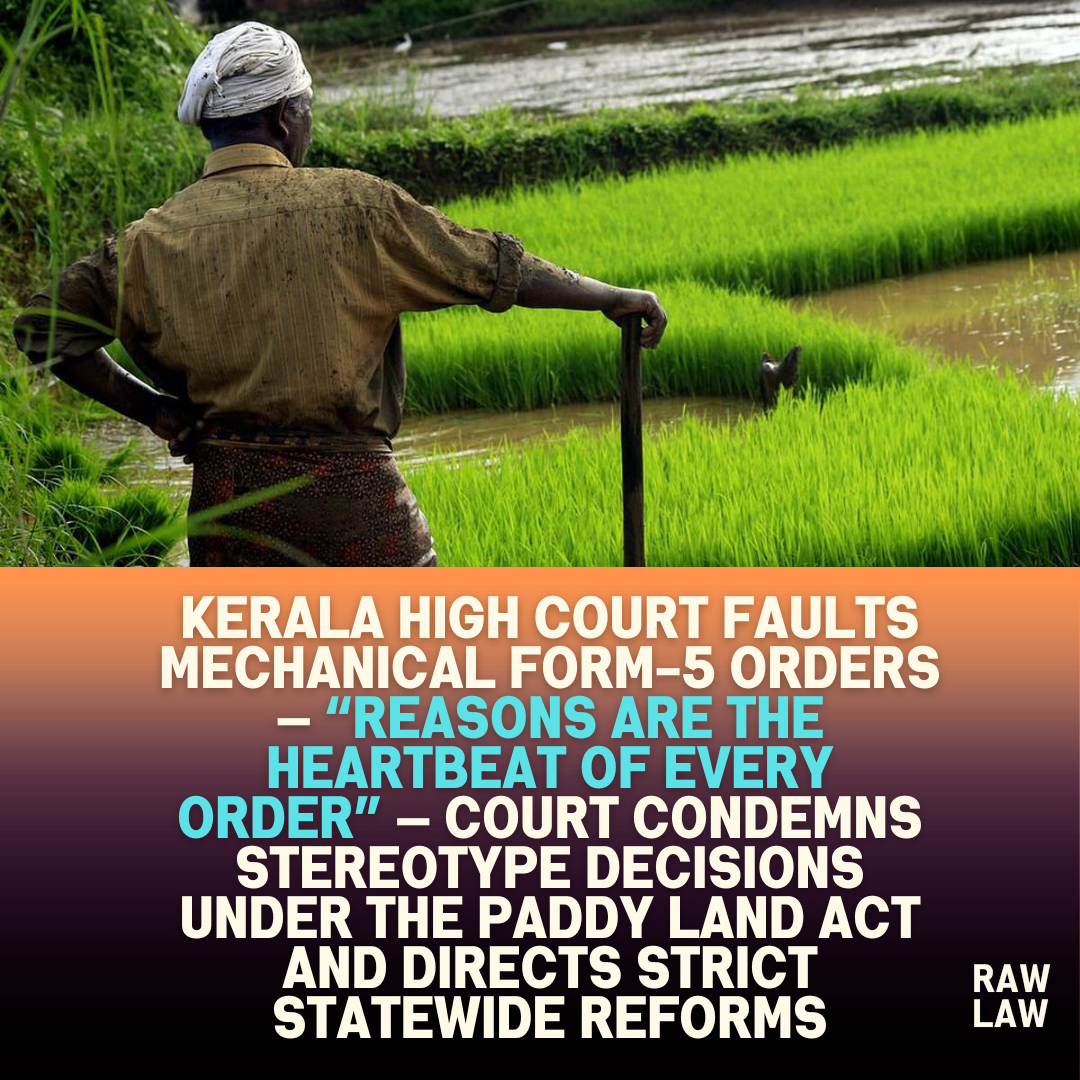
The Kerala High Court delivered a strongly worded judgment quashing the order passed by the Authorised Officer on a Form-5 application under the Kerala Conservation of Paddy Land and Wetland Act and Rules, 2008. The Court held that the officer had passed a stereotyped, non-speaking order, ignoring binding precedents and even repeating an earlier order that had already been set aside by the Court. The Court found this to be a serious dereliction of quasi-judicial responsibility under the Paddy Land Act.
The Court directed a fresh reconsideration of the Form-5 application within two weeks and imposed personal costs on the officer for compelling the Petitioner to approach the Court twice. It also ordered the State Chief Secretary to circulate the judgment to all authorised officers across Kerala so that future orders comply with the requirement of reasoned decision-making.
Further, the Court held that the Authorised Officer’s justification—stating in an affidavit that a subordinate drafted the order because he was busy with election duty—was unacceptable. The Court noted that a quasi-judicial authority cannot sign orders drafted by clerical staff and cannot abdicate statutory responsibility under the Paddy Land Act.
The Court relied heavily on decisions such as Joy K.K., Sudheesh U., Arthasasthra Ventures, and Mather Nagar Residents Association, and also cited the Supreme Court ruling in Basudev Dutta to reiterate that speaking orders are mandatory for administrative and quasi-judicial authorities.
Facts
The Petitioner jointly owned a small extent of land that had long remained barren and unsuitable for paddy cultivation. Although neighbouring lands had been converted and built upon, the Petitioner’s land was included in the statutory data bank as paddy land.
The Petitioner submitted a Form-5 application seeking removal of the property from the data bank. The Authorised Officer dismissed the application with a standardised order, merely noting that the land appeared fallow and lacked proof of conversion before 2008. The order did not discuss the KSREC report, the Local Level Monitoring Committee recommendation, or the Petitioner’s contentions.
The Petitioner challenged this order and obtained directions from the High Court requiring a reconsideration in light of binding precedents. Despite this, the Authorised Officer passed an almost identical order, repeating earlier reasoning without change. The Petitioner therefore approached the High Court for the second time.
Issues
The primary issue was whether the Authorised Officer could reject a Form-5 application through a non-speaking, mechanical order that ignored statutory duties and judicial directions. Another core question was whether the land’s classification as “fallow” or “lying waste” could legally justify continued inclusion in the data bank under the Paddy Land Act.
Additionally, the Court examined whether the Authorised Officer’s act of signing an order drafted by a Junior Superintendent amounted to a violation of the principles governing quasi-judicial functioning.
Petitioner’s arguments
The Petitioner argued that the impugned order violated settled law under the Paddy Land Act because it failed to consider the actual physical condition of the land as on 12 August 2008, when the Act came into force. The Petitioner emphasised that the KSREC report clearly showed that the land had remained fallow for years, and multiple neighbouring properties had been converted long ago.
The Petitioner further argued that the Local Level Monitoring Committee had recommended removal of the land from the data bank, but the Authorised Officer dismissed this recommendation without giving reasons. The Petitioner contended that the officer’s refusal to consider satellite imagery and failure to give a reasoned order violated judicial precedents and amounted to mechanical decision-making.
Respondent’s arguments
The Respondents submitted that the Authorised Officer handled numerous Form-5 matters and inadvertently repeated the earlier reasoning. They contended that the officer was occupied with official election duties and relied on staff to prepare draft orders. They argued that the mistake was unintentional and that the matter could be remanded again for reconsideration.
The Respondents maintained that the land was historically classified as paddy land and that absence of proof of conversion before 2008 justified rejection. They also argued that the presence of vegetation indicated possible cultivation feasibility.
Analysis of the law
The Court analysed the statutory objective behind the Kerala Conservation of Paddy Land and Wetland Act, emphasising its ecological purpose while also reminding that no citizen can be deprived of property except by authority of law. The Court reiterated that Form-5 determinations must consider whether the land was paddy land as on 12 August 2008 and whether it remains fit for paddy cultivation.
The Court stressed that fallow land is not equivalent to paddy land. It also noted that satellite imagery, scientific data, and the Local Level Monitoring Committee’s expert assessment must be considered. The Court held that mechanical reliance on revenue records without verifying ground realities is impermissible under precedents.
The Court concluded that the Authorised Officer had abdicated statutory responsibility by merely echoing the Village Officer’s report and ignoring KSREC findings.
Precedent analysis
The Court relied on Joy K.K., which held that the capability of converting land back to paddy is irrelevant; what matters is its nature on 12 August 2008.
In Sudheesh U., the Court held that failure to conduct site inspection or obtain KSREC reports renders Form-5 orders arbitrary.
In Muraleedharan Nair, the Court reiterated that the Authorised Officer must independently assess the land’s fitness and cannot rely solely on LLMC opinions.
In Arthasasthra Ventures, the Court mandated reliance on satellite data when physical evidence was insufficient.
In Mather Nagar Residents Association, the Court clarified that fallow land, even if waterlogged during monsoon, cannot automatically be categorised as paddy land.
The Supreme Court in Basudev Dutta held that reasons are the “heartbeat” of every quasi-judicial order.
Court’s reasoning
The Court found that the Authorised Officer passed a virtually identical order even after judicial remand. The Court held that this demonstrated disregard for judicial authority and failure to apply independent mind.
The Court noted that signing an order drafted by a subordinate is a grave violation of quasi-judicial responsibility. A statutory authority must evaluate evidence, apply statutory principles, and issue reasoned findings. Delegating this task to clerical staff undermines the integrity of statutory adjudication.
The Court emphasised that speaking orders are essential to uphold transparency and allow meaningful judicial review.
Conclusion
The Court set aside the impugned order, directed fresh disposal within two weeks, and imposed ₹10,000 personal costs on the Authorised Officer. The Court instructed the Chief Secretary to circulate guidelines to all officers and warned that future violations would lead to personal liability.
Implications
The judgment has far-reaching consequences for Form-5 adjudication under the Paddy Land Act. It reinforces that fallow land cannot be mechanically treated as paddy land and that detailed speaking orders are mandatory. It also signals that officers who repeat stereotype reasoning or delegate quasi-judicial tasks to subordinates will face personal consequences.
This decision is likely to significantly improve transparency, reduce arbitrary refusals, and ensure scientific assessment through KSREC data.