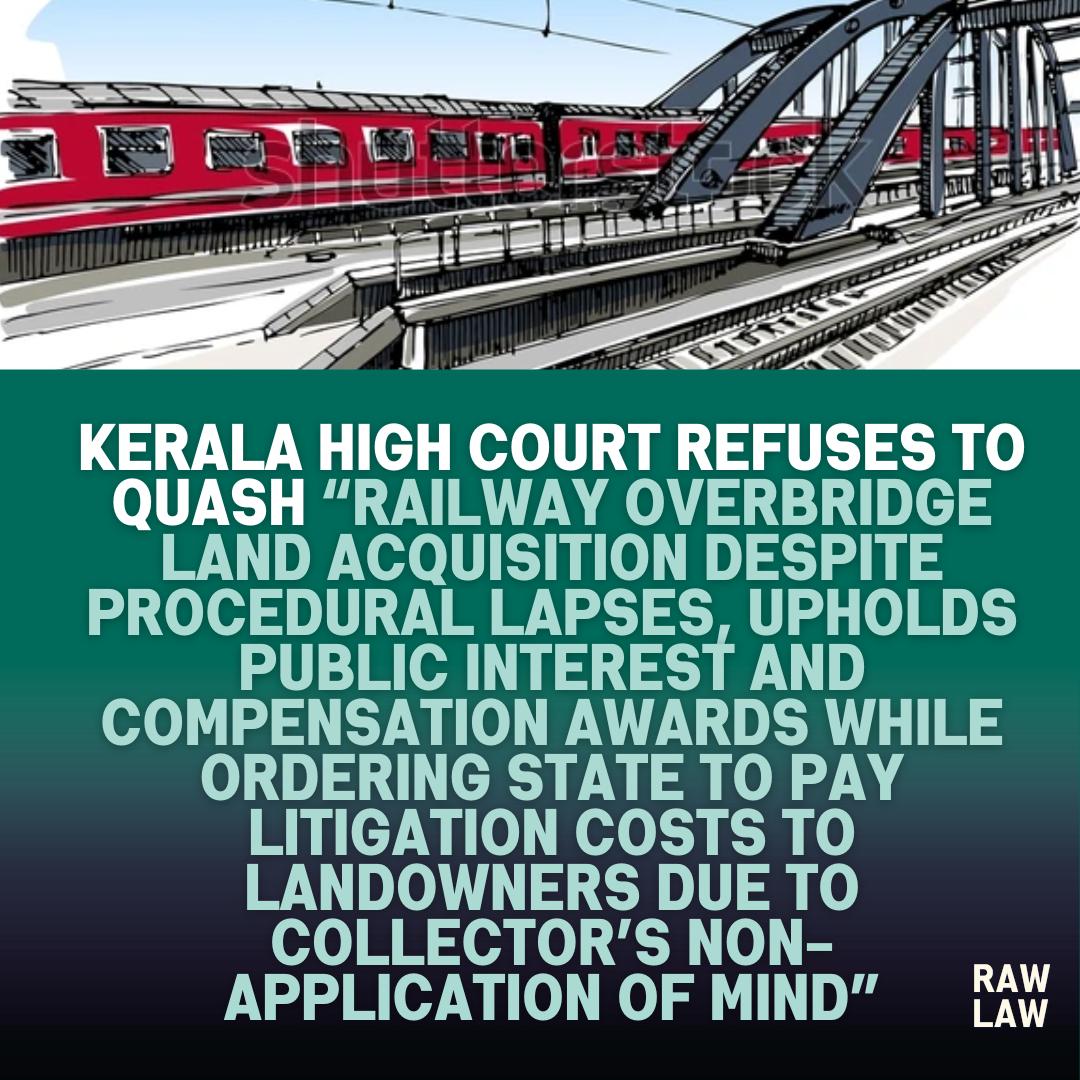
Kerala High Court Refuses to Quash Railway Overbridge Land Acquisition Despite Procedural Lapses, Upholds Public Interest and Compensation Awards While Ordering State to Pay Litigation Costs to Landowners Due to Collector’s Non-Application of Mind

“The lackadaisical approach of statutory authorities must be deprecated, but public interest in proceeding with the project outweighs setting aside the acquisition.”
Court’s Decision:
The Kerala High Court dismissed the appeal by landowners seeking to quash land acquisition proceedings under the Right to Fair Compensation and Transparency in Land Acquisition, Rehabilitation and Resettlement Act, 2013 for constructing a railway overbridge, despite acknowledging procedural lapses and lack of documented application of mind by the District Collector under Section 8.
However, due to advanced progress of acquisition, compensation already paid, and clear public benefit, the Court refused to set aside the proceedings but directed the State to pay ₹1 lakh each to the appellants for litigation costs within a month.
Facts:
The appellants challenged compulsory acquisition of their land for constructing a railway overbridge and approach roads at Kuruppanthara, Kottayam under the 2013 Act. They argued:
- There was already an existing overbridge within 250 metres and another within 1 km.
- Procedural safeguards under Sections 7 and 8 of the 2013 Act were breached, particularly absence of a proper decision by the District Collector based on the expert group’s report.
- The social impact assessment and the expert group’s report failed to consider the necessity of the new overbridge, violating the requirement of demonstrating a legitimate and bona fide public purpose.
The State argued that acquisition was completed with awards passed, compensation paid to most affected persons, and the project had public support. The learned Single Judge had dismissed the writ petition, leading to the present appeal.
Issues:
- Whether procedural lapses under Sections 7 and 8 of the 2013 Act render the acquisition proceedings void.
- Whether public interest in proceeding with the overbridge construction outweighs procedural irregularities.
- Whether landowners are entitled to relief, including costs, for the procedural lapses.
Petitioners’ Arguments:
The petitioners argued that:
- Section 8 mandates the Collector to apply mind to the expert group’s report, which was not done.
- The expert group’s report did not consider the proximity of two existing overbridges, indicating a lack of public necessity.\
- The procedural safeguards introduced under the 2013 Act were intended to protect property rights under Article 300-A of the Constitution.
- The acquisition violated principles set out by the Supreme Court in Urban Improvement Trust, Bikaner v. Gordhan Dass and Vidya Devi v. State of Himachal Pradesh regarding procedural compliance during compulsory acquisition.
- As only two landowners were resisting acquisition, the violation of their rights was more egregious.
Respondent’s Arguments:
The State and other respondents argued:
- Acquisition had progressed significantly with awards passed and compensation paid to most affected persons.
- The project addressed severe traffic congestion and had public and elected representatives’ support.
- Private interests of two landowners could not override the wider public interest.
- The procedural system in Collectorate ensures due process through established office procedures even if explicit endorsements are not reflected digitally.
- Setting aside the acquisition would disrupt public welfare and waste significant public resources already expended.
Analysis of the Law:
The Court examined:
- Preamble of the 2013 Act emphasising humane, participative, transparent, and fair acquisition with minimal disturbance.
- Sections 7 and 8 of the 2013 Act requiring the expert group’s report and the Collector’s informed decision on public purpose.
- The constitutional guarantee under Article 300-A, which permits deprivation of property only with lawful authority and fair procedure.
- The principles in Urban Improvement Trust, Bikaner v. Gordhan Dass highlighting procedural compliance in compulsory acquisition.
- Kolkata Municipal Corporation v. Bimal Kumar Shah (2024) 10 SCC 533, underscoring substantive and procedural due process.
- State of Kerala v. Abdul Manaf P.M (Kerala DB, 2024), where procedural lapses led to setting aside acquisition proceedings.
The Court noted that the Collector’s affidavit did not convincingly establish application of mind under Section 8, and acknowledged procedural lapses that could have justified quashing the acquisition.
Precedent Analysis:
- Urban Improvement Trust, Bikaner v. Gordhan Dass: Reinforced the need for strict adherence to procedural safeguards in acquisition.
- Vidya Devi v. State of Himachal Pradesh: Affirmed property rights as constitutional and human rights under Article 300-A, requiring lawful procedures for dispossession.
- Kolkata Municipal Corporation v. Bimal Kumar Shah: Held that procedural and substantive due process are integral under Article 300-A.
- State of Kerala v. Abdul Manaf P.M: Held that non-compliance with procedural requirements under the 2013 Act can invalidate acquisition.
The Court considered these precedents but distinguished the present case due to advanced stage of acquisition, compensation payments, and demonstrated public necessity, which weighed against quashing the acquisition.
Court’s Reasoning:
The Court found:
- Procedural safeguards under the 2013 Act were not strictly followed, and the statutory authorities displayed a “lackadaisical approach.”
- However, public interest in addressing traffic congestion, public support for the project, and the advanced stage of compensation disbursement outweighed the procedural lapses.
- The appellants’ rights were recognised through an award of ₹1 lakh each towards litigation costs, ensuring partial relief for the procedural irregularity without derailing the public project.
Conclusion:
The Kerala High Court dismissed the writ appeal, holding that:
“While the procedural lapses are deprecated, setting aside the acquisition at this belated stage would not serve public interest.”
The State was directed to pay ₹1 lakh each to the appellants within a month as compensation for litigation costs incurred due to the procedural lapses in the acquisition process.
Implications:
- Reiterates the importance of procedural compliance under the 2013 Act while balancing public interest.
- Clarifies that acquisition proceedings will not be quashed solely for procedural lapses if the project has advanced significantly and serves clear public necessity.
- Strengthens property rights protections while preserving critical public infrastructure projects.
- Encourages authorities to compensate individuals for procedural lapses even if quashing of acquisition is not feasible.
Brief Note on Cases Referred:
- Urban Improvement Trust v. Gordhan Dass: Emphasised mandatory procedural compliance in acquisitions.
- Vidya Devi v. State of Himachal Pradesh: Upheld property rights as constitutional and human rights.
- Kolkata Municipal Corporation v. Bimal Kumar Shah: Clarified due process under Article 300-A.
- State of Kerala v. Abdul Manaf P.M: Held that procedural lapses under Section 7 invalidate acquisition.
These were applied to highlight the importance of due process, but balanced against public interest to avoid halting public welfare projects.
FAQs:
1. Can land acquisition be quashed solely for procedural lapses under the 2013 Act?
Yes, but courts may refuse to quash if the project serves clear public necessity, is advanced, and compensation is disbursed.
2. Is the District Collector required to explicitly record reasons under Section 8 of the 2013 Act?
Yes, the Collector must apply mind to the expert group’s report and explicitly record reasons to comply with statutory requirements.
3. Can landowners receive compensation for litigation costs in acquisition disputes?
Yes, courts can award costs to landowners if procedural lapses are established, even if acquisition is not quashed.