Kerala High Court Upholds Conviction of School Principal in ₹10,000 Bribery Trap: “Demand and Acceptance of Bribe are Sine Qua Non — Mere Allegations of Entrapment Unsustainable”

Court’s Decision
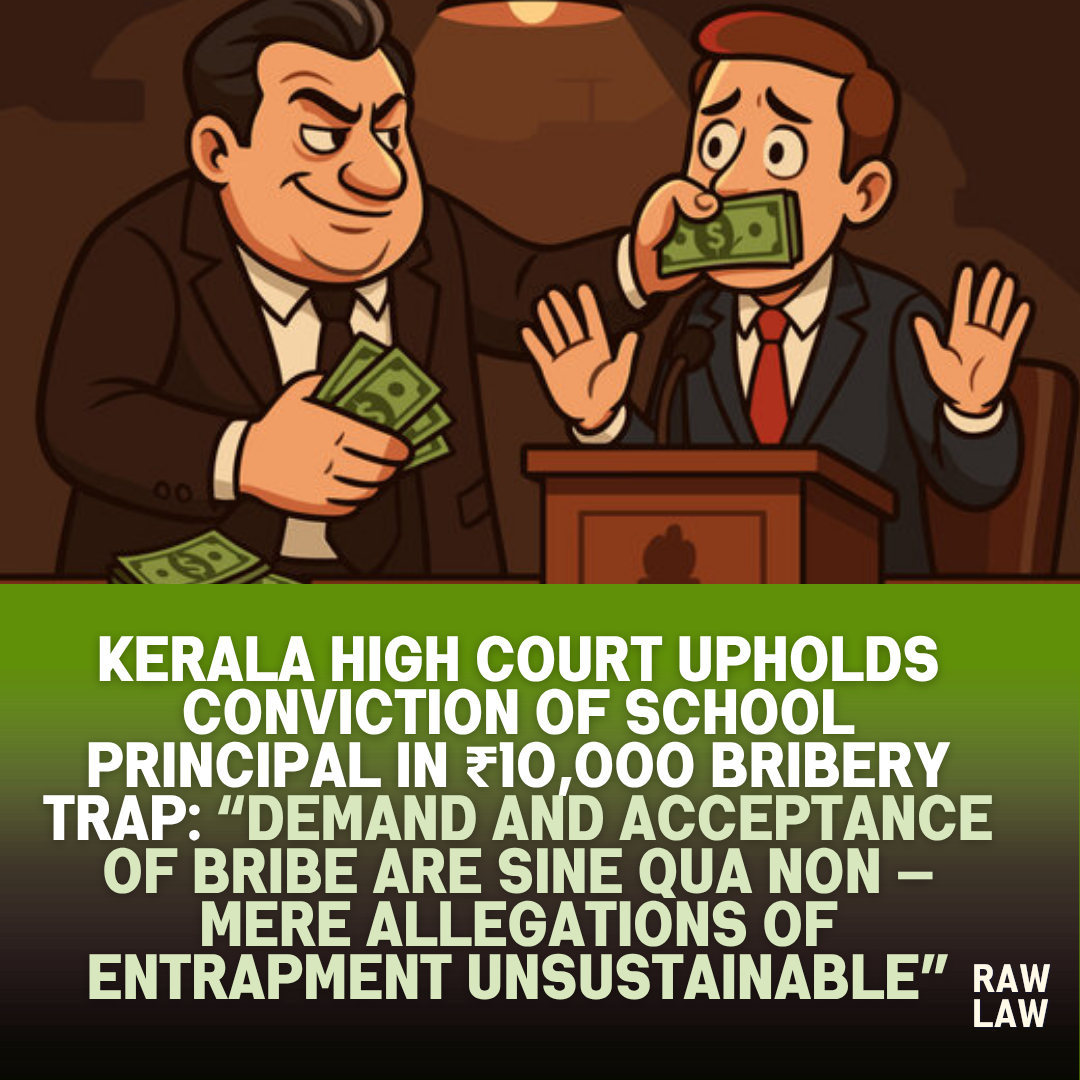
The Kerala High Court, presided by Justice A. Badharudeen, upheld the conviction of a school principal under Sections 7 and 13(2) read with 13(1)(d) of the Prevention of Corruption Act, 1988, for demanding and accepting a bribe of ₹10,000 for awarding a manpower supply contract to a cooperative society.
However, the Court modified the sentence, reducing imprisonment from two years to one year, while maintaining the fines imposed by the trial court.
In a key observation, the Court reiterated:
“Proof of demand and acceptance of illegal gratification by a public servant as a fact in issue is a sine qua non to establish guilt under Sections 7 and 13(1)(d) of the Act.”
Rejecting the defense’s claim that the bribe money was “planted,” the Court affirmed that the prosecution had proved demand, acceptance, and recovery beyond reasonable doubt, supported by corroborative testimony, documentary evidence, and forensic confirmation.
Facts
The case arose from a Central Bureau of Investigation (CBI) probe into corruption allegations against the principal of Kendriya Vidyalaya, Payyannur.
The principal allegedly demanded ₹10,000 as illegal gratification from the Secretary of Kannur District Labour Welfare Co-operative Society, which had been identified as the lowest bidder (L1) for providing manpower services such as cleaning, gardening, and security.
According to the prosecution, the demand was made on 15 March 2013 as a precondition to executing a contract agreement. The complainant lodged a written complaint (Exhibit P7) with the CBI on 17 March 2013, leading to a trap operation on 18 March 2013.
During the trap, the accused accepted ₹10,000 in phenolphthalein-laced notes at his office around 7:45 p.m. He received the money with his right hand, placed it in his left trouser pocket, and was immediately apprehended by the CBI.
The phenolphthalein test showed a positive result on his right hand and on the pocket area of his trousers. The currency notes (MO1 series) were recovered from him. The forensic report confirmed the presence of phenolphthalein on all exhibits, corroborating the prosecution’s narrative.
The Special Judge (CBI Court) convicted the accused on 5 February 2015, sentencing him to two years’ rigorous imprisonment and fines totaling ₹25,000. The accused challenged the conviction before the High Court under Section 374(2) CrPC.
Issues
- Whether the demand and acceptance of illegal gratification were proved beyond reasonable doubt.
- Whether the trap proceedings and mahazars (seizure records) were reliable and properly conducted.
- Whether the Special Judge erred in convicting the accused without proof of pre-trap verification or by relying on “computer-generated documents.”
- Whether the sentence required modification given the nature of the offence and evidence.
Petitioner’s Arguments
The defense argued that the pre-trap verification was not specifically mentioned in the FIR, raising doubts about the authenticity of the trap operation. It was contended that Ext. P8 (pre-trap mahazar) and Ext. P10 (post-trap mahazar) were computer-generated and prepared later at the CBI office, which undermined their evidentiary value.
The appellant also pointed out an inconsistency in PW1’s testimony, where he mistakenly stated that he had signed the post-trap mahazar on 15 March 2013, though the trap occurred on 18 March.
The defense cited Nikesh v. State of Kerala [2021 KHC 3242], arguing that the use of pre-printed or computer-generated mahazars indicated an artificial prosecution story.
It was also argued that the lack of color change on the accused’s left hand disproved the prosecution’s version that he had placed the money in his left pocket. The defense suggested that the complainant had forcibly inserted the money to falsely implicate the accused.
Lastly, counsel contended that the accused had no authority to award the manpower contract, which was to be finalized by a committee headed by the District Collector, thereby negating any motive or jurisdiction to demand a bribe.
Respondent’s Arguments
The Special Public Prosecutor (CBI) rebutted these claims, emphasizing that the pre-trap verification report (Ext. P18) clearly demonstrated due diligence before the operation.
He argued that PW1 (complainant) and PW2 (independent witness) provided consistent, corroborative testimony on demand and acceptance. The slip in PW1’s date reference was a minor lapse, not affecting the credibility of his evidence.
The CBI stressed that Ext. P8 and P10 were computer-generated in line with standard CBI procedures, and no objections had been raised before the trial court regarding their authenticity.
To substantiate guilt, the prosecution relied on call detail records (Ext. P25 and P26) showing that the accused had called PW1 twice on 18 March 2013, once just before the trap.
The forensic report (Ext. P38) confirmed the presence of phenolphthalein on the accused’s hands and trouser pocket. The security guard (PW10) also testified that PW1 and PW2 entered the office just before the CBI’s arrival, corroborating the sequence of events.
The CBI argued that even if the final contract approval rested with a higher committee, the accused’s recommendation was essential, and thus his demand for bribe as a “facilitator” constituted a clear offence under Sections 7 and 13(1)(d) of the Prevention of Corruption Act.
Analysis of the Law
Justice Badharudeen revisited the legal framework under Sections 7 and 13 of the Prevention of Corruption Act, 1988, emphasizing that conviction requires proof of demand and acceptance of illegal gratification, not merely recovery.
Section 7 criminalizes acceptance or attempt to obtain illegal gratification as a motive or reward for doing or forbearing to do an official act. Section 13(1)(d) covers obtaining any pecuniary advantage through abuse of position.
The Court reaffirmed that proof of demand is indispensable, citing the five-judge bench ruling in Neeraj Dutta v. State [AIR 2023 SC 330], which clarified:
“Mere recovery of tainted money is not enough. There must be proof of demand and voluntary acceptance, established through direct, documentary, or circumstantial evidence.”
The Court also referred to State of Karnataka v. Chandrasha [2024 KHC 6658], where the Supreme Court elaborated on Section 20’s presumption—once acceptance of illegal gratification is proved, the court must presume it was for corrupt motives unless rebutted by the accused.
Further reliance was placed on Sunil Kumar K. v. State of Kerala [2025 KHC OnLine 983], where the Court reiterated that proof of demand is the sine qua non for conviction under Sections 7 and 13(1)(d).
Justice Badharudeen held that in the present case, the prosecution successfully established the foundational facts necessary to invoke the statutory presumption under Section 20.
Precedent Analysis
- Neeraj Dutta v. State [AIR 2023 SC 330] – The Supreme Court held that demand and acceptance can be proved by direct or circumstantial evidence and that even in the absence of the complainant’s testimony, corroborative evidence can sustain conviction.
- State of Karnataka v. Chandrasha [2024 KHC 6658] – Clarified that the presumption under Section 20 arises once receipt of gratification is established; triviality of amount is no defense.
- Sunil Kumar K. v. State of Kerala [2025 KHC OnLine 983] – Reaffirmed that proof of demand is essential and mere recovery of money without demand does not suffice.
These judgments collectively guided the High Court’s conclusion that the accused’s guilt was conclusively proven and no grounds existed for acquittal.
Court’s Reasoning
The Court dismissed all defense objections as untenable. It found that:
- Ext. P18 report conclusively established pre-trap verification.
- The computer-generated mahazars were valid procedural documents, routinely prepared by the CBI.
- The minor date confusion in PW1’s statement was a trivial lapse and did not discredit his entire testimony.
- The left-hand sodium carbonate test anomaly was inconsequential, as the left trouser pocket tested positive.
- The security guard’s testimony (PW10) and call records corroborated the timing and sequence of the trap.
The Court observed that the accused’s arrival at odd hours and his direct demand and receipt of the money established conscious acceptance of the bribe.
Hence, the prosecution had proved all elements of demand, acceptance, and recovery beyond reasonable doubt.
Conclusion
The Kerala High Court confirmed the conviction under Sections 7 and 13(1)(d) read with 13(2) of the Prevention of Corruption Act but modified the sentence as follows:
- Section 7: 6 months’ rigorous imprisonment + ₹10,000 fine (3 months’ simple imprisonment in default).
- Section 13(2): 1 year’s rigorous imprisonment + ₹15,000 fine (3 months’ simple imprisonment in default).
The sentences were directed to run concurrently, and the accused was ordered to surrender before the Special Court immediately.
“The conviction stands confirmed, as the prosecution has proved demand, acceptance, and recovery beyond reasonable doubt. However, in the interest of justice, the sentence is modified.”
Implications
This judgment strengthens anti-corruption jurisprudence by reinforcing that:
- Proof of demand and acceptance is central to conviction under the PC Act.
- Minor procedural lapses or inconsistencies cannot defeat otherwise credible prosecution evidence.
- Courts will uphold convictions where corroborative testimonies and scientific evidence align to establish guilt.
The case underscores the judiciary’s zero-tolerance approach toward corruption in educational and administrative institutions.
FAQs
1. What is essential to convict a public servant under the Prevention of Corruption Act?
Both demand and acceptance of illegal gratification must be proved. Mere recovery of money is insufficient.
2. Can pre-trap or post-trap documentation errors invalidate a conviction?
No. Minor procedural lapses or typographical mistakes do not override substantive evidence proving guilt.
3. Why was the sentence reduced?
The High Court upheld the conviction but granted partial relief considering the limited bribe amount and passage of time since conviction.