

1. Court’s decision
The Madras High Court allowed a civil revision petition filed under Article 227 of the Constitution challenging the dismissal of an application seeking amendment of pleadings under Order VI Rule 17 of the Code of Civil Procedure.
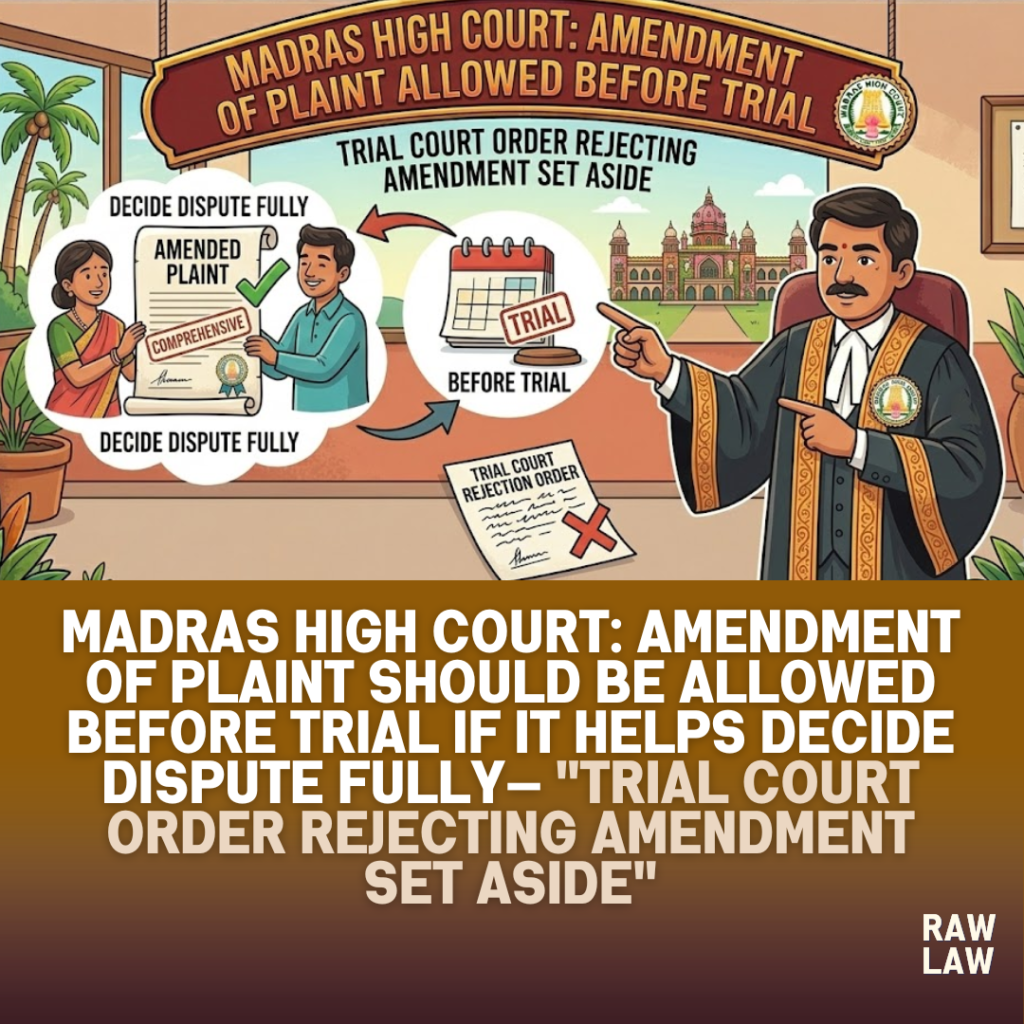
The Court held that the trial court had erred in rejecting the amendment merely on the ground of delay. Since the trial had not commenced and the amendment would assist in resolving the dispute comprehensively, the High Court concluded that the amendment should be permitted. Accordingly, the trial court’s order was set aside and the amendment application was allowed.
2. Facts
The dispute arose from a civil suit filed before the Additional Subordinate Court in Tindivanam concerning partition and declaration of rights in certain family properties.
The plaintiffs claimed that several properties were joint family properties and sought partition and declaration that a partition deed and rectification deed executed earlier were invalid. According to the plaintiffs, those documents had been executed when the first plaintiff was suffering from mental illness and therefore caused prejudice to their rightful share in the family properties.
One of the properties in dispute was a house site measuring approximately twelve cents which the plaintiffs claimed had been orally partitioned among family members earlier. The plaintiffs later filed an interlocutory application seeking amendment of the plaint to include additional facts regarding adjacent property allegedly purchased earlier and its role in the partition arrangement.
3. Issues
The principal issue before the High Court was whether the trial court was justified in rejecting the plaintiffs’ application for amendment of the plaint under Order VI Rule 17 of the Code of Civil Procedure.
The Court also examined whether an amendment could be permitted when the suit had been pending for several years but trial had not yet commenced.
Another issue was whether the proposed amendment would fundamentally alter the nature of the suit or merely clarify facts relevant to the adjudication of the dispute.
4. Petitioner’s arguments
The plaintiffs argued that the trial court had wrongly dismissed the amendment application without properly considering the stage of the proceedings. It was submitted that although the suit had been posted for trial, the trial itself had not commenced.
The plaintiffs contended that the amendment sought to incorporate additional facts regarding an adjacent property that had allegedly been purchased earlier and subsequently partitioned along with the disputed house property.
According to the plaintiffs, the relevant sale documents had only recently been traced, which explained why the details were not included in the original plaint. The plaintiffs argued that the amendment would help the court adjudicate the dispute effectively and avoid future litigation on the same subject matter.
5. Respondent’s arguments
The defendants opposed the amendment application and argued that it had been filed three years after the institution of the suit. According to them, the amendment was a deliberate attempt to prolong the proceedings.
The defendants further contended that the plaintiffs had not referred to the alleged sale transactions in earlier pleadings or earlier litigation. They argued that introducing new facts at this stage would change the nature of the suit and require additional parties to be impleaded.
On this basis, the defendants supported the trial court’s decision rejecting the amendment application.
6. Analysis of the law
The High Court analyzed the legal principles governing amendment of pleadings under Order VI Rule 17 of the Code of Civil Procedure. The provision allows courts to permit amendment of pleadings when such amendment is necessary for determining the real questions in controversy between the parties.
However, after the 2002 amendment to the Code, courts must exercise caution when amendments are sought after the commencement of trial. Once trial begins, amendments may be allowed only if the party demonstrates that despite due diligence the matter could not have been raised earlier.
In the present case, the High Court noted that trial had not yet commenced and therefore the stricter restrictions applicable after the commencement of trial were not attracted.
7. Precedent analysis
Courts have consistently held that amendments should generally be permitted if they help in effectively resolving the dispute between the parties and do not cause irreparable prejudice to the opposing side.
Judicial precedents emphasize that procedural rules should not obstruct substantive justice. If refusal of amendment would lead to multiple proceedings or prevent full adjudication of the dispute, courts typically adopt a liberal approach in allowing amendments.
The High Court applied these principles while assessing whether the trial court’s refusal to allow the amendment was justified.
8. Court’s reasoning
The High Court observed that it was an admitted fact that the disputed house property had not been included in the earlier partition deed and rectification deed that were being challenged in the suit.
The plaintiffs sought to amend the plaint to include details regarding the alleged purchase of adjacent property and its alleged partition along with the house property. Whether such purchase actually took place and whether the property was part of the partition were matters that could be decided only during trial based on evidence.
The Court further noted that the trial had not yet commenced, and therefore permitting the amendment would not cause prejudice to the defendants. On the contrary, allowing the amendment would enable the court to adjudicate the dispute comprehensively and avoid multiplicity of proceedings.
9. Conclusion
The High Court concluded that the trial court had erred in rejecting the amendment application solely on the ground of delay.
Since the trial had not commenced and the amendment would assist in determining the real controversy between the parties, the High Court allowed the civil revision petition. The order of the trial court dismissing the amendment application was set aside and the amendment petition was allowed.
The Court also clarified that the defendants would be entitled to file an additional written statement responding to the amended pleadings.
10. Implications
The judgment reinforces the liberal approach adopted by courts in allowing amendments to pleadings before commencement of trial.
It clarifies that delay alone is not a sufficient ground to reject an amendment when the amendment is necessary for effective adjudication of the dispute. Courts are expected to prioritize substantive justice and avoid multiplicity of proceedings.
For litigants and practitioners, the ruling highlights that amendment applications filed before the start of trial are more likely to be allowed if they assist the court in determining the real issues involved in the case.
Case Law References
- Principle under Order VI Rule 17 of the Code of Civil Procedure
Courts may allow amendments to pleadings when such amendments are necessary to determine the real controversy between the parties. - Post-2002 Amendment Standard
After the amendment to the Code of Civil Procedure, courts exercise stricter scrutiny once trial has commenced, but adopt a more liberal approach before trial begins.
FAQs
1. When can a plaint be amended under the Code of Civil Procedure?
A plaint can be amended when the court finds that the amendment is necessary to determine the real issues in dispute between the parties.
2. Can courts reject amendment applications simply because of delay?
Delay alone is not sufficient to reject an amendment if the trial has not commenced and the amendment is necessary for effective adjudication.
3. What happens after a court allows amendment of pleadings?
The opposite party is generally given an opportunity to respond by filing an additional written statement addressing the amended pleadings.


