Madras High Court: Generator liable for damages after abruptly stopping – ” Power supply without contractual basis, arbitral award upheld”

1. Court’s decision
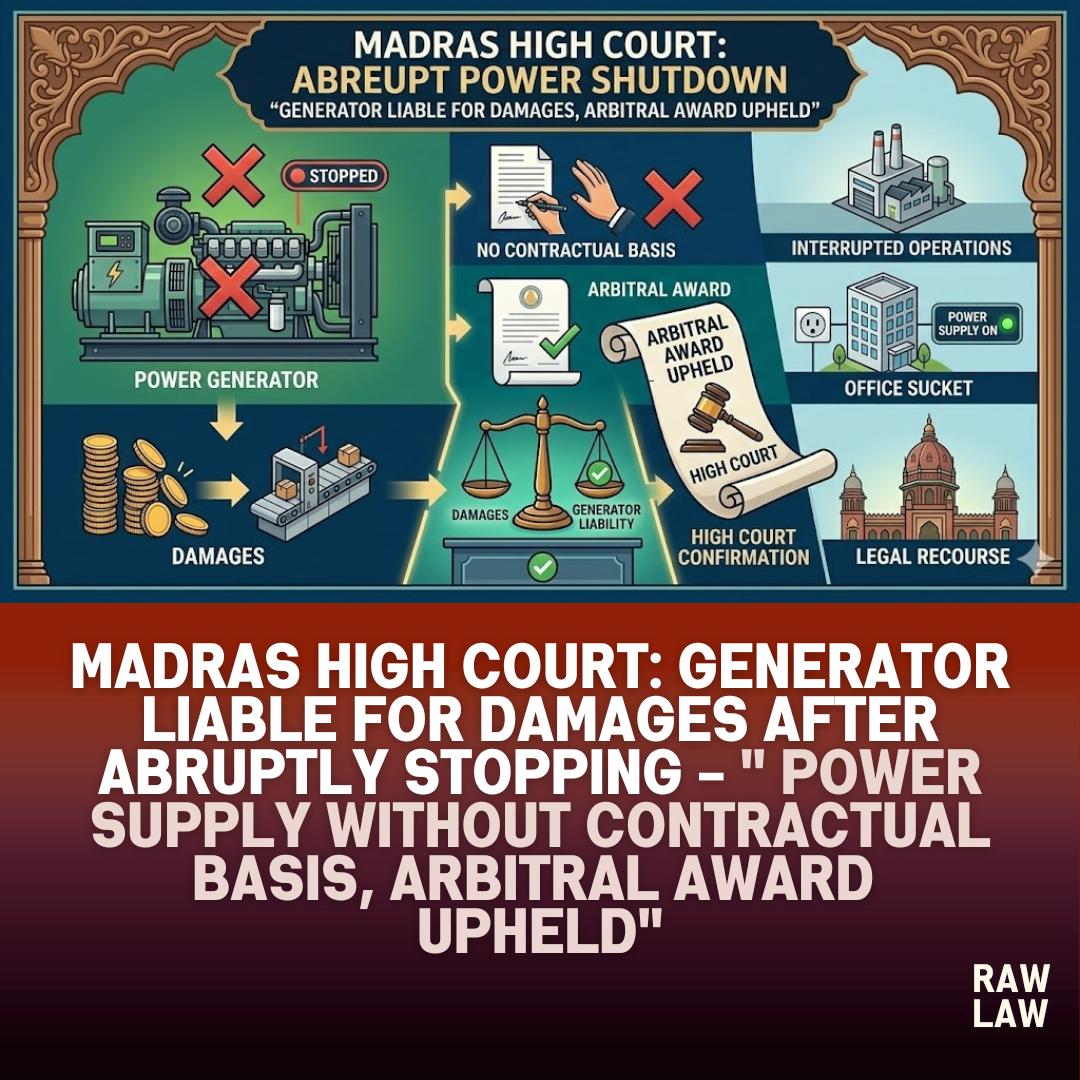
A Division Bench of the Madras High Court dismissed an appeal filed by a power generation company challenging the rejection of its petition seeking to set aside an arbitral award.
The arbitral award had directed the generator to compensate an industrial consumer for losses caused by stoppage of electricity supply.
The High Court held that the arbitral tribunal had correctly concluded that the generator breached the power supply agreement by unilaterally revising tariff and ceasing electricity supply without contractual justification.
Since the arbitral award was based on evidence and proper interpretation of the contract, the Court declined to interfere with the award.
2. Facts
The dispute arose from a power supply agreement dated 18 April 2018 between a private power generation company and an industrial paper manufacturing company in Coimbatore.
Under the agreement, the generator agreed to supply electricity for three years at a tariff of ₹5.75 per unit. The billing period ran from the 28th of each month to the 27th of the succeeding month.
Invoices were raised monthly, and the consumer was required to make payment within seven days of receiving the invoice.
A dispute emerged when the generator unilaterally increased the tariff from ₹5.75 to ₹6.15 per unit and subsequently stopped supplying electricity.
As a result, the consumer had to procure electricity from the Tamil Nadu Generation and Distribution Corporation at higher rates and claimed damages.
3. Issues
The Court considered several legal issues arising from the appeal.
First, whether the generator had contractual authority to unilaterally increase the tariff under the power supply agreement.
Second, whether cessation of power supply by the generator constituted a breach of contract.
Third, whether the arbitral award granting damages for additional electricity procurement costs suffered from perversity or patent illegality warranting interference under Section 34 of the Arbitration Act.
4. Petitioner’s arguments
The generator argued that the power supply agreement permitted revision of tariff in the event of changes in fuel prices or other operational costs affecting electricity generation.
It was contended that the increase in tariff had been communicated to the consumer in advance and therefore the consumer was required to accept the revised price.
The generator also argued that the consumer failed to make payment within the stipulated period, which entitled the generator under the agreement to reduce or stop electricity supply.
Accordingly, the generator claimed that its actions were contractually justified and that the arbitral award granting damages was erroneous.
5. Respondent’s arguments
The consumer argued that the generator had no contractual authority to arbitrarily increase tariff without demonstrating any actual increase in fuel costs or statutory charges.
It was further contended that the generator stopped supply even before expiry of the seven-day payment period provided in the agreement.
The consumer submitted that the sudden cessation of supply forced it to purchase electricity from the state electricity utility at significantly higher rates and to increase its security deposit, causing financial loss.
Therefore, the consumer argued that the arbitral tribunal correctly awarded compensation for the losses directly resulting from the generator’s breach of contract.
6. Analysis of the law
The Court examined the scope of judicial review under the Arbitration and Conciliation Act, 1996.
Under Section 34 of the Act, courts may set aside arbitral awards only on limited grounds such as patent illegality, violation of public policy, or perversity in findings.
The Court emphasised that arbitral awards cannot be re-examined as if the court were exercising appellate jurisdiction.
Unless the award is based on no evidence or reflects irrational reasoning, courts must respect the autonomy of arbitral tribunals and refrain from interfering with their findings.
7. Precedent analysis
The Court relied on decisions of the Supreme Court of India emphasising the limited scope of interference with arbitral awards.
In Dyna Technologies Pvt. Ltd. v. Crompton Greaves Ltd., the Supreme Court held that courts must not interfere with arbitral awards unless the award is perverse or patently illegal.
The Court also considered principles laid down in cases concerning perversity of findings and the evidentiary threshold required to set aside arbitral awards.
These precedents guided the Court in evaluating whether the award suffered from any legal infirmity.
8. Court’s reasoning
The Court observed that the generator relied on a contractual clause allowing tariff revision in the event of changes in fuel prices or other costs.
However, the arbitral tribunal had found that the generator produced no documentary evidence demonstrating any increase in the cost of fuel used for power generation.
The tribunal also noted that the generator stopped electricity supply even before the contractual period allowed for payment of invoices had expired.
Consequently, the tribunal concluded that the generator’s actions constituted breach of the agreement.
The High Court found that this conclusion was based on evidence and a reasonable interpretation of the contract, and therefore could not be characterised as perverse.
9. Conclusion
The High Court held that the arbitral award was well-reasoned and supported by the evidence placed before the tribunal.
It further held that the generator’s cessation of electricity supply without contractual justification amounted to a breach of the power supply agreement.
Since the award did not suffer from patent illegality or perversity, the Court dismissed the appeal and upheld the arbitral award granting damages to the consumer.
10. Implications
The ruling reiterates the judiciary’s consistent approach of exercising restraint when reviewing arbitral awards.
By refusing to interfere with a reasoned arbitral award, the Court reinforced the principle that arbitration is a final dispute resolution mechanism whose outcomes should not be lightly disturbed.
The judgment also highlights that contractual rights—such as tariff revision clauses—must be exercised strictly within the framework of the agreement and supported by evidence.
Commercial entities invoking such clauses must therefore demonstrate genuine contractual justification before altering agreed terms or suspending contractual obligations.
Case Law References
- Dyna Technologies Pvt. Ltd. v. Crompton Greaves Ltd.
The Supreme Court held that arbitral awards should not be interfered with unless they suffer from patent illegality or perversity. - PSA Sical Terminals Pvt. Ltd. v. Board of Trustees, V.O.C. Port Trust
The Supreme Court clarified the test of perversity in arbitral awards and emphasised that courts should not re-evaluate evidence unless findings are irrational. - Kanchan Udyog Ltd. v. United Spirits Ltd.
The Court discussed the principle of causation in claims for damages arising from breach of contract.
FAQs
1. When can a court set aside an arbitral award in India?
Courts can set aside arbitral awards only on limited grounds under Section 34 of the Arbitration and Conciliation Act, such as patent illegality, violation of public policy, or perversity in the award.
2. Can a power supplier unilaterally increase tariff under a contract?
Only if the contract expressly permits such revision and the conditions specified in the contract—such as changes in fuel prices or statutory charges—are satisfied.
3. What happens if a supplier stops electricity supply in breach of a contract?
The affected party may claim damages for losses directly caused by the breach, including costs incurred in procuring electricity from alternative sources.