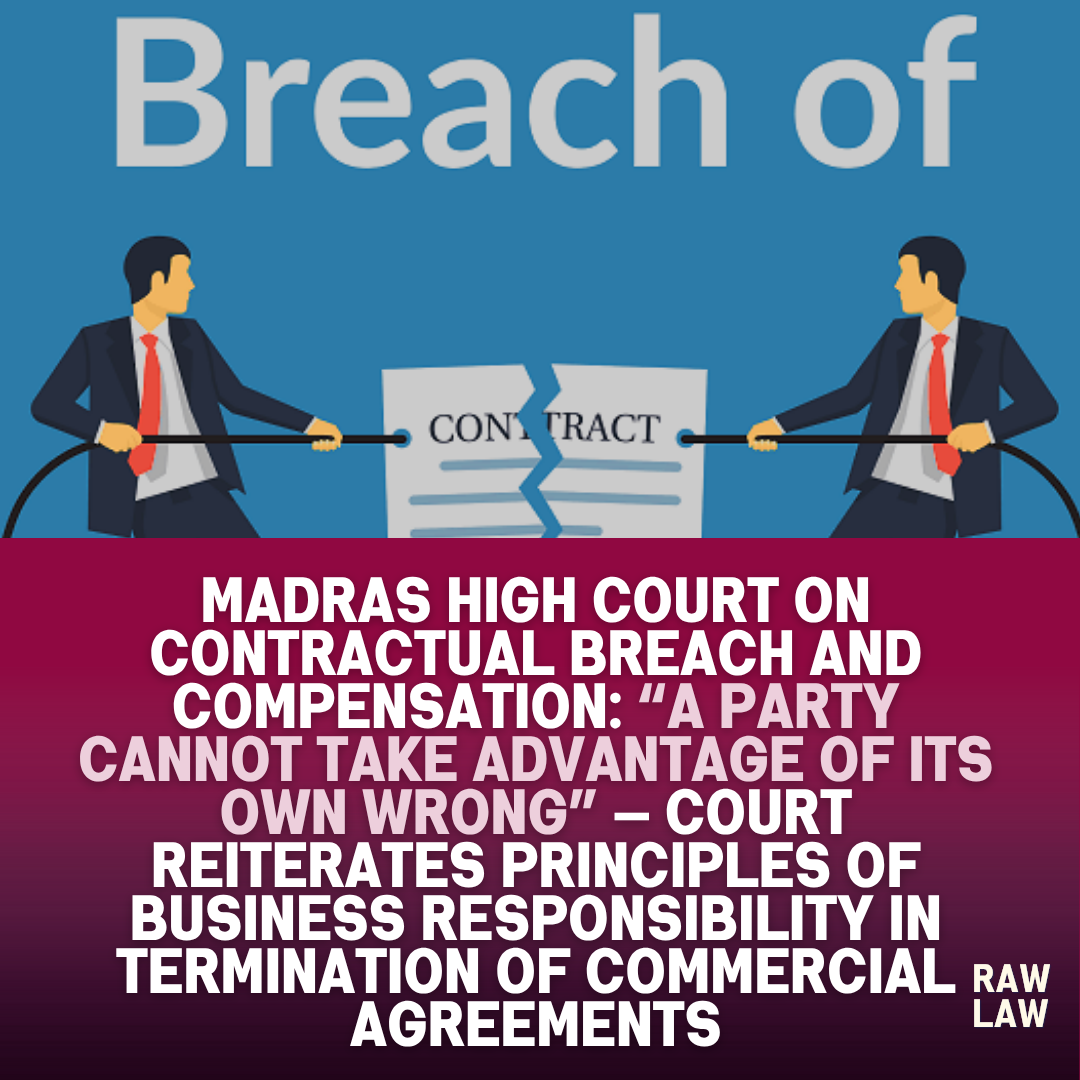
Madras High Court on Contractual Breach and Compensation: “A Party Cannot Take Advantage of Its Own Wrong” — Court Reiterates Principles of Business Responsibility in Termination of Commercial Agreements

Court’s Decision
The Madras High Court, while deciding a commercial dispute between a digital service provider and a contracting entity, delivered a significant ruling on the termination of commercial agreements and assessment of damages in case of breach. The Court held that where a party unilaterally terminates a contract without fulfilling reciprocal obligations, it cannot later claim damages for alleged non-performance by the other side.
The Court observed:
“A party who has itself failed to perform cannot put the blame upon the other and claim compensation. The law does not permit a defaulter to take advantage of his own wrong.”
Holding that the plaintiff failed to demonstrate a legitimate basis for termination, the Court dismissed the suit for recovery of damages and emphasized that contracts must be construed strictly according to their terms and the doctrine of reciprocal promises under Section 54 of the Indian Contract Act, 1872.
Facts
The dispute arose out of a commercial agreement between a technology company engaged in internet infrastructure and a franchisee business partner. The plaintiff was appointed as a channel partner responsible for marketing, billing, and customer support in a designated area, while the defendant (a corporate entity) was to provide back-end services and bandwidth infrastructure.
The plaintiff alleged that despite fulfilling its contractual duties, including customer acquisition and payment of security deposit, the defendant unilaterally terminated the agreement without notice and withheld the security deposit, causing significant financial loss. The plaintiff therefore filed a civil suit seeking refund of deposit, compensation for business loss, and damages for wrongful termination.
The defendant, on the other hand, claimed that the plaintiff had failed to meet sales and payment obligations, resulting in accumulation of dues and customer dissatisfaction. The termination, it contended, was made in accordance with the termination clause of the agreement after repeated notices and warnings.
Issues
- Whether the termination of the agreement by the defendant was valid under the contractual terms.
- Whether the plaintiff was entitled to refund of security deposit and damages for alleged wrongful termination.
- Whether there was breach of reciprocal obligations under Section 54 of the Indian Contract Act, 1872.
Petitioner’s Arguments
The plaintiff contended that the termination was arbitrary and in breach of contract, as no prior notice was served as required under the agreement. It was argued that the plaintiff had invested substantial capital, built infrastructure, and acquired customers relying on the defendant’s commitments.
The plaintiff claimed that the defendant’s failure to supply stable bandwidth, invoices, and technical support crippled its operations and forced customers to withdraw, thereby causing reputational and financial damage.
It was also contended that the security deposit was unlawfully retained, amounting to unjust enrichment. Relying on Sections 73 and 74 of the Indian Contract Act, the plaintiff argued that the breach caused foreseeable loss, and hence, damages must be awarded for loss of profit and business goodwill.
Citing ONGC v. Saw Pipes Ltd. (2003) 5 SCC 705, the plaintiff argued that compensation under Section 74 should extend to the loss directly arising from the breach, irrespective of whether actual loss is precisely proved.
Respondent’s Arguments
The defendant maintained that the termination was lawful and justified, as the plaintiff repeatedly defaulted in meeting key obligations, including timely remittance of customer payments. It was argued that under the agreement, failure to maintain prescribed performance standards entitled the defendant to terminate the contract without further notice.
The respondent further submitted that the plaintiff had itself failed to maintain service standards and deliverables, leading to several customer complaints and defaults. The company had also incurred losses due to non-remittance of dues collected by the plaintiff on its behalf.
It was emphasized that the security deposit was adjusted against outstanding dues and that the plaintiff had not provided any documentary proof of loss. Relying on Kailash Nath Associates v. Delhi Development Authority (2015) 4 SCC 136, it was contended that no compensation can be awarded in the absence of actual loss.
Analysis of the Law
The Court analyzed the scope of Sections 37 to 54 of the Indian Contract Act, focusing on the doctrine of reciprocal promises and the principle that a party who prevents performance cannot seek enforcement. The Court observed that when the performance of one party depends on the cooperation of the other, failure of such cooperation amounts to breach.
The judgment discussed the distinction between lawful termination and repudiation, clarifying that contractual clauses must be read harmoniously with the principle of natural justice, unless expressly excluded.
The Court reiterated that in commercial contracts, damages must satisfy two tests laid down in Hadley v. Baxendale (1854) 9 Ex 341 — (1) losses arising naturally from the breach, and (2) those within the contemplation of the parties at the time of contract formation.
Applying these principles, the Court found that the plaintiff’s own defaults contributed to the contractual breakdown, and hence, damages were not recoverable under Section 73.
Precedent Analysis
- ONGC v. Saw Pipes Ltd. (2003) 5 SCC 705) — Clarified that compensation can be granted even when loss is not proved, if the contract provides for a genuine pre-estimate of damages. The Court noted that the present case lacked any such clause.
- Kailash Nath Associates v. Delhi Development Authority (2015) 4 SCC 136) — Held that proof of loss is essential unless the amount stipulated represents a genuine pre-estimate. Applied here to deny damages as no quantifiable loss was shown.
- Hadley v. Baxendale (1854) — Reaffirmed the rule of foreseeability of loss; applied to limit compensation to direct consequences of breach.
- Hind Construction Contractors v. State of Maharashtra (1979) 2 SCC 70) — Emphasized that a party who has committed breach cannot claim damages for the same. Relied on to reject the plaintiff’s claim for wrongful termination.
Court’s Reasoning
Justice Abdul Quddhose held that the plaintiff failed to establish the defendant’s wrongful conduct or breach. The evidence showed that several performance warnings had been issued to the plaintiff, and customer complaints were on record. The Court noted that termination followed multiple reminders, fulfilling the contractual precondition.
It observed that the security deposit was lawfully adjusted, and the plaintiff’s failure to produce audited accounts or correspondence showing non-cooperation by the defendant rendered its claim speculative.
The Court emphasized:
“In commercial relationships, performance is measured by conduct, not allegations. The party in breach cannot assume victimhood to claim damages.”
Holding that the plaintiff had itself breached reciprocal obligations, the Court concluded that termination was valid and no damages could be awarded under Sections 73 or 74.
Conclusion
The Madras High Court dismissed the plaintiff’s suit for recovery, holding that the termination was lawful and justified. The Court found that the plaintiff was the defaulting party and thus not entitled to compensation.
The judgment reaffirmed that in contractual disputes, the onus of proving loss and breach lies on the claimant, and mere assertion of damages without evidence cannot sustain a claim.
“Commercial certainty requires that parties honor their commitments; the Court cannot rewrite contracts to favor one who disregards their own obligations.”
Implications
This judgment underscores the importance of strict adherence to contractual clauses and reciprocal obligations in commercial dealings. It reiterates that parties must act in good faith and cannot claim damages while being in breach themselves.
The decision also clarifies the threshold of proof for damages under Sections 73 and 74, reaffirming that actual loss or injury must be demonstrated unless a genuine pre-estimate of loss is contractually stipulated.
It provides clear guidance for businesses in the digital and service sectors, reinforcing that termination clauses must be exercised with procedural fairness and evidentiary support.
FAQs
1. Can a party in breach of a contract claim damages?
No. A party who fails to perform its obligations cannot claim damages for the other party’s non-performance.
2. Is proof of actual loss necessary to claim compensation?
Yes, unless the contract specifies a genuine pre-estimate of loss as liquidated damages, proof of loss is essential.
3. What happens if termination is done without notice?
If the agreement mandates notice and none is served, termination is unlawful and may give rise to a claim for damages.