

1. Court’s decision
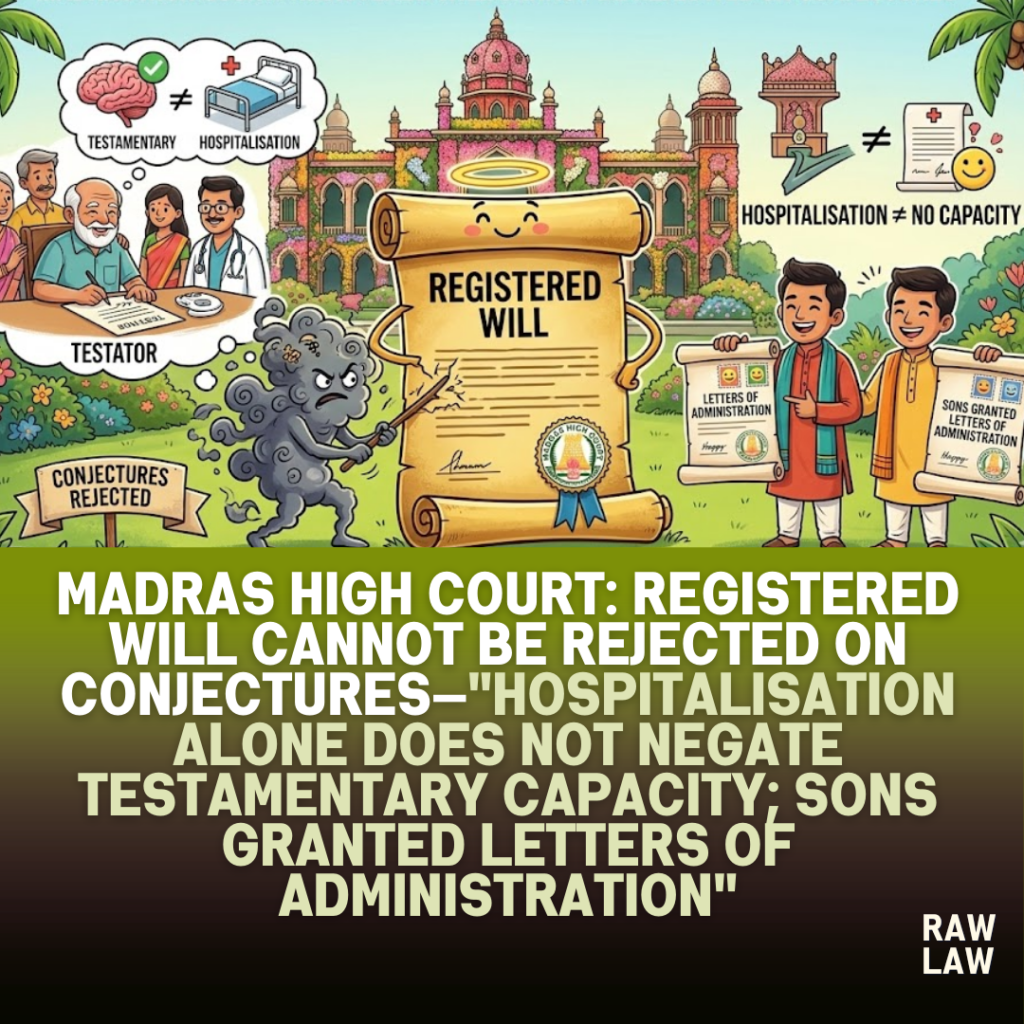
A Division Bench of the Madras High Court allowed an appeal filed by the sons of a deceased testatrix after a Single Judge had rejected their petition for grant of Letters of Administration.
The High Court held that the propounders of the Will had established its due execution and attestation in accordance with statutory requirements. It further held that the circumstances relied upon by the Single Judge did not constitute serious or legally sustainable grounds to doubt the genuineness of the Will.
Accordingly, the Court set aside the earlier decree and granted Letters of Administration in respect of the Will executed by the deceased mother in favour of her sons.
2. Facts
The dispute concerned the estate of a woman who had executed a Will on 14 July 2006 bequeathing her properties exclusively to her two sons. She had two daughters as well, who later contested the Will.
The testatrix died on 11 July 2007. Following her death, the sons filed a testamentary petition seeking grant of Letters of Administration based on the Will.
The daughters opposed the petition alleging that the Will had been obtained through fraud, undue influence and misrepresentation. They also contended that the testatrix was in poor health and hospitalised at the time of execution, thereby questioning her mental capacity to execute a valid testamentary document.
3. Issues
The High Court examined several key issues.
The primary question was whether the appellants had proved the due execution and attestation of the Will in accordance with the requirements of the Indian Succession Act, 1925 and the Indian Evidence Act, 1872.
Another issue was whether the Will was surrounded by suspicious circumstances—such as the testatrix’s hospitalisation, alleged illness, and the exclusion of daughters—that would cast doubt on its authenticity.
The Court also examined whether the Single Judge had correctly evaluated the evidence relating to the mental capacity of the testatrix at the time of execution.
4. Petitioner’s arguments
The appellants argued that the Single Judge had erred in treating routine factual circumstances as suspicious without legal basis.
They contended that the execution of the Will had been duly proved by examining attesting witnesses as required under law. They also emphasized that the Will was a registered document and therefore carried an additional presumption supporting its genuineness.
The appellants further argued that the testatrix was suffering only from asthma and not from any mental illness affecting her testamentary capacity. According to them, the Single Judge had wrongly inferred mental incapacity from a medical diagnosis that did not actually indicate lack of mental competence.
5. Respondent’s arguments
The respondents contended that the Will was surrounded by suspicious circumstances that had not been adequately explained by the appellants.
They argued that the testatrix had been admitted in hospital and possibly under intensive care at the time the Will was executed and registered. According to them, this raised serious doubts about whether she was physically capable of visiting the Sub-Registrar’s office and executing the document voluntarily.
The respondents also pointed to inconsistencies in the signatures appearing on different pages of the Will and argued that these discrepancies indicated possible manipulation or lack of genuine execution.
6. Analysis of the law
The Court analysed the legal principles governing proof of Wills. Under the Indian Succession Act, a valid Will must be executed by the testator and attested by at least two witnesses.
Additionally, under Section 68 of the Indian Evidence Act, at least one attesting witness must be examined in court to prove execution of the Will.
Where suspicious circumstances are alleged, the burden lies on the propounder of the Will to dispel those suspicions and satisfy the court that the document represents the true testamentary intention of the testator.
7. Precedent analysis
The Court referred to earlier decisions emphasising that registration of a Will does not by itself prove its validity but constitutes a relevant factor supporting its authenticity.
In particular, the Court relied on precedent applying the principle that when a Will is registered and its execution is proved through attesting witnesses, the court should not reject it merely on conjectures or speculative suspicion.
The Court also reiterated that testamentary autonomy allows a testator to distribute property unevenly among heirs without automatically creating suspicion.
8. Court’s reasoning
The Division Bench held that the Single Judge had relied on conjectural reasoning rather than concrete evidence.
The fact that the Will was executed and registered in the evening hours was not inherently suspicious, as there is no legal prohibition against such timing. Similarly, hospitalisation alone does not establish that a person lacks testamentary capacity.
The Court also observed that the medical evidence on record did not prove that the testatrix was mentally incapacitated or incapable of understanding the nature of her actions.
Since the execution and attestation of the Will had been duly proved through witnesses and documentary evidence, the alleged suspicious circumstances were insufficient to invalidate the document.
9. Conclusion
The High Court concluded that the appellants had successfully discharged the burden placed upon them as propounders of the Will.
It held that the Will had been validly executed and attested, and the objections raised by the respondents did not amount to legally sustainable suspicious circumstances.
Accordingly, the Court allowed the appeal, set aside the judgment of the Single Judge, and directed that Letters of Administration be granted in favour of the appellants in respect of the Will dated 14 July 2006.
10. Implications
The ruling reinforces established principles governing proof of Wills in Indian succession law. Courts must carefully distinguish between genuine suspicious circumstances and speculative doubts unsupported by evidence.
The judgment also emphasises that hospitalisation or unequal distribution of property among heirs does not automatically invalidate a Will.
By restoring the validity of the testamentary document, the Court reaffirmed the principle of testamentary freedom and clarified the evidentiary burden placed upon parties challenging a Will.
Case Law References
- Metpalli Lasum Bai v. Metapalli Muthaih (Supreme Court of India)
The Supreme Court held that registration of a Will, though not conclusive proof, is a relevant circumstance supporting its authenticity. - Paneerselvam @ Nellappan v. Amsavalli (Madras High Court)
The Court reiterated that once execution and attestation of a Will are proved, the burden shifts to those alleging suspicious circumstances to substantiate their claims.
FAQs
1. Does hospitalisation of a testator invalidate a Will?
No. Hospitalisation alone does not invalidate a Will. The crucial question is whether the testator had the mental capacity to understand the nature and effect of the document at the time of execution.
2. Is registration necessary for a valid Will in India?
Registration is not mandatory for a Will, but a registered Will can serve as a supporting factor indicating authenticity when disputes arise.
3. What must be proved to establish a valid Will in court?
The propounder must prove that the Will was executed by the testator and attested by at least two witnesses, and at least one attesting witness must testify in court under Section 68 of the Evidence Act.


