

1. Court’s decision
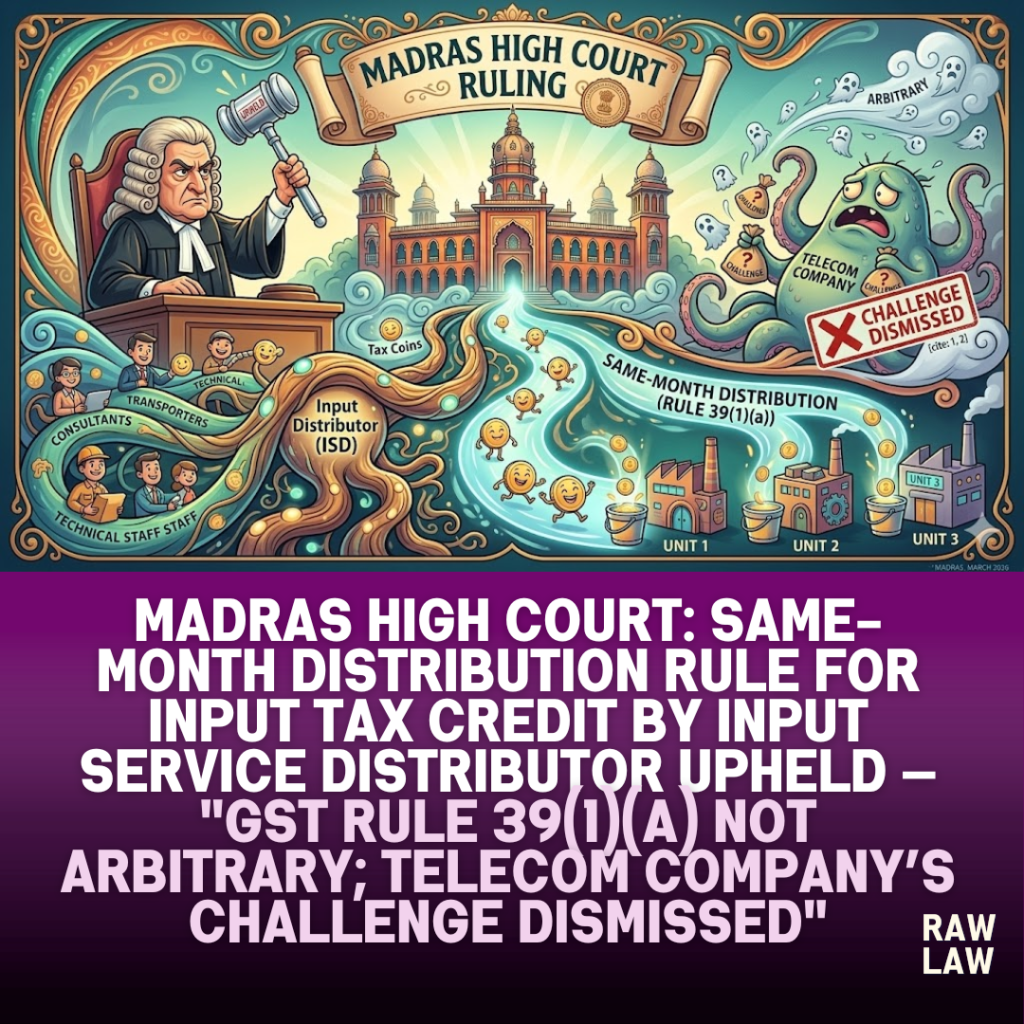
A Division Bench of the Madras High Court dismissed writ petitions filed by Reliance Jio Infocomm Ltd challenging the legality of Rule 39(1)(a) of the GST Rules relating to distribution of input tax credit by Input Service Distributors.
The Court upheld the rule and ruled that the requirement for distributing credit in the same month as receipt of the underlying invoice was consistent with the statutory framework of the GST law.
The Bench further held that the challenge to show cause notices issued by tax authorities was premature and that the petitioner could raise its objections during the statutory adjudication process.
2. Facts
The petitioner is a telecommunications company operating across India with multiple GST registrations in different states and union territories.
Under the GST regime, businesses operating in multiple jurisdictions may use an Input Service Distributor (ISD) mechanism to distribute input tax credit for services received centrally but used by multiple branches.
The petitioner maintained ISD registrations to distribute input tax credit among its various branch offices.
Tax authorities issued show cause notices alleging that the petitioner had distributed input tax credit in months different from those in which the underlying invoices were received, contrary to Rule 39(1)(a) of the GST Rules.
The company challenged both the validity of the rule and the legality of the show cause notices before the High Court.
3. Issues
The High Court considered the following issues:
- Whether Rule 39(1)(a) requiring distribution of input tax credit in the same month as receipt of the underlying invoice was ultra vires the CGST Act.
- Whether the rule was arbitrary and violated constitutional guarantees under Article 14.
- Whether the show cause notices issued by tax authorities could be quashed at the stage of writ proceedings.
4. Petitioner’s arguments
The petitioner argued that the statutory provisions of the GST Act prior to the amendment effective from 1 April 2025 did not empower the government to prescribe a specific time limit for distribution of input tax credit by an Input Service Distributor.
It was contended that Rule 39(1)(a) imposed an impractical requirement by mandating that credit be distributed in the same month in which the invoice was issued.
The petitioner submitted that determining eligibility of input tax credit requires verification of multiple statutory conditions, including compliance with provisions governing eligibility and documentation.
According to the petitioner, such verification could not realistically be completed within the same month as receipt of the invoice.
The company further argued that the rule imposed unreasonable restrictions on business operations and therefore violated constitutional protections relating to equality and the freedom to conduct trade and business.
5. Respondent’s arguments
The Union government argued that Rule 39(1)(a) was validly framed under the rule-making powers conferred by the GST legislation.
The government submitted that the rule served legitimate administrative objectives including preventing accumulation of credit, maintaining audit trails, and ensuring proper flow of credit within the GST system.
It was further argued that input tax credit is a statutory concession rather than an absolute right and therefore can be regulated through procedural conditions prescribed by law.
The respondents also contended that the writ petitions were premature because the show cause notices had not yet been adjudicated and the petitioner could raise its objections before the tax authorities.
6. Analysis of the law
The Court examined the statutory scheme governing input tax credit under the Central Goods and Services Tax Act, 2017.
The Court noted that the GST framework treats input tax credit as a statutory benefit subject to conditions and procedural requirements prescribed by the legislature.
Relying on Supreme Court precedents interpreting similar tax credit provisions, the Court observed that tax concessions may legitimately be regulated by procedural rules designed to ensure proper administration of the tax system.
The Court also analysed the role of Input Service Distributors in the GST structure, noting that they function primarily as accounting mechanisms for distributing credit to multiple registered entities within the same corporate structure.
7. Precedent analysis
The Court relied on several decisions of the Supreme Court of India relating to tax credits and statutory concessions.
In Jayam & Co. v. Assistant Commissioner, the Supreme Court held that input tax credit is a statutory concession and can be subject to conditions imposed by legislation.
The Court also referred to Union of India v. VKC Footsteps India Pvt Ltd, which emphasised that tax credits operate within a statutory framework and must comply with prescribed conditions.
Additionally, reliance was placed on ALD Automotive Pvt Ltd v. Commercial Tax Officer to reiterate that concessions granted under tax statutes must be claimed strictly in accordance with statutory requirements.
8. Court’s reasoning
The Court held that input tax credit is a statutory benefit rather than a constitutional right and therefore can be regulated through procedural rules.
The Court further observed that the same-month distribution requirement ensures transparency, prevents manipulation of credit flows, and supports the GST system’s destination-based taxation principle.
It also noted that the petitioner’s argument conflated two distinct concepts: distribution of credit by an Input Service Distributor and actual availment of credit by the recipient unit.
The Court held that compliance with conditions governing availment of credit by the recipient unit does not prevent the ISD from distributing credit within the prescribed time frame.
Consequently, the Court concluded that the rule was neither arbitrary nor beyond the powers conferred by the statute.
9. Conclusion
The High Court dismissed the writ petitions and upheld the validity of Rule 39(1)(a) of the GST Rules.
The Court held that the procedural requirement for same-month distribution of input tax credit by an Input Service Distributor is legally valid and consistent with the statutory framework of the GST law.
The Court also declined to quash the show cause notices, holding that the petitioner could raise its defenses before the appropriate adjudicating authority during the statutory proceedings.
10. Implications
The ruling clarifies the scope of regulatory authority under the GST framework regarding the distribution of input tax credit by Input Service Distributors.
By upholding Rule 39(1)(a), the Court affirmed the government’s power to impose procedural timelines for credit distribution to ensure transparency and administrative efficiency in the GST system.
The judgment also reiterates an important principle of tax law: statutory concessions such as input tax credit must be exercised strictly in accordance with legislative conditions and procedural requirements.
Case Law References
- Jayam & Co. v. Assistant Commissioner (2016)
The Supreme Court held that input tax credit is a statutory concession and must be claimed strictly according to the conditions prescribed by the legislature. - Union of India v. VKC Footsteps India Pvt Ltd (2022)
The Supreme Court clarified the statutory nature of input tax credit under the GST framework and upheld legislative conditions regulating its availability. - ALD Automotive Pvt Ltd v. Commercial Tax Officer (2019)
The Court held that tax credit schemes are concessions that must be availed only in strict compliance with statutory conditions.
FAQs
1. What is Rule 39(1)(a) of the GST Rules?
Rule 39(1)(a) requires an Input Service Distributor to distribute available input tax credit to recipient units in the same month in which the credit becomes available.
2. Can the government impose procedural conditions on input tax credit?
Yes. Courts have consistently held that input tax credit is a statutory concession and can be regulated through procedural rules prescribed under tax legislation.
3. Can companies challenge GST show cause notices directly in the High Court?
Courts generally discourage such challenges unless exceptional circumstances exist, as taxpayers can raise their objections during statutory adjudication proceedings.


