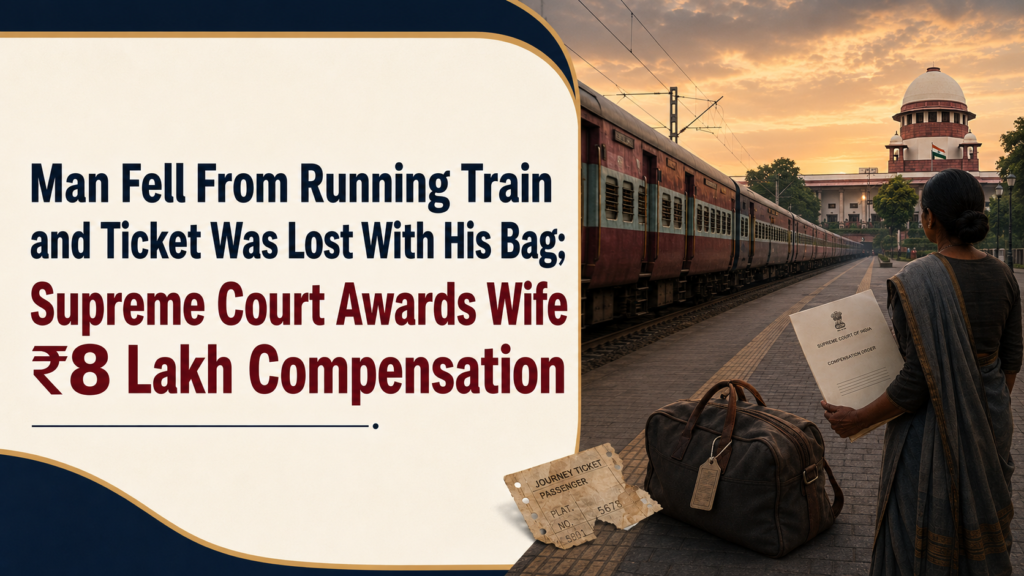
Man Fell From Running Train and Ticket Was Lost With His Bag; Supreme Court Awards Wife ₹8 Lakh Compensation

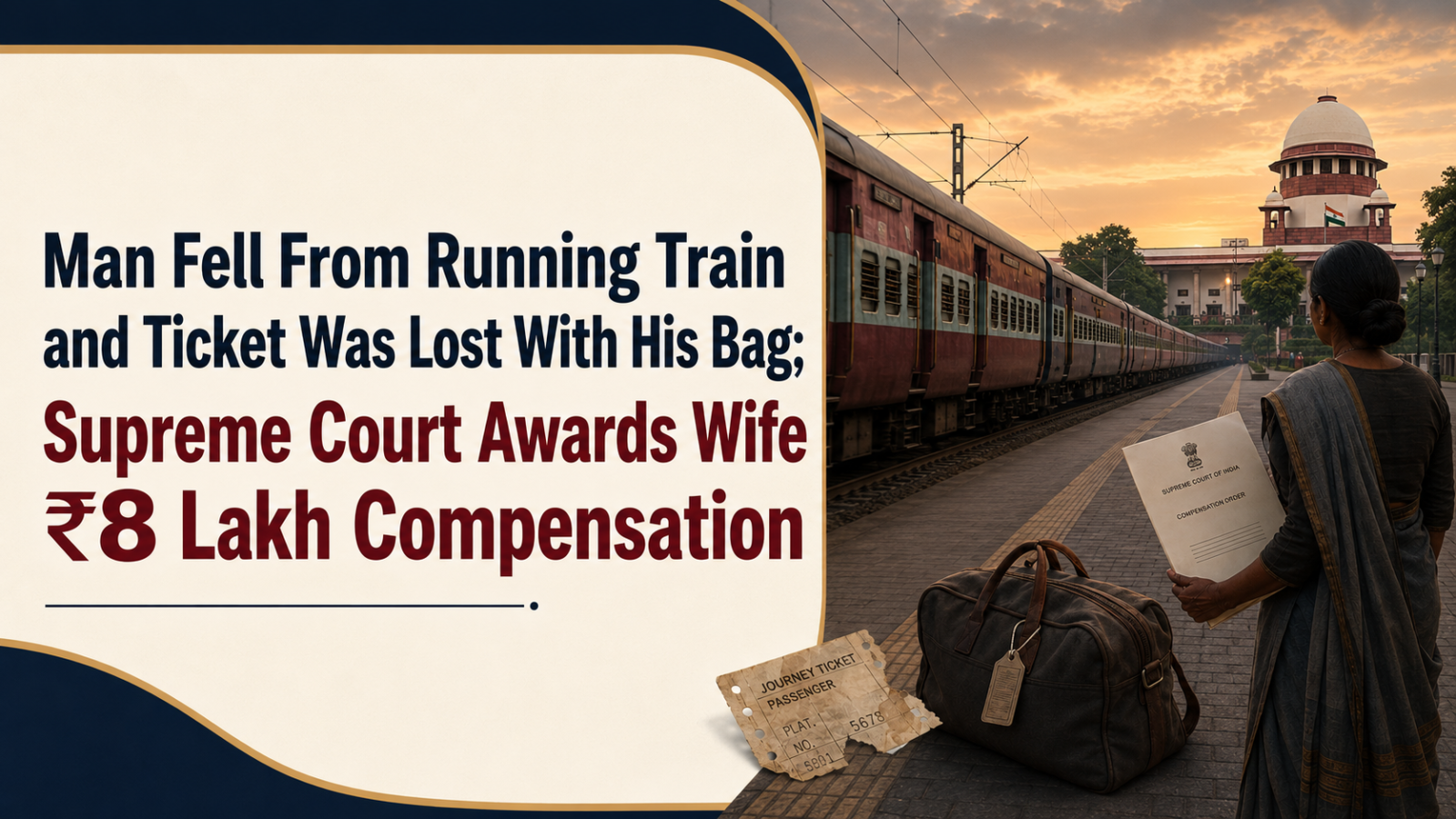
Supreme Court Protects Railway Accident Victims: Missing Ticket Alone Cannot Disqualify a Passenger’s Family From Compensation
Facts
On 28 November 2015, Chandrakant Thakkar was travelling from Raipur to Ahmedabad aboard Train No. 12834, the Ahmedabad-Howrah Mail, for business purposes.
During the journey, he accidentally fell from the running train somewhere between Khandbada and Khatgaon and died at the spot from the injuries he sustained.
His wallet was recovered by the police. It contained details of his son, Brijesh, who was informed about the accident. However, the deceased’s travel bag could not be found. According to his wife, Lata, the railway ticket was kept inside that missing bag.
Lata filed a claim before the Railway Claims Tribunal, Bhopal Bench, seeking compensation of ₹4 lakh with interest at 18% per annum from the date of the claim petition.
She stated in her affidavit that her husband had purchased a valid ticket from Raipur to Ahmedabad and had boarded the train for a business-related journey. The ticket could not be produced because it was lost along with his travel bag during the accident.
The Railway Claims Tribunal accepted that the death resulted from an “untoward incident” under Section 123(c)(2) of the Railways Act, 1989. However, it rejected the compensation claim because the ticket had not been recovered and the deceased was therefore not proved to be a bona fide passenger.
The Madhya Pradesh High Court upheld that decision. It also noted an inconsistency concerning the date of travel. In her cross-examination, Lata stated that her husband boarded the train on 26 November and that she received information about his death on 27 November, whereas the claim petition identified the journey date as 28 November 2015.
Lata challenged the concurrent rejection of her claim before the Supreme Court.
Issues
- Whether non-recovery of a railway ticket is sufficient to conclude that a deceased person was not a bona fide passenger.
- Whether a claimant can discharge the initial burden of proving valid travel by filing an affidavit explaining the journey and loss of the ticket.
- Whether the absence of the deceased’s luggage and ticket justified rejection of compensation under Section 124A of the Railways Act.
- Whether the provisions governing compensation for railway accidents and untoward incidents should receive a liberal and beneficial interpretation.
- Whether Lata was entitled to the enhanced statutory compensation of ₹8 lakh for her husband’s death.
Petitioner’s Arguments
Lata argued that her husband was a bona fide passenger travelling from Raipur to Ahmedabad with a valid railway ticket.
She explained that the ticket was kept inside his travel bag, which went missing after he fell from the train. Despite requests made to the police, neither the bag nor the ticket could be traced.
She maintained that her husband was travelling to Ahmedabad in connection with his catering business at Anjar, Gujarat.
The appellant relied on her affidavit containing the relevant details of the journey, the purchase of the ticket, the accidental fall and the loss of the travel bag.
She contended that a family should not be denied compensation merely because the ticket was lost during the same fatal incident for which compensation was being sought.
The appellant further relied upon the beneficial and no-fault nature of Section 124A of the Railways Act. Since the Railways did not deny that the deceased had travelled on the train or that he died after falling from it, compensation ought to have been granted.
Respondent’s Arguments
The judgment does not separately reproduce the detailed submissions made on behalf of the Union of India and the Railways.
The Railways’ position, as reflected in the orders under challenge, was that the deceased had not been established to be a bona fide passenger because no valid ticket was recovered from his body or belongings.
It also relied upon the inconsistencies concerning the date of his journey and the absence of independent material corroborating the appellant’s claim that he had purchased a ticket.
Accordingly, the Railways sought to sustain the findings of the Railway Claims Tribunal and the High Court that the foundational requirement of valid ticketed travel had not been established.
Analysis of the Law
No-Fault Liability Under Section 124A
Section 124A of the Railways Act imposes no-fault liability upon the Railway Administration when a passenger dies or is injured in an untoward incident.
The claimant is not required to prove negligence, wrongful conduct or default on the part of the Railways.
An accidental fall from a passenger train is expressly included within the meaning of an “untoward incident” under Section 123(c)(2).
Compensation may be refused only where death or injury results from one of the statutory exceptions, including:
- Suicide or attempted suicide;
- Self-inflicted injury;
- The passenger’s criminal act;
- An act committed while intoxicated or insane; or
- A natural cause, disease or unrelated medical treatment.
None of these exceptions was alleged or established in the present case.
Beneficial Interpretation of Railway Compensation Law
The Supreme Court held that Section 124A is a beneficial provision intended to provide prompt compensation to railway accident victims and their dependants.
Such legislation must receive a liberal and purposive interpretation that advances its humanitarian objective. Courts should avoid narrow or technical interpretations that defeat legitimate compensation claims.
The governing standard is the preponderance of probabilities, not proof beyond reasonable doubt as required in a criminal trial.
Burden of Proving Bona Fide Travel
The claimant bears the initial burden of showing that the deceased was travelling as a passenger with a valid ticket.
However, producing the original ticket is not the only method of establishing bona fide travel.
The initial burden may be discharged through an affidavit setting out relevant facts, including:
- The intended journey;
- The train involved;
- The purpose of travel;
- Purchase of a valid ticket; and
- The circumstances explaining why the ticket could not be produced.
Once such an affidavit is filed, the burden shifts to the Railways. The issue must then be determined from the surrounding facts and circumstances.
The mere fact that a ticket was not recovered from the body does not automatically establish ticketless travel.
Duties of the Railways
The Court examined the Indian Railway Commercial Manual and Operating Manual, which impose responsibilities upon railway staff concerning:
- Checking tickets at platforms, during journeys and at destinations;
- Preventing ticketless travel;
- Preventing passengers from travelling on footboards;
- Closing carriage doors before departure;
- Managing overcrowding;
- Ensuring the safety and comfort of passengers; and
- Assisting passengers in obtaining proper accommodation.
The Court observed that if these procedures were consistently followed, official records could help establish whether a person had entered and travelled on a train with a valid ticket.
It also acknowledged that overcrowding regularly contributes to passengers falling from trains and emphasised the need for more effective implementation of existing safety measures.
Precedent Analysis
Union of India v. Prabhakaran Vijaya Kumar
The Supreme Court held that Section 124A creates no-fault liability and must be interpreted liberally.
The expression “accidental falling of a passenger from a train” includes incidents occurring while a person is attempting to board a train. A narrow interpretation would defeat the beneficial purpose of the provision.
Union of India v. Rina Devi
This was the principal precedent governing the burden of proof.
The Court held that the presence of a body on railway premises is not, by itself, sufficient to prove that the deceased was a bona fide passenger. At the same time, the absence of a ticket does not automatically defeat the compensation claim.
The claimant may discharge the initial burden through an affidavit stating the relevant facts. The burden then shifts to the Railways, and the question must be decided based on the circumstances of each case.
Kamukayi v. Union of India
The Court reaffirmed the principles laid down in Rina Devi. Non-recovery of a ticket is only one circumstance and cannot conclusively establish that the deceased was not a bona fide passenger.
Doli Rani Saha v. Union of India
A three-judge Bench approved the principle that the absence of a ticket on the deceased’s body does not automatically alter the person’s status as a bona fide passenger.
Rajni v. Union of India
The Court emphasised that railway compensation claims must be assessed on the standard of preponderance of probabilities. Courts and tribunals should preserve the humanitarian objective of providing accessible compensation.
Southern Electricity Supply Co. of Orissa Ltd. v. Sri Seetaram Rice Mill
The Court explained that purposive interpretation should be preferred when it advances the purpose of a beneficial statute.
X v. State (NCT of Delhi)
The decision reiterated that where two interpretations of beneficial legislation are possible, courts should adopt the interpretation favouring the intended beneficiaries.
Workmen v. American Express International Banking Corporation
The Court held that social-welfare legislation should not be restricted through rigid literal interpretation. Such statutes must be interpreted broadly in light of their context and remedial purpose.
Court’s Reasoning
The Supreme Court found that there was no dispute that Chandrakant Thakkar had travelled on the train and had died after falling from it.
His death clearly resulted from an untoward incident. The Railways did not claim that his death fell within any of the statutory exceptions under Section 124A.
The only question was whether he possessed a valid ticket.
Lata had filed an affidavit stating that her husband purchased a ticket for the journey from Raipur to Ahmedabad and kept it in his travel bag. That bag could not be recovered after the accident despite requests made to the police.
The Court held that there was no other reasonable manner in which the appellant could prove possession of the ticket. Under the principles laid down in Rina Devi, her affidavit was sufficient to discharge the initial burden.
The mere failure to recover the ticket from the deceased’s body could not change his status as a bona fide passenger.
The Court held that the Tribunal and the High Court had adopted an unduly technical approach inconsistent with the beneficial purpose of the Railways Act.
It further observed that the Railways, as an instrumentality of a welfare State, should not take a narrow view that forces the family of a deceased passenger to pursue litigation up to the Supreme Court solely because the ticket was lost during the accident.
The Court also suggested that the Railways reconsider using the expression “second-class passenger.” It observed that the class description should be attached to the railway coach rather than the passenger, considering India’s history of class divisions and the constitutional spirit of equality.
Conclusion
The Supreme Court allowed Lata’s appeal and set aside the decisions of the Madhya Pradesh High Court and the Railway Claims Tribunal.
It held that non-recovery of the deceased’s ticket did not justify rejecting the claim. Lata’s affidavit sufficiently established that her husband had purchased a valid ticket and that it was lost with his missing travel bag.
Since the deceased died after accidentally falling from a running passenger train and none of the statutory exceptions applied, the Railways was liable to pay compensation under Section 124A.
Under the applicable Railway Accidents and Untoward Incidents (Compensation) Rules, the Court awarded Lata ₹8 lakh.
The Railways was directed to pay the amount within four weeks. If payment was not made within that period, the compensation would carry interest at 8% per annum from the date on which the original claim petition was filed.
Case Details
Case: Lata v. Union of India & Another
Court: Supreme Court of India
Case Number: Civil Appeal arising out of Special Leave Petition (Civil) No. 30726 of 2025; 2026 INSC 715
Judge: Justice Sanjay Karol and Justice Nongmeikapam Kotiswar Singh
Date: 17 July 2026
Result: Appeal allowed. The orders of the Railway Claims Tribunal and Madhya Pradesh High Court were set aside. The appellant was awarded ₹8 lakh, payable within four weeks, failing which it would carry interest at 8% per annum from the date of filing the claim petition.