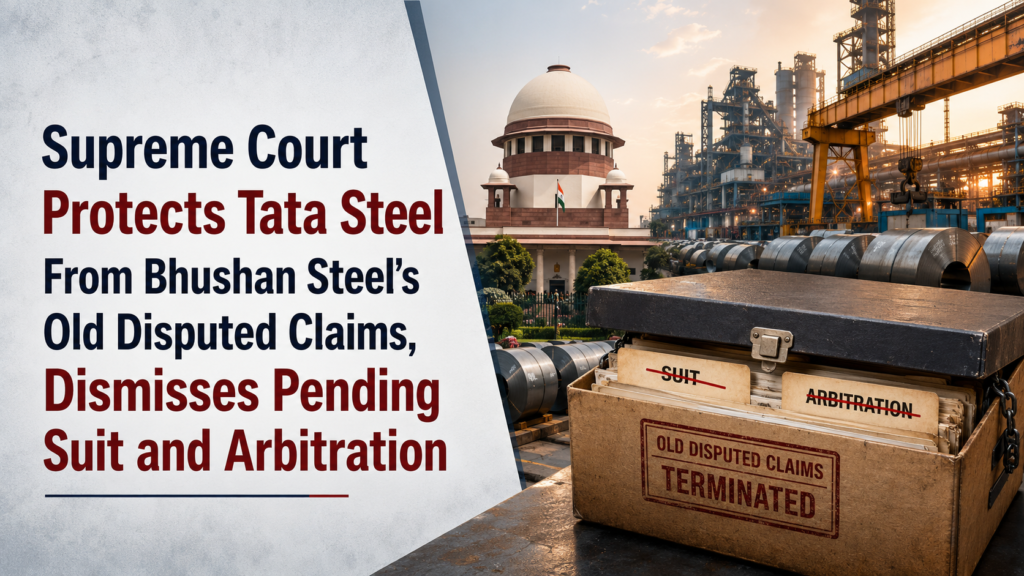
Supreme Court Protects Tata Steel From Bhushan Steel’s Old Disputed Claims, Dismisses Pending Suit and Arbitration

Operational Creditors Continued Civil Suit and Arbitration After Tata Steel Took Over Bhushan Steel; Supreme Court Dismisses Proceedings and Limits Claims to ₹1 Each
Facts
Before insolvency proceedings commenced against Bhushan Steel Limited, Varsha instituted a recovery suit seeking ₹38,89,674.14 with interest at 18% per annum.
Masyc Projects Private Limited similarly commenced six arbitration proceedings concerning goods engineered and supplied to Bhushan Steel.
During the pendency of these proceedings, the State Bank of India initiated the Corporate Insolvency Resolution Process against Bhushan Steel under the Insolvency and Bankruptcy Code, 2016.
Both Varsha and Masyc submitted claims before the Interim Resolution Professional as operational creditors:
- Varsha submitted a claim of ₹34,27,895.
- Masyc submitted claims totalling ₹31,30,67,354.
In the interim list of creditors, both claims were admitted at a notional value of ₹1 each because they were disputed and pending adjudication. The accompanying note initially stated that the liabilities would remain subject to the outcome of the pending proceedings.
Tata Steel submitted its resolution plan on 3 February 2018 based on the information memorandum prepared by the Resolution Professional.
As the admitted financial debt exceeded Bhushan Steel’s liquidation value, operational creditors were legally entitled to nil payment. Nevertheless, Tata Steel voluntarily created a settlement corpus of ₹1,200 crore for operational creditors:
- ₹1,000 crore for essential and critical operational creditors; and
- ₹200 crore for distribution among other admitted operational creditors on a pro-rata basis.
In the final list of creditors dated 20 March 2018, the claims of Varsha and Masyc continued to be valued at ₹1 each. However, the earlier note stating that liability would be subject to the outcome of pending proceedings was removed.
The Committee of Creditors approved Tata Steel’s resolution plan on 20 March 2018. The NCLT approved it on 15 May 2018, and the NCLAT subsequently dismissed the challenges against it.
Tata Steel thereafter sought dismissal of Varsha’s recovery suit and termination of Masyc’s arbitration proceedings, arguing that all claims relating to the period before approval of the resolution plan stood extinguished.
The Civil Court refused to dismiss Varsha’s suit. The Bombay High Court, Nagpur Bench, upheld that decision and permitted the suit to continue. Tata Steel consequently approached the Supreme Court.
Masyc was permitted to intervene because the same question—whether an operational creditor could continue arbitration for past dues after approval of a resolution plan—arose in its proceedings.
Issues
- Whether an operational creditor can continue a civil suit or arbitration concerning past dues after approval of a resolution plan under Section 31 of the IBC.
- Whether disputed claims admitted at a value of ₹1 were kept alive until their final determination in the pending civil or arbitration proceedings.
- Whether the ₹1,200-crore settlement corpus created for operational creditors required Tata Steel to reserve funds for disputed and uncrystallised claims.
- Whether the resolution plan contained a carve-out preserving the pending claims of Varsha and Masyc.
- Whether allowing such proceedings to continue would violate the clean-slate principle under the IBC.
- Whether the approved resolution plan had been obtained through fraud or manipulation of the creditors’ list.
Petitioner’s Arguments
Tata Steel argued that the disputed claims of Varsha and Masyc were admitted at ₹1 each because they had not been crystallised when the resolution plan was approved.
The final creditors’ list differed from the interim list. It did not contain the earlier note stating that liability would depend upon the outcome of pending proceedings. Therefore, the final admitted value of each claim was ₹1.
Tata Steel submitted that the treatment of creditors was governed by the approved resolution plan. The Committee of Creditors had accepted that treatment in the exercise of its commercial wisdom, which could not ordinarily be reopened by courts.
The plan expressly provided that:
- Sub-judice claims were treated as operational debts;
- Their liquidation value was nil;
- No amount was payable beyond the operational creditors’ settlement amount;
- Proceedings relating to pre-resolution claims would stand withdrawn, abated, settled or extinguished; and
- Operational creditors would have no further rights against the corporate debtor concerning the period before the effective date.
Tata Steel argued that the ₹1,200-crore corpus was an upper limit voluntarily created despite operational creditors being legally entitled to nil payment. It was not a fund intended to remain indefinitely reserved for disputed claims.
The ₹200 crore meant for ordinary operational creditors was required to be distributed within 12 months among creditors whose claims had already been crystallised and admitted.
Allowing pending claims to be determined and enforced years after approval of the resolution plan would defeat the clean-slate doctrine. A successful resolution applicant must know the precise liabilities it is undertaking and cannot be confronted with uncertain claims after taking over the corporate debtor.
Tata Steel also pointed out that Masyc had earlier challenged the treatment of its claim, but that challenge was dismissed as withdrawn. The order had attained finality.
Respondent’s Arguments
Varsha’s Arguments
Varsha alleged that Tata Steel obtained approval of the resolution plan by misleading the Resolution Professional and the NCLT.
It was argued that the Resolution Professional alone had authority to collect, verify and collate claims. Tata Steel could not alter or selectively omit claims verified by the Resolution Professional.
Varsha relied upon the interim creditors’ list, which stated that disputed claims were subject to the outcome of pending proceedings. According to her, removal of this note from the final list amounted to an improper alteration of her rights.
She further argued that the resolution plan earmarked ₹1,200 crore against admitted operational-creditor claims of approximately ₹1,050 crore, leaving a surplus. That surplus should have been placed in escrow to satisfy sub-judice claims after their adjudication.
Varsha maintained that the clean-slate principle could apply only to a legally approved resolution plan. It could not protect a plan allegedly obtained through fraud or manipulation.
Masyc’s Arguments
Masyc argued that the resolution plan expressly preserved claims included in its annexures. Since Masyc’s claims appeared in the annexures concerning operational-creditor and sub-judice claims, they did not stand extinguished.
It submitted that the words “other than the payment of Operational Creditors Settlement Amount” created an exception for disputed claims. According to Masyc, it was entitled to payment from the ₹200-crore corpus after its claims were determined in arbitration.
Masyc argued that admitting its claim at ₹1 was only a notional arrangement intended to preserve the claim until the arbitration concluded. It was not a final determination restricting its claim to ₹1.
It proposed a “face-value reservation mechanism” under which Tata Steel should have calculated and ring-fenced the pro-rata share of every disputed claim pending its final adjudication.
Masyc also invoked the principle of contra proferentem, arguing that any ambiguity in the resolution plan should be interpreted against Tata Steel, which had drafted it.
It contended that the clean-slate doctrine protects a successful resolution applicant from unknown or surprise claims—not claims that were disclosed, recorded and expressly included in the resolution plan.
Analysis of the Law
Binding Effect of an Approved Resolution Plan
Once a resolution plan is approved under Section 31(1) of the IBC, it becomes binding upon:
- The corporate debtor;
- Its employees and members;
- Financial and operational creditors;
- Government and local authorities;
- Guarantors; and
- Other stakeholders.
Claims dealt with under the plan become frozen. Claims that are not preserved or provided for stand extinguished, and proceedings relating to them cannot ordinarily be initiated or continued.
Clean-Slate Principle
A successful resolution applicant must be permitted to take over the corporate debtor with certainty regarding its financial liabilities.
If disputed or unquantified claims are allowed to resurface after approval of the plan, the commercial calculations underlying the resolution will become unreliable. The Court described such recurring liabilities as a “hydra-headed” problem inconsistent with the IBC.
Commercial Wisdom of the Committee of Creditors
The treatment and classification of claims under a resolution plan fall primarily within the commercial wisdom of the Committee of Creditors.
Once the plan is approved by the Committee of Creditors and the NCLT, courts cannot rewrite its commercial terms unless the grounds for interference specifically recognised under the IBC are established.
Treatment of Disputed Claims at ₹1
The final list of creditors did not preserve the note stating that liability would depend upon the outcome of pending litigation.
Consequently, the Court treated ₹1 not merely as a temporary or notional value but as the final quantified value of each disputed claim under the approved plan.
Requirement That Claims Be Crystallised
The applicable version of Regulation 12(2) of the CIRP Regulations permitted creditors to submit claims only until the resolution plan’s approval by the Committee of Creditors.
The Court held that operational-creditor liabilities had to be crystallised and quantified by the relevant date. Allowing unquantified claims to continue until their eventual determination would disrupt the pro-rata distribution already made under the plan.
Precedent Analysis
Committee of Creditors of Essar Steel India Ltd. v. Satish Kumar Gupta
The Supreme Court held that all claims must be submitted and determined during the resolution process so that the successful resolution applicant knows precisely what it must pay.
It also approved the practice of admitting disputed claims at a notional value of ₹1.
The judgment established that a resolution applicant cannot be exposed to undecided claims after taking over the corporate debtor.
Ghanashyam Mishra & Sons Pvt. Ltd. v. Edelweiss Asset Reconstruction Co. Ltd.
The Court held that once a resolution plan is approved, all claims provided for under it stand frozen and become binding on the stakeholders.
Claims not forming part of the approved plan stand extinguished, and no person may initiate or continue proceedings concerning such claims.
K. Sashidhar v. Indian Overseas Bank
This decision established that the commercial wisdom of the Committee of Creditors is ordinarily non-justiciable. Courts and tribunals cannot reassess the commercial merits of an approved resolution plan beyond the grounds specified in the IBC.
Kalyani Transco v. Bhushan Power and Steel Ltd.
The Court reaffirmed that creditors may be placed in different classes under a resolution plan and that the Committee of Creditors’ commercial decision concerning such classification cannot ordinarily be challenged.
JSW Steel Ltd. v. Pratishtha Thakur Haritwal
The Court reiterated that all claims must be submitted to and decided during the insolvency process. This enables a prospective resolution applicant to assess its liabilities before taking over the corporate debtor.
Uttar Pradesh Power Corporation Ltd. v. Bhushan Steels and Strips Ltd.
This judgment was relied upon to reinforce the finality of the Committee of Creditors’ commercial wisdom in approving the treatment of claims.
Greater Noida Industrial Development Authority v. Prabhjit Singh Soni
Varsha relied upon this decision to argue that an NCLT order approving a resolution plan may be recalled where fraud or manipulation is established.
The Supreme Court found it inapplicable because no recall application had been filed under Rule 11 of the NCLT Rules, and the allegation of fraud was unsupported in the present proceedings.
Swiss Ribbons Pvt. Ltd. v. Union of India
The Court had upheld the distinction between financial and operational creditors as based on an intelligible differentia.
However, in the present judgment, the Supreme Court observed that small operational creditors, including MSMEs, may be significantly disadvantaged under the existing IBC framework.
Court’s Reasoning
The Supreme Court held that the final list of operational creditors and the approved resolution plan had attained finality.
Varsha had never challenged the final list. Masyc had challenged the treatment of its claim, but its proceeding was dismissed as withdrawn, and that order was never questioned.
The allegation that Tata Steel had procured approval through fraud or manipulation was rejected. No recall application had been filed before the NCLT, and such allegations could not be examined indirectly in Tata Steel’s appeal.
The Court found that the removal of Note 3 from the final creditors’ list was significant. The final list merely recorded that the disputed claims had been verified at ₹1 each. It did not state that their final value would depend upon pending litigation. Therefore, ₹1 became the quantified value of each claim under the approved plan.
The ₹200 crore earmarked for ordinary operational creditors was available only for claims that had been crystallised and approved by the relevant date. It was not intended to remain reserved indefinitely for disputed claims awaiting adjudication.
Reading the resolution plan as a whole, the Court found no carve-out preserving the recovery suit or arbitration proceedings. Its clauses expressly provided that proceedings concerning pre-resolution operational debts would stand withdrawn, abated, settled or extinguished.
The Court rejected Masyc’s proposed face-value reservation mechanism because the approved resolution plan did not provide for such a procedure. Introducing it judicially would amount to rewriting the plan.
It also refused to apply the principle of contra proferentem because it found no ambiguity in the plan.
Allowing disputed claims to remain alive beyond the resolution process would undermine the clean-slate and fresh-start principles of the IBC. Accordingly, Varsha and Masyc could not recover anything beyond their quantified claims of ₹1 each.
The Court nevertheless expressed concern regarding the effect of the IBC on small operational creditors, particularly MSMEs and statutory local bodies. It observed that the Law Commission and Parliament may consider a fairer repayment mechanism for such creditors.
Conclusion
The Supreme Court allowed Tata Steel’s appeals and set aside the Bombay High Court’s orders.
It held that all civil suits, arbitration proceedings and other legal proceedings involving claims that had not become determinable and quantifiable by the effective date of the resolution plan stood abated, extinguished, waived or withdrawn.
Only crystallised claims existing on the effective date could be paid on a pro-rata basis under the approved resolution plan.
The claims of Varsha and Masyc had been finally quantified at ₹1 each. They were therefore not entitled to pursue their recovery suit or arbitration proceedings to claim any additional amount.
The Supreme Court consequently:
- Dismissed Varsha’s Civil Suit No. 153 of 2011;
- Dismissed the arbitration proceedings commenced by Masyc;
- Held that only ₹1 each was payable to Varsha and Masyc; and
- Protected Tata Steel, as the successful resolution applicant, from Bhushan Steel’s unresolved past liabilities.
Case Details
Case: M/s Tata Steel Ltd. v. Varsha & Another
Court: Supreme Court of India
Case Number: Civil Appeal Nos. 9052–9053 of 2026, arising out of SLP (Civil) Nos. 24000–24001 of 2026; 2026 INSC 717
Judge: Justice Manoj Misra and Justice Manmohan
Date: 17 July 2026
Result: Appeals allowed. The Bombay High Court’s orders and the Civil Court’s order were set aside. Varsha’s recovery suit and Masyc’s arbitration proceedings were dismissed. Their claims were restricted to ₹1 each under the approved resolution plan.