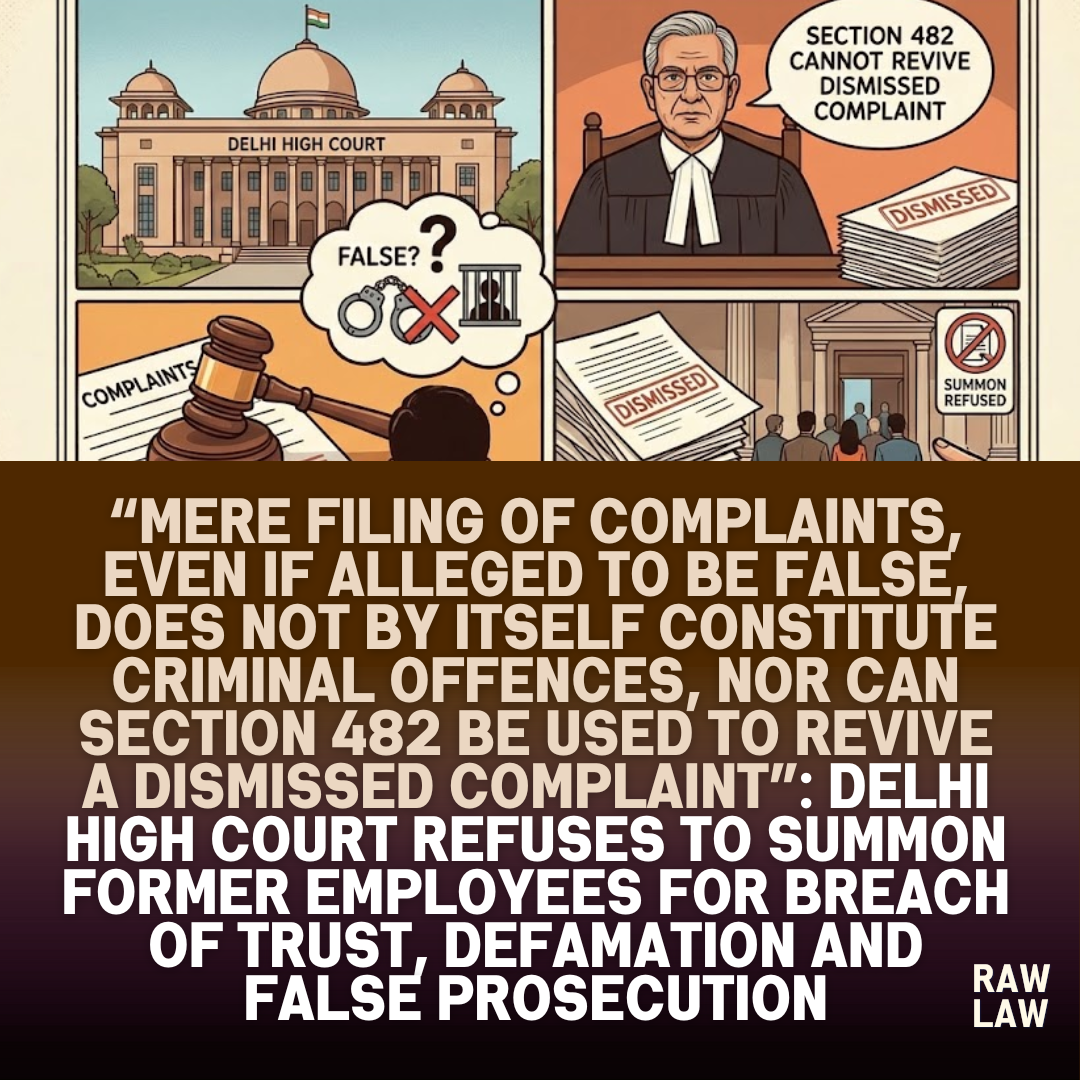
“Mere filing of complaints, even if alleged to be false, does not by itself constitute criminal offences, nor can Section 482 be used to revive a dismissed complaint”: Delhi High Court refuses to summon former employees for breach of trust, defamation and false prosecution, applies statutory bar under Section 195 CrPC, holds no ‘entrustment’ of data during employment, but upholds summoning of one respondent for criminal intimidation under Section 506 IPC

HEADNOTE
Rajan Sareen v. State (NCT of Delhi) & Ors.
Court: High Court of Delhi
Bench: Justice Neena Bansal Krishna
Date of Judgment: 15 December 2025
Citation: CRL.M.C. 2514/2017
Laws / Sections Involved: Sections 182, 211, 406, 500, 506, 34, 120B IPC; Section 195 CrPC; Section 482 CrPC
Keywords: Criminal complaint dismissal, Section 195 CrPC bar, criminal breach of trust, defamation complaint, intimidation, summoning order
Summary
The Delhi High Court dismissed a petition under Section 482 CrPC filed by a company director challenging orders of the Magistrate and Sessions Court which refused to summon four former women employees for multiple criminal offences including criminal breach of trust, defamation and false prosecution. The Court held that allegations of false FIRs and data theft did not disclose prima facie offences under Sections 182 and 211 IPC due to the statutory bar under Section 195 CrPC. It further ruled that possession of company data during employment does not amount to “entrustment” for purposes of Section 406 IPC absent proof of dishonest misappropriation. The Court upheld summoning of one respondent for criminal intimidation under Section 506 IPC but declined interference with discharge of others, reiterating limits of inherent jurisdiction and the need for strict scrutiny at the pre-summoning stage.
Court’s decision
The Delhi High Court dismissed the petition filed under Section 482 CrPC and upheld the orders of the Magistrate and the Sessions Court. The Court affirmed the discharge of Respondent Nos. 2 to 5 for offences under Sections 182, 211, 406, 500, 34 and 120B IPC, while sustaining the limited summoning of Respondent No. 2 for the offence of criminal intimidation under Section 506 IPC. The Court held that no perversity or legal infirmity existed in the concurrent findings of the courts below and declined to exercise inherent jurisdiction to interfere.
Facts
The petitioner was a Director of two private companies engaged in wealth management and trading activities. Respondent Nos. 2 to 5 were former women employees who had resigned from the company between 2013 and 2014. After their resignation, four FIRs were registered against the petitioner on complaints filed by the respondents alleging offences of sexual harassment and outraging modesty. These FIRs resulted in filing of charge-sheets and are pending trial.
Alleging that the FIRs were false, retaliatory and malicious, the petitioner filed a criminal complaint accusing the respondents of criminal conspiracy, criminal breach of trust, defamation, criminal intimidation, and instituting false proceedings. He alleged that the respondents had taken confidential company data, failed to return documents, deleted official emails, and threatened him with false cases. His application under Section 156(3) CrPC was declined and treated as a complaint under Section 200 CrPC, leading to pre-summoning evidence.
Issues
The primary issues before the High Court were whether the Magistrate and Sessions Court erred in refusing to summon the respondents for offences under Sections 182 and 211 IPC relating to false prosecution, Section 406 IPC for alleged data theft, Section 500 IPC for defamation, and Section 120B IPC for conspiracy. The Court also examined whether the limited summoning of one respondent for criminal intimidation under Section 506 IPC was justified and whether inherent powers under Section 482 CrPC could be invoked to revive a largely dismissed complaint.
Petitioner’s arguments
The petitioner argued that the courts below had mechanically ignored voluminous documentary and oral evidence establishing a conspiracy by the respondents to falsely implicate him in sexual harassment cases. He contended that company data was entrusted to the respondents during employment and their failure to return the same constituted criminal breach of trust. It was further argued that filing of false FIRs damaged his reputation in business circles, attracting defamation. Reliance was placed on Supreme Court judgments holding that at the summoning stage, courts need only see whether a prima facie case exists, and not conduct a mini-trial.
Respondent’s arguments
The State opposed the petition and submitted that four FIRs registered against the petitioner had culminated in charge-sheets after investigation. It was argued that allegations of falsity or mala fides in those FIRs could only be tested during trial and not presumed at the pre-summoning stage of a counter-complaint. The respondents supported the findings of the courts below, contending that no offence under Sections 182 or 211 IPC could be taken cognizance of without a complaint by a public servant or court, and that no entrustment or dishonest misappropriation of property was made out.
Analysis of the law
The High Court analysed the statutory bar contained in Section 195 CrPC, which mandates that offences under Sections 182 and 211 IPC can be taken cognizance of only on a complaint by the concerned public servant or court. In the absence of such a complaint, the Magistrate lacked jurisdiction to summon the respondents for those offences. The Court further examined the ingredients of criminal breach of trust under Sections 405 and 406 IPC, emphasising that mere possession of company data during employment does not constitute “entrustment” unless accompanied by dishonest intention or conversion for personal gain.
On defamation, the Court reiterated that complaints made to lawful authorities, even if later found to be incorrect, do not automatically amount to defamation unless malice and intent to harm reputation are clearly established.
Precedent analysis
The Court relied on settled principles laid down in Nagawwa v. Veeranna Shivalingappa Konjalgi and M.N. Damani v. S.K. Sinha, which limit interference with summoning orders and recognise that pre-summoning scrutiny must be cautious. It also followed jurisprudence holding that criminal law cannot be invoked as a retaliatory measure where civil or employment disputes exist, and that statutory bars under Section 195 CrPC are mandatory.
Court’s reasoning
Justice Neena Bansal Krishna held that the petitioner’s grievance regarding false FIRs was misplaced in the present proceedings, as those FIRs were already under trial and their veracity would be adjudicated separately. The Court found that no public servant complaint existed to trigger Sections 182 or 211 IPC. It further agreed with the courts below that the petitioner failed to establish prima facie entrustment or dishonest misappropriation of data to attract Section 406 IPC.
However, the Court upheld the finding that a prima facie case of criminal intimidation was made out against Respondent No. 2, based on consistent testimony that she threatened the petitioner with false cases if legal action was pursued against another employee. Beyond this limited aspect, the Court found no justification to summon the remaining respondents.
Conclusion
The Delhi High Court dismissed the petition and upheld the concurrent findings of the Magistrate and the Sessions Court. It confirmed that Respondent No. 2 would face trial only for the offence under Section 506 IPC, while all other respondents stood discharged of the remaining allegations. The Court reiterated that inherent jurisdiction under Section 482 CrPC cannot be exercised to circumvent statutory bars or to convert employment disputes into criminal prosecutions.
Implications
This judgment reinforces strict limits on retaliatory criminal litigation arising from employment disputes. It clarifies the scope of Section 195 CrPC, reiterates the high threshold for criminal breach of trust in employer–employee relationships, and underscores that defamation cannot be presumed merely from filing of complaints before authorities. The ruling serves as a caution against misuse of criminal law as a counter-blast strategy and strengthens procedural discipline at the pre-summoning stage.
CASE LAW REFERENCES
• Nagawwa v. Veeranna Shivalingappa Konjalgi – Scope of summoning and pre-summoning scrutiny
• M.N. Damani v. S.K. Sinha – Limits on interference at summoning stage
• Subramanian Swamy v. Union of India – Ingredients of defamation
FAQs
Q1. Can false FIRs automatically lead to prosecution under Sections 182 or 211 IPC?
No. Cognizance is barred under Section 195 CrPC unless a complaint is filed by a public servant or court.
Q2. Does possession of company data by an employee amount to criminal breach of trust?
No, unless dishonest misappropriation or conversion is prima facie established.
Q3. When can High Courts interfere under Section 482 CrPC?
Only to prevent abuse of process or secure justice, not to revive complaints barred by law.