NDPS Trial Cannot Be Kept Pending Indefinitely for Co-Accused: J&K High Court Rejects Bail but Orders Fresh Review

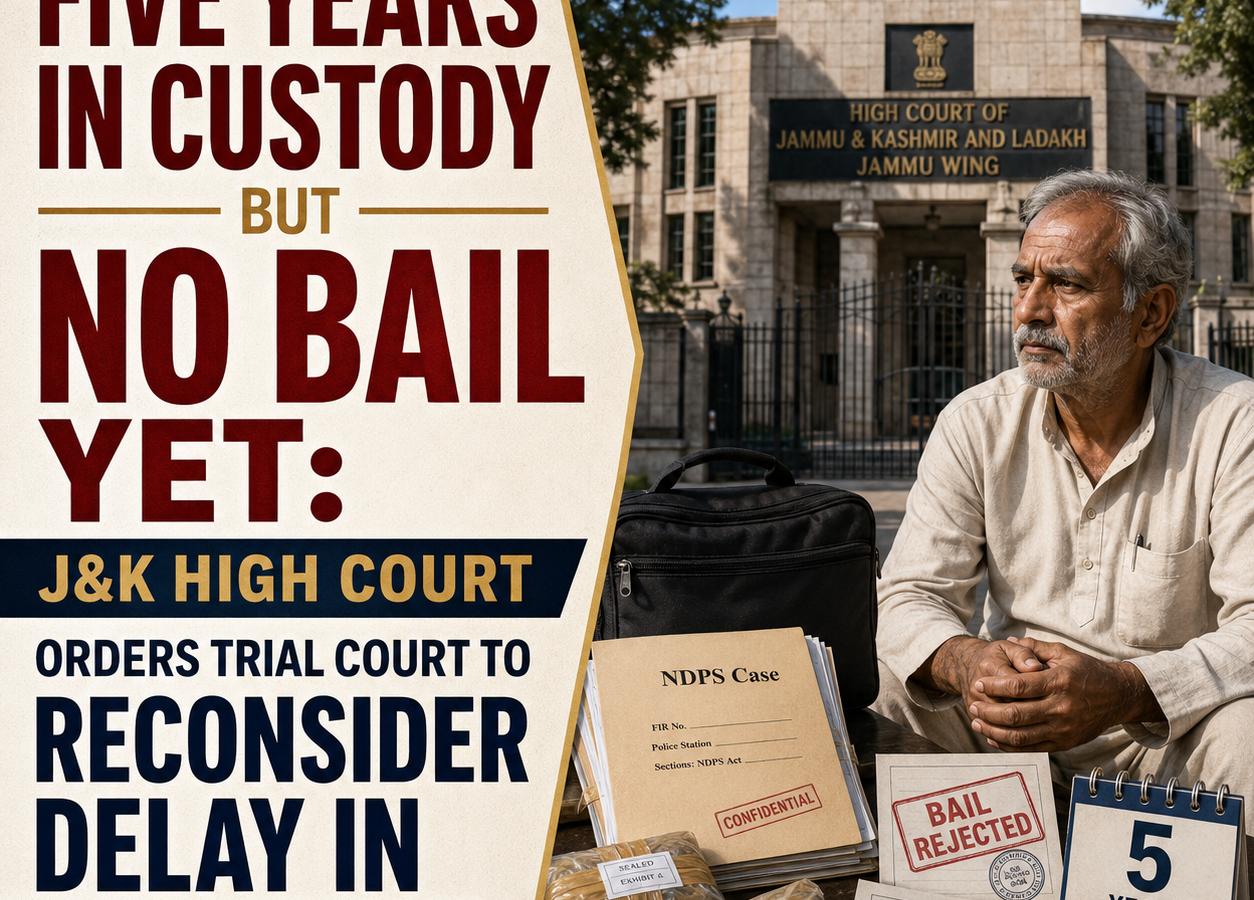
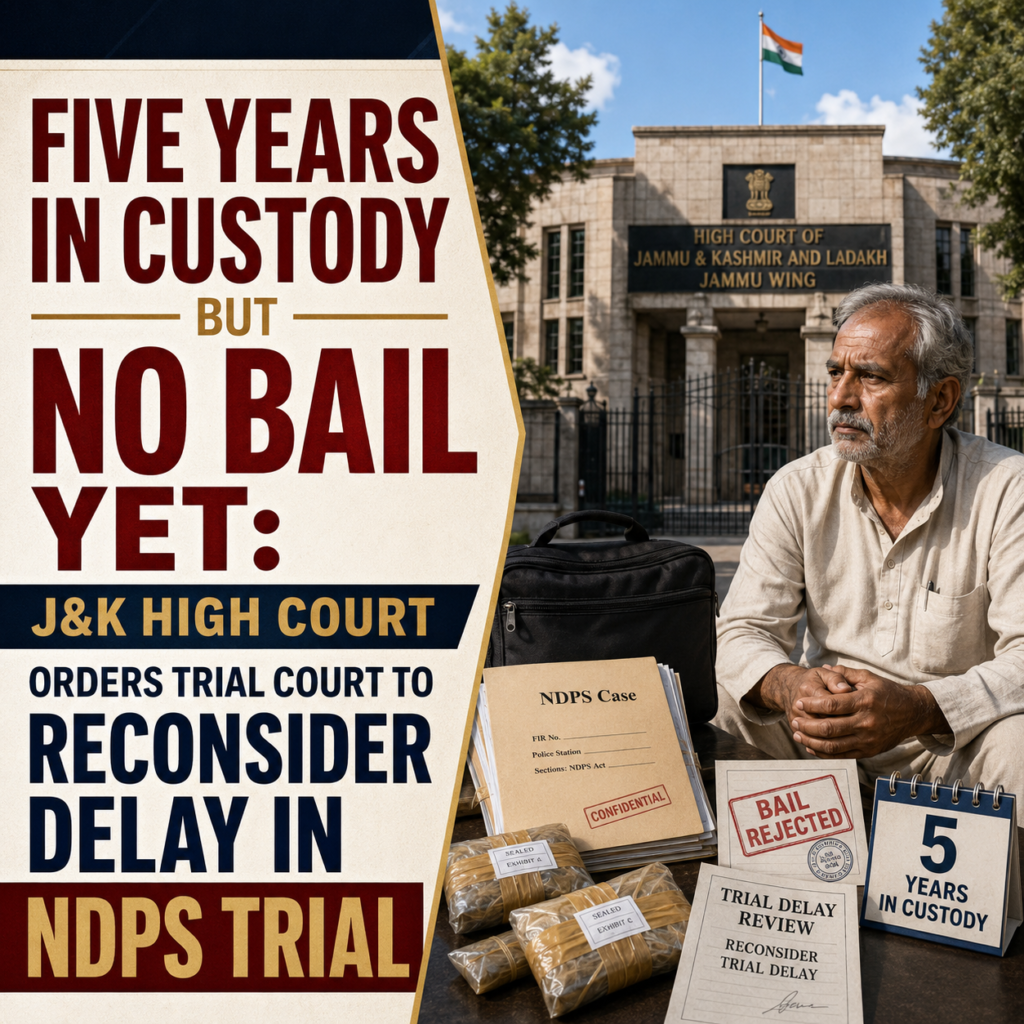
Commercial Quantity Charas Case: J&K High Court Denies Bail, Directs Trial Court to Decide Whether Trials Should Be Separated
Facts
Afroz Ahmed Sheikh, aged about 60 years, was prosecuted under Sections 8 and 20 of the Narcotic Drugs and Psychotropic Substances Act, 1985. According to the prosecution, on 28 September 2020, the Narcotics Control Bureau received information that the petitioner was travelling from Anantnag to Surat through Jammu while carrying charas in a black shoulder bag.
An NCB team intercepted a bus at Parmandal Morh, Jammu. The petitioner was allegedly found seated in the sleeper section with a black bag containing five packets wrapped in brown tape. The recovered substance was stated to be charas weighing 5.5 kilograms with packaging and 5.4 kilograms without packaging, which constituted a commercial quantity.
The petitioner was arrested on 29 September 2020. A complaint was filed in March 2021 and charges under Sections 8 and 20 of the NDPS Act were framed in July 2021.
The prosecution evidence was closed on 6 November 2024, and the petitioner’s statement under Section 313 CrPC was recorded on 9 December 2024. The case had therefore reached the stage of final arguments.
However, a supplementary complaint was subsequently filed against an alleged supplier and co-accused, Ghulam Mohudin Shah. On that basis, the trial court deferred final arguments in the petitioner’s case pending further proceedings against the co-accused.
The petitioner sought bail on the ground that he had remained in custody for approximately five years and that the trial, although substantially complete as against him, had been indefinitely stalled because of the supplementary complaint. His earlier bail application had been rejected by the Special Judge, NDPS Cases, Jammu.
Issues
- Whether prolonged incarceration of approximately five years justified bail in a commercial-quantity NDPS case despite the restrictions under Section 37 of the NDPS Act.
- Whether the trial court was justified in indefinitely deferring final arguments in the petitioner’s case merely because a supplementary complaint had been filed against a co-accused.
- Whether the petitioner’s trial ought to be separated from the proceedings arising from the supplementary complaint.
- Whether the petitioner could be granted bail when the trial court had not yet formally decided whether the cases should proceed jointly or separately.
- Whether the trial court was competent to consider prolonged incarceration and speedy-trial concerns while deciding bail.
Petitioner’s Arguments
The petitioner argued that his continued detention for nearly five years amounted to impermissible pre-trial punishment.
He submitted that the delay was not attributable to him. Only six prosecution witnesses had been examined over nearly five years, and the prosecution evidence had eventually closed. His statement under Section 313 CrPC had also been recorded, leaving only final arguments.
According to the petitioner, the trial court had indefinitely postponed his case merely because a supplementary complaint had been filed against the alleged supplier. The supplementary complaint contained no fresh allegation against him and should not prevent completion of his trial.
It was further argued that, as far as the petitioner was concerned, the trial stood concluded in substance. Continuing his detention served no legitimate procedural purpose and violated his constitutional right to a speedy trial.
The petitioner also criticised the trial court’s view that prolonged incarceration could be considered only by a constitutional court and not by the trial court.
Respondent’s Arguments
The NCB opposed bail on the ground that the petitioner had allegedly been found in possession of a commercial quantity of charas.
It argued that Section 37 of the NDPS Act imposed stringent restrictions on the grant of bail and that the petitioner had not satisfied the statutory twin conditions.
Reliance was placed upon Narcotics Control Bureau v. Mohit Aggarwal, 2022 LiveLaw (SC) 613, to contend that length of custody alone cannot justify bail in a commercial-quantity NDPS case.
The respondent further submitted that the filing of the supplementary complaint was not a tactic to delay the proceedings. Since the case had reached the stage of final arguments, it was argued that bail should not be granted at such an advanced stage.
Analysis of the Law
Section 37 of the NDPS Act
Section 37 places a stringent embargo on bail in cases involving commercial quantity. Ordinarily, bail cannot be granted unless the court is satisfied that:
- there are reasonable grounds for believing that the accused is not guilty; and
- the accused is not likely to commit any offence while on bail.
However, the existence of Section 37 does not permit indefinite detention or mechanical delay in trial. NDPS prosecutions must be conducted with particular expedition because the statute prescribes severe punishments while simultaneously restricting bail.
Right to a Speedy Trial
Prolonged incarceration without conclusion of trial raises concerns under Article 21 of the Constitution. A criminal trial cannot be indefinitely kept pending when the prosecution evidence is complete and only final arguments remain.
The Court did not hold that prolonged custody automatically overrides Section 37. Instead, it examined whether the delay was legally justified and whether the trial court had properly exercised its jurisdiction.
Joint or Separate Trial
The Court treated the situation as analogous to the addition of an accused under Section 319 CrPC. Where another accused is brought into the proceedings at a late stage, the trial court must consciously decide whether:
- the accused should be tried jointly; or
- the existing trial should be separated and completed independently.
The trial court cannot simply defer the main trial indefinitely without a reasoned judicial determination.
If a separate trial is appropriate, there is no legal impediment to continuing and concluding the case against the original accused.
Precedent Analysis
Narcotics Control Bureau v. Mohit Aggarwal, 2022 LiveLaw (SC) 613
The respondent relied upon this judgment to argue that prolonged custody by itself is not a sufficient ground for bail in a commercial-quantity NDPS case.
The High Court did not disregard this principle. It declined to grant bail merely because the petitioner had completed approximately five years in custody. Instead, it focused on correcting the procedural stagnation and ensuring that the trial court reconsidered whether the petitioner’s case should continue independently.
Sukhpal Singh Khaira v. State of Punjab, 2022 INSC 1252
The High Court principally relied upon the Supreme Court’s guidelines concerning summoning of an additional accused under Section 319 CrPC.
The Supreme Court held that, when an additional accused is summoned, the trial court must decide whether a joint or separate trial is necessary. If a separate trial is ordered, the main case may continue and be concluded independently.
The High Court applied these principles by analogy. It held that the supplementary complaint against Ghulam Mohudin Shah did not automatically justify indefinite suspension of the petitioner’s nearly completed trial.
The trial court was required to make a reasoned determination on segregation instead of mechanically deferring proceedings.
Court’s Reasoning
The Court found that the prosecution evidence against the petitioner had concluded and that his statement under Section 313 CrPC had already been recorded. His case was therefore ready for final arguments.
The supplementary complaint did not contain any new allegation against the petitioner. The main complaint had already alleged that the petitioner had obtained the charas from Ghulam Mohudin Shah.
The Court was critical of the fact that, despite the supplementary complaint having been filed in March 2025, even arguments on charge or discharge against the co-accused had not been concluded.
It held that the trial court had mechanically deferred the petitioner’s case on the basis of submissions made by the prosecutor and an initial concession by defence counsel, without independently determining whether such deferment was legally necessary.
The Court also noticed inconsistency in the prosecution’s position. The prosecutor had earlier sought deferment of the petitioner’s case but later sought time to argue the same matter finally.
The High Court concluded that the trial court was required to reconsider whether the petitioner’s trial should be segregated and completed independently.
Nevertheless, the High Court refused bail at that stage. Since the procedural issue could still be corrected promptly by the trial court, the Court considered it appropriate first to direct an expeditious decision on segregation rather than grant bail immediately.
The petitioner was granted liberty to file a fresh bail application if the trial court again decided to defer his proceedings.
Conclusion
The Jammu & Kashmir and Ladakh High Court rejected the petitioner’s bail application at that stage.
However, it issued the following directions:
- the trial court must reconsider, within 15 days, whether the petitioner’s trial should continue to remain deferred;
- after reconsideration, the trial court must proceed in accordance with law;
- if the trial court again decides to defer the petitioner’s case, he may file a fresh bail application; and
- arguments on charge or discharge in the supplementary complaint against Ghulam Mohiuddin Shah must be concluded, and an appropriate order passed, within 30 days.
The judgment holds that an NDPS trial cannot be mechanically or indefinitely stalled merely because proceedings are subsequently initiated against another accused. The trial court must make a reasoned choice between a joint and separate trial and ensure expedition, particularly where the accused is in prolonged custody.
Case Details
Case: Afroz Ahmed Sheikh v. Narcotics Control Bureau, Jammu Zone
Court: High Court of Jammu & Kashmir and Ladakh at Jammu
Case Number: Bail Application No. 272 of 2025
Neutral Citation: 2026:JKLHC-JMU:998
Judge: Hon’ble Mr. Justice Rajnesh Oswal
Date: 10 April 2026
Result: Bail application rejected at that stage; trial court directed to reconsider deferment of the petitioner’s trial within 15 days and decide charge or discharge in the supplementary complaint within 30 days.