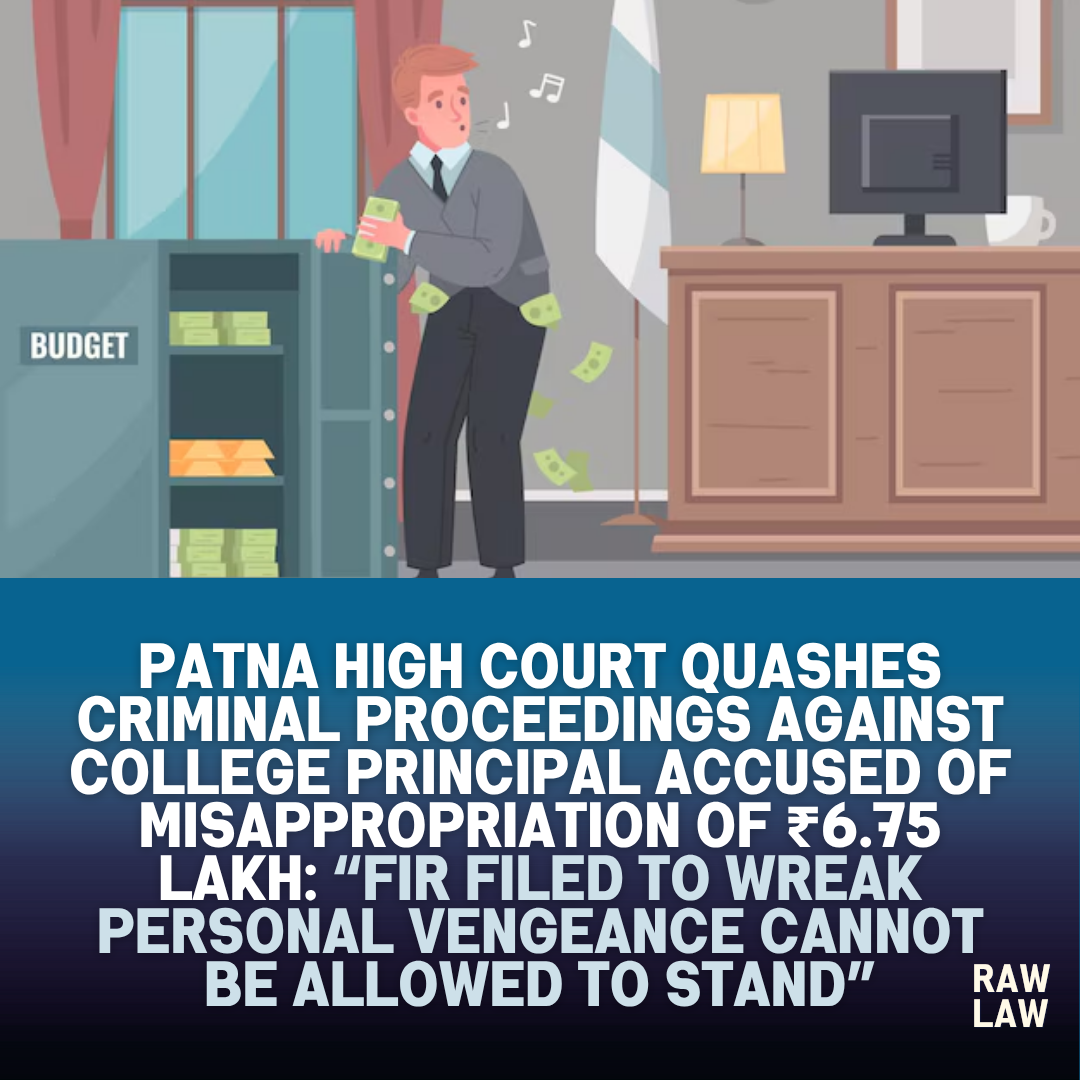
Patna High Court Quashes Criminal Proceedings Against College Principal Accused of Misappropriation of ₹6.75 Lakh: “FIR Filed to Wreak Personal Vengeance Cannot Be Allowed to Stand”

Court’s Decision
The Patna High Court, presided over by Justice Anil Kumar Sinha, quashed the criminal proceedings and cognizance order dated 16 April 2015 passed by the Sub-Divisional Judicial Magistrate, Darbhanga, in a case alleging misappropriation of government funds by a college principal.
The Court held that the First Information Report (FIR) was lodged with ulterior motives and personal vengeance, and that the prosecution was bereft of foundational evidence to sustain charges under Sections 420, 467, 468, 471, 409, and 120-B of the Indian Penal Code.
The Court observed:
“Permitting the prosecution to continue against the petitioner shall amount to abuse of the process of the criminal court. The FIR, though meticulously drafted, reads more like a departmental charge-sheet than a criminal complaint.”
Accordingly, the Court quashed the order of cognizance and allowed the petition, emphasizing that criminal law should not be weaponized for personal vendetta.
Facts
The case arose out of allegations by the Vice-Chairman of J.N.B. Trust, the parent body of J.N.B. Adarsh Sanskrit Mahavidyalaya, Lagma, that the Principal had illegally withdrawn ₹6,75,000 from the joint account of the college and deposited it into an unauthorized personal account under the name “Principal (Kalyan Kosh)”, thereby embezzling government grant funds.
The FIR, registered in 2011, alleged that the amount was meant for salary and scholarship payments and that the Principal manipulated signatures, falsified audit reports, and used unauthorized signatories after obtaining pre-signed cheques from retired staff members. It also claimed that an internal inquiry by Rashtriya Sanskrit Sansthan had found irregularities in his appointment and financial conduct.
The police submitted a charge sheet in 2014 against the petitioner and one co-accused but found no material against two other named persons. Cognizance was taken in 2015. The petitioner thereafter approached the High Court seeking quashing of the proceedings.
Issues
- Whether the order of cognizance passed by the SDJM was sustainable in law.
- Whether the material on record disclosed a prima facie case of misappropriation, forgery, or criminal breach of trust.
- Whether the FIR and criminal proceedings were motivated by personal animosity and constituted abuse of process.
Petitioner’s Arguments
The petitioner argued that the informant had no locus standi, having resigned from the Trust in 2008, while the FIR was lodged in 2011. Documentary proof in the form of letters dated 29 April 2008 and 10 May 2008 confirmed his resignation and disassociation from the Trust.
It was submitted that the alleged “unauthorized account” (A/c No. 6845) was not a secret personal account, but an institutional account opened in 1990, long before the petitioner became Principal in 1996. The Central Bank of India’s certificate dated 22 December 2011 confirmed this fact.
The petitioner contended that the college maintained two accounts — one for government grants (A/c No. 2284) and the other for donations and welfare funds (A/c No. 6845) — both regularly used for legitimate institutional expenditures, including staff salaries and scholarships.
Further, auditor’s reports and utilization certificates for FY 2008–09 demonstrated that all funds were duly audited and properly utilized. The account statement showed an unutilized balance of ₹3,43,479, inconsistent with any allegation of misappropriation.
Relying on the judgments of State of Haryana v. Bhajan Lal (1992 Supp (1) SCC 335) and Anand Kumar Mohatta v. State (2019) 11 SCC 706, the petitioner argued that mechanical cognizance without evidence amounts to a miscarriage of justice and should be quashed under Section 482 Cr.P.C.
Respondent’s Arguments
The State opposed the quashing, submitting that the FIR disclosed prima facie evidence of misappropriation, as funds from the official account were transferred to another account in the Principal’s control. It was contended that whether the account was “personal” or “institutional” was a matter for trial.
However, despite notice, no representation appeared on behalf of the original informant, and the State did not produce any contradictory documentary evidence to refute the petitioner’s claims regarding account ownership or audit verification.
Analysis of the Law
The Court emphasized that to constitute offences under Sections 467 and 468 IPC, there must be clear evidence of forgery or creation of a false document. Referring to Mohammed Ibrahim v. State of Bihar (2009) 8 SCC 751, it observed:
“A person is said to have made a false document only if he makes or executes a document claiming to be someone else, alters an existing document, or obtains a signature by deception.”
Similarly, for offences under Section 409 IPC (criminal breach of trust) and Section 13(1)(c) of the Prevention of Corruption Act, there must be entrustment and dishonest misappropriation. Mere transfer of funds between institutional accounts, without proof of personal gain or falsification, does not constitute criminal breach of trust.
The Court further invoked the principles laid down in Salib @ Shalu @ Salim v. State of U.P. (2023 INSC 687) and Pradeep Kumar Kesarwani v. State of U.P. (2025 LiveLaw SC 880), which require courts to scrutinize FIRs more closely where they appear to be motivated or vexatious, and to determine whether continuation of proceedings would serve the ends of justice or merely abuse judicial process.
Precedent Analysis
- State of Haryana v. Bhajan Lal (1992 Supp (1) SCC 335) – Enumerated the categories of cases where criminal proceedings may be quashed to prevent abuse of process.
Applied: To hold that continuation of the prosecution without prima facie evidence amounts to abuse of court process. - Mohammed Ibrahim v. State of Bihar (2009) 8 SCC 751) – Clarified what constitutes making a “false document.”
Applied: The Court found no evidence of any such falsification by the petitioner. - Salib @ Shalu @ Salim v. State of U.P. (2023 INSC 687) – Held that courts must look beyond the FIR’s face value in cases of personal vendetta.
Applied: The FIR in this case, running 69 pages, was held to be meticulously drafted to resemble a departmental complaint. - Pradeep Kumar Kesarwani v. State of U.P. (2025 LiveLaw SC 880) – Laid down a four-step test to assess the credibility of material before permitting prosecution.
Applied: The High Court found that all four tests favored quashing. - Mehmood Ul Rehman v. Khazir Mohammad Tunda (2015) 12 SCC 420) – Stressed that while detailed reasoning is not mandatory for cognizance, application of mind must be evident.
Applied: The SDJM’s order lacked such application, making it legally unsustainable.
Court’s Reasoning
Justice Sinha held that the police investigation was vague and perfunctory, revealing no evidence to substantiate allegations of forgery or fraud. The FIR was filed three years after the alleged incident, and the informant lacked any legal authority to represent the Trust after his resignation.
The Court meticulously applied the Pradeep Kumar Kesarwani four-step test, finding that:
- The documents produced by the petitioner—bank certificates, audit reports, and account statements—were unimpeachable and unrefuted by the prosecution.
- The material ruled out the assertions in the FIR, proving that the account existed before the petitioner’s tenure.
- There was no evidence of dishonest intent or personal gain, essential for offences under Sections 409 or 420 IPC.
- Continuation of proceedings would constitute an abuse of process and waste judicial resources.
Justice Sinha concluded:
“The FIR, however detailed, is a product of personal vendetta and ulterior motive. To permit such prosecution would erode the sanctity of criminal justice.”
Conclusion
The High Court quashed the order of cognizance dated 16.04.2015 and all subsequent proceedings against the petitioner. The judgment reaffirmed the principle that criminal proceedings cannot be used as instruments of harassment or to settle private and institutional disputes.
“Permitting such prosecution would amount to an abuse of process. The judicial conscience of this Court demands quashing to secure the ends of justice.”
Accordingly, the petition was allowed, and the case against the petitioner was dismissed in its entirety.
Implications
This judgment strengthens safeguards against malicious prosecution, particularly in educational and institutional contexts where administrative disputes are often criminalized. It underscores the judiciary’s duty to prevent abuse of process and affirms that transfer of funds between institutional accounts cannot by itself constitute misappropriation without mens rea.
The decision also sets a strong precedent for quashing vexatious FIRs filed long after alleged events, especially when accompanied by documentary evidence disproving the allegations.
FAQs
1. Can a person be prosecuted for misappropriation if the account was institutional and not personal?
No. Unless it is proven that the person used the funds for personal gain or had dishonest intent, mere operation of an institutional account cannot constitute misappropriation.
2. Does a delayed FIR affect the validity of criminal proceedings?
Yes. Unexplained delay in lodging an FIR raises serious doubts about the complainant’s motives and the authenticity of allegations.
3. What powers does the High Court have to quash false FIRs?
Under Section 482 Cr.P.C., the High Court can quash criminal proceedings to prevent abuse of process and to secure the ends of justice.