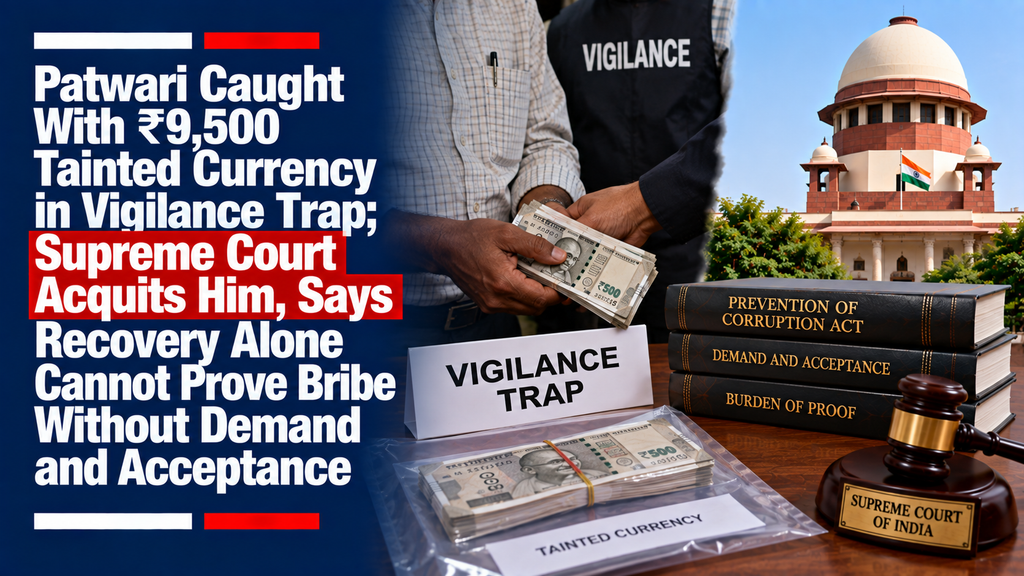
Patwari Caught With ₹9,500 Tainted Currency in Vigilance Trap; Supreme Court Acquits Him, Says Recovery Alone Cannot Prove Bribe Without Demand and Acceptance

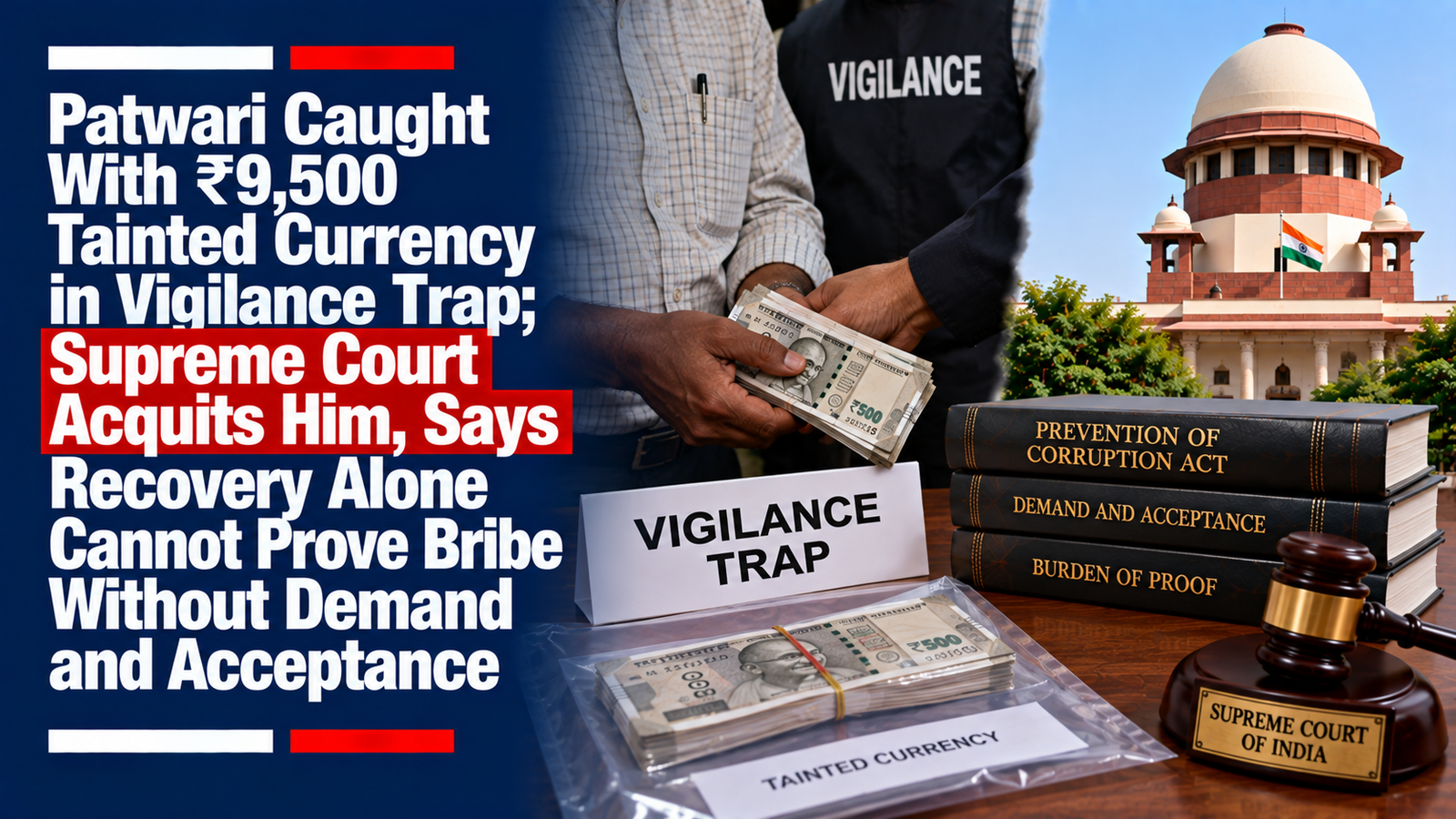
Vigilance Trap Recovers 19 Tainted ₹500 Notes From Patwari; Supreme Court Finds No Witness Saw Demand or Acceptance, Sets Aside Conviction
Facts
The appeal concerned Jaswinder Singh, who was serving as a Patwari when he was prosecuted under Section 7 read with Section 13(2) of the Prevention of Corruption Act, 1988. The Special Judge, Hoshiarpur convicted him in 2004 and sentenced him to two years’ rigorous imprisonment with a fine of ₹10,000. The Punjab and Haryana High Court affirmed that conviction in 2013.
During the pendency of the appeal before the Supreme Court, Jaswinder Singh died, following which his legal representatives were permitted to continue the appeal.
The prosecution alleged that Kulwant Singh approached Jaswinder Singh for mutation of his deceased brother’s property in favour of the legal heirs. Jaswinder allegedly demanded ₹10,000 as bribe, which was subsequently negotiated to ₹9,500.
Kulwant Singh approached the Vigilance Bureau. A trap was organised on 19 April 2002. Nineteen ₹500 notes were treated with phenolphthalein powder and given to the complainant with instructions to hand them over upon demand. Onkar Singh was appointed as the shadow witness.
According to the prosecution, the complainant handed ₹9,500 to Jaswinder, who kept the money in his pocket. The raiding party entered thereafter, recovered the notes and conducted the hand-wash test, which turned pink.
Issues
The principal question was whether recovery of tainted currency and a positive phenolphthalein test were sufficient to sustain a corruption conviction when the prosecution evidence did not reliably establish demand and acceptance of the bribe.
The Court also examined whether contradictions between the complainant, shadow witness and official trap witness created reasonable doubt about the prosecution’s version.
Appellant’s Arguments
The appellant challenged the conviction principally on the ground that the essential ingredients of the offences under Sections 7 and 13 of the Prevention of Corruption Act had not been established.
The prosecution was required to prove the alleged demand and acceptance of illegal gratification, rather than merely showing that tainted currency was recovered.
The defence relied upon the contradictions in the trap evidence, particularly because the shadow witness was not present when the alleged money changed hands and the witnesses differed even on the pocket from which the money was allegedly recovered.
Respondent’s Case
The State relied upon the complainant’s evidence that the Patwari had demanded money for carrying out the mutation.
Kulwant Singh stated that the demand was initially ₹10,000 and was negotiated to ₹9,500. He further testified that during the trap he handed the tainted currency to the appellant upon demand.
The prosecution also relied upon recovery of the nineteen ₹500 notes and the positive phenolphthalein hand-wash test.
Analysis of the Law
The Supreme Court reiterated that in corruption prosecutions, mere recovery of tainted money is not by itself sufficient.
Relying on P. Satyanarayana Murthy v. State of Andhra Pradesh, the Court reiterated that proof of demand of illegal gratification is central to the offence. Mere acceptance or recovery, without proof of the necessary demand, cannot by itself establish guilt under Sections 7 and 13(1)(d).
The Court then examined the Constitution Bench judgment in Neeraj Dutta v. State (Government of NCT of Delhi).
Neeraj Dutta recognised that demand and acceptance may be established through direct evidence or circumstantial evidence. Thus, absence of direct testimony from a complainant is not necessarily fatal.
But the foundational facts establishing the relevant offer/demand and acceptance must still be proved.
Precedent Analysis
P. Satyanarayana Murthy
The Court reiterated that proof of demand is the gravamen of the corruption offence and that recovery of currency cannot substitute for proof of demand.
Neeraj Dutta
The Constitution Bench had clarified that demand and acceptance may be proved circumstantially even where direct evidence is unavailable.
However, the prosecution must still establish those foundational facts before culpability can be inferred.
Aman Bhatia v. State
The Supreme Court also relied upon its 2025 decision in Aman Bhatia, which held that mere recovery of tainted money from a public servant does not establish corruption.
The prosecution must prove beyond reasonable doubt that the public servant voluntarily accepted the money knowing it to be a bribe.
Court’s Reasoning
1. Shadow Witness Did Not Witness the Payment
Onkar Singh, the shadow witness, admitted that although he initially accompanied the complainant into the Patwari’s office, he subsequently came outside.
He specifically stated that ₹9,500 was not handed over to the appellant in his presence.
This substantially weakened the prosecution’s independent corroboration of the alleged demand and acceptance.
2. Shadow Witness Did Not Witness Recovery Either
Onkar Singh further admitted that after the raiding party entered, he stood behind its members and could not properly see what proceedings were taking place.
Crucially, he stated that the alleged money was not recovered from Jaswinder Singh in his presence.
3. Contradiction Over the Pocket From Which Money Was Recovered
There was a material inconsistency regarding the recovery itself.
The complainant stated that Jaswinder kept the money in his trouser pocket.
However, Onkar Singh’s earlier police statement indicated that he had been told that the money was recovered from the appellant’s shirt pocket.
The official witness, Harnandan Singh, also stated that the DSP recovered the nineteen currency notes from the front pocket of the appellant’s shirt.
4. Official Witness Also Did Not See Payment
Harnandan Singh admitted in cross-examination that the complainant did not hand over the money to the appellant in his presence.
Thus, the witnesses supposedly providing independent corroboration had not actually witnessed the crucial transaction.
5. Neither Demand Nor Acceptance Was Proved
The Supreme Court regarded this as decisive.
Both the shadow witness and official witness testified that the money was neither paid nor recovered in their presence. The shadow witness specifically stated that no member of the raiding party had witnessed the alleged demand or acceptance.
The Court therefore concluded:
“neither the demand nor acceptance of the bribe can be said to have been proved.”
No witness saw Jaswinder make the demand at the relevant time, no independent witness saw the complainant hand him the money, and no independent evidence satisfactorily proved his acceptance of the alleged bribe.
The case was consequently covered by the principles laid down in Satyanarayana Murthy, Neeraj Dutta and Aman Bhatia.
Conclusion
The Supreme Court held that Jaswinder Singh’s conviction could not be sustained merely because tainted currency was allegedly recovered and the phenolphthalein test was positive.
The prosecution failed to satisfactorily prove the essential facts of demand and acceptance of illegal gratification.
Accordingly, the Supreme Court set aside both the Special Judge’s conviction dated 25 February 2004 and the Punjab and Haryana High Court judgment dated 28 November 2013.
Jaswinder Singh was cleared of the charges under Sections 7 and 13(2) of the Prevention of Corruption Act, and the appeal was allowed.
Case Details
Case: Jaswinder Singh (Dead Through Legal Representatives) v. State of Punjab
Court: Supreme Court of India
Case No.: Criminal Appeal No. 2137 of 2014
Citation: 2026 INSC 1031
Bench: Justice Ujjal Bhuyan & Justice Arun Palli
Judgment by: Justice Ujjal Bhuyan
Date: 22 September 2026
Result: Appeal allowed; conviction and sentence set aside; accused cleared of corruption charges.