Son Claims Exclusive Ownership After Father Dies in 1949; Supreme Court Says Widow’s Limited Property Right Became Absolute Without Any Partition

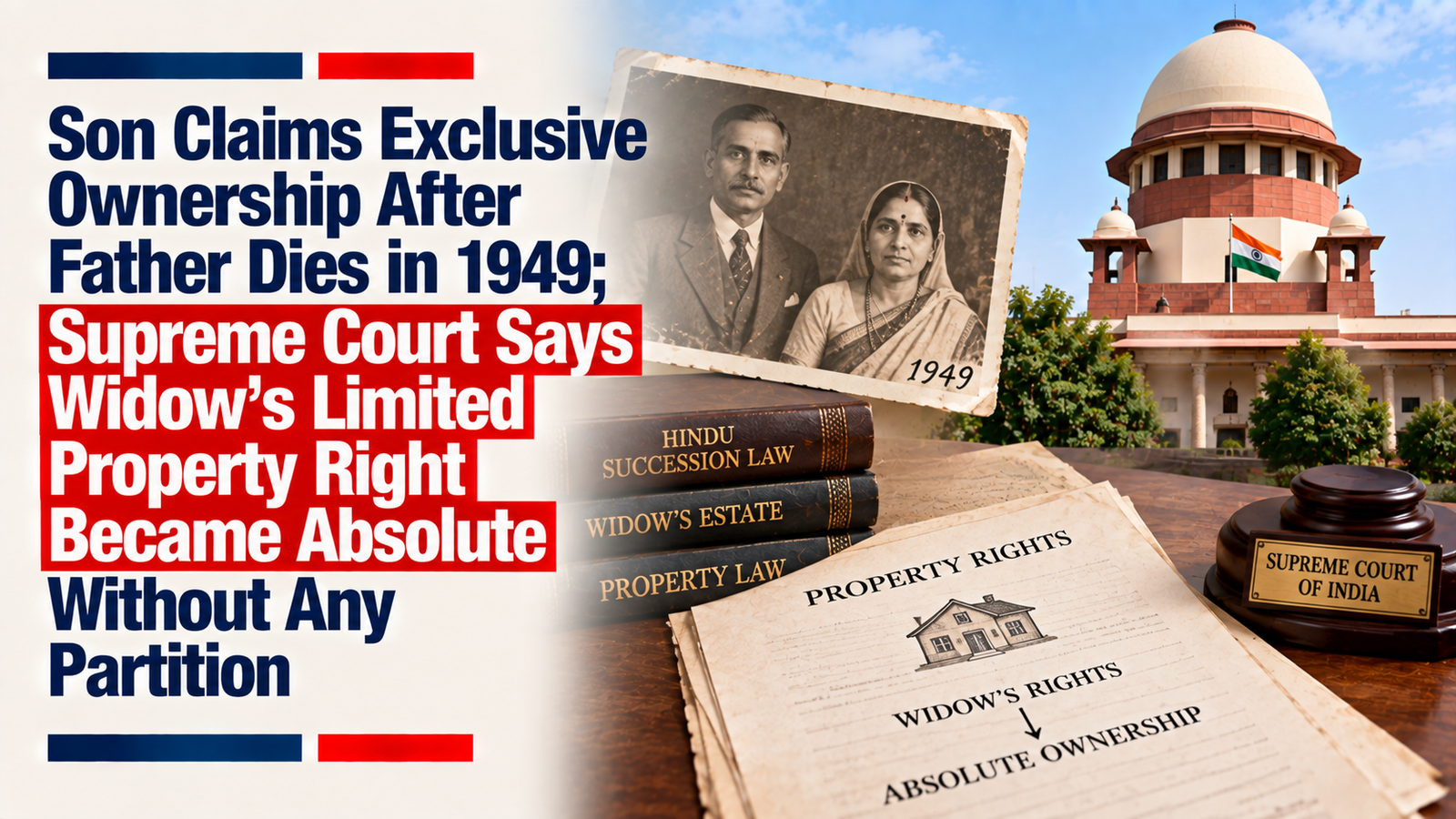
No Oral Partition Proved Between Widow and Son; Supreme Court Says That Does Not Defeat Widow’s Statutory Property Rights
Facts
The dispute concerned two house properties bearing TMC Nos. 1074 and 1075 at Terdal Village, Jamkhandi Taluka, Bagalkot District, Karnataka.
The family structure, also depicted in the genealogical chart on page 2 of the judgment, was that Gangaram had a son, Ganapati, through his first wife. His second wife, Kashibai, had two daughters, Shakuntala and Kamalavva.
Gangaram died in 1949.
Ganapati claimed that because his father died before the Hindu Succession Act, 1956, he exclusively succeeded to Gangaram’s estate under the then-prevailing Hindu law and became absolute owner of the properties.
After Kashibai died in 1986, Shakuntala secured mutation of the properties in her name based upon a registered Will dated 13 October 1984 executed by Kashibai.
Ganapati challenged this, contending that Kashibai never acquired title capable of being bequeathed.
While the suit was pending, Shakuntala executed a registered sale deed dated 3 August 1995, transferring TMC No. 1074 to a third-party purchaser, who was consequently impleaded.
Issues
The principal question before the Supreme Court was:
Whether Kashibai’s limited interest in her husband’s property under Section 3 of the Hindu Women’s Rights to Property Act, 1937 became absolute ownership under Section 14(1) of the Hindu Succession Act, 1956 even though no partition between Kashibai and Ganapati had been proved.
The consequential question was whether Kashibai could validly execute the Will in favour of her daughter, enabling the daughter subsequently to transfer the property.
Appellants’ Arguments
Ganapati’s legal representatives argued that the defendants’ entire case rested on an alleged oral partition between Ganapati and Kashibai, but both the Trial Court and First Appellate Court had concurrently found that no such partition was proved.
There was no evidence showing when the alleged partition occurred, whether it was oral or written, or in whose presence it had taken place.
According to the appellants, Kashibai therefore never enjoyed the suit property in her independent right between Gangaram’s death in 1949 and the commencement of the Hindu Succession Act in 1956.
Consequently, her limited right could not have enlarged into absolute ownership under Section 14(1).
They argued that the Karnataka High Court had wrongly transformed an unpartitioned limited interest into absolute ownership.
Respondents’ Arguments
The respondents argued that Gangaram’s death in 1949 attracted Section 3 of the Hindu Women’s Rights to Property Act, 1937.
Kashibai stepped into the shoes of her deceased husband and acquired an interest in his property. That right existed independently of whether a physical partition subsequently took place.
Once the Hindu Succession Act, 1956 came into force, Section 14(1) enlarged her existing limited interest into absolute ownership.
The respondents therefore argued that partition was not a condition precedent for this statutory enlargement.
Analysis of the Law
The Supreme Court examined the interplay between:
Section 3(2) of the Hindu Women’s Rights to Property Act, 1937, which conferred upon a Hindu widow the same interest in the joint family property as her deceased husband, although subject to the limited nature of a Hindu woman’s estate under Section 3(3); and
Section 14(1) of the Hindu Succession Act, 1956, which transformed property possessed by a Hindu female into property held by her as its full owner rather than merely as a limited owner.
The Court rejected the proposition that Kashibai first needed an actual partition before Section 14(1) could operate.
It held that even if the defendants failed to prove the alleged oral partition, the statutory consequence flowing from the 1937 Act read with Section 14(1) remained unaffected.
Precedent Analysis
V. Tulasamma v. Sesha Reddy
The Supreme Court reiterated that a Hindu woman’s pre-existing right must receive a liberal interpretation under Section 14(1).
A woman’s limited interest becomes absolute where her possession is supported by a pre-existing right or some vestige of title.
Importantly, “possessed by” does not mean only actual physical possession. It extends to legal and constructive possession where the woman possesses an underlying right or title.
Raghubar Singh v. Gulab Singh
The Court reiterated that a Hindu widow’s right to maintenance is a pre-existing right rooted in Shastric Hindu law rather than merely a right created for the first time by legislation.
Where a document, decree or arrangement merely recognises such a pre-existing right, Section 14(1) operates to enlarge the limited interest into absolute ownership.
Potti Lakshmi Perumallu v. Potti Krishnavenamma
The judgment also considered the principle that the precise quantum of a widow’s interest is determined with reference to the point when partition is actually sought, rather than simply the date of her husband’s death.
Court’s Reasoning
1. Failure to Prove Oral Partition Was Not Decisive
The Trial Court and First Appellate Court had focused substantially upon the defendants’ inability to prove the alleged oral partition.
The Supreme Court held that this did not resolve the real statutory question.
Even assuming that no partition ever occurred, Kashibai’s statutory right under the 1937 Act continued to exist.
2. Kashibai Acquired Her Husband’s Interest in 1949
Section 3 of the 1937 Act operated upon Gangaram’s death.
Kashibai therefore acquired an interest in the property as his widow. Although this was initially a limited Hindu woman’s estate, it was nevertheless a legally recognised property interest.
The Court explained that property may devolve not only through survivorship or inheritance but also by operation of legislation.
3. Section 14(1) Converted the Limited Interest Into Absolute Ownership
When the Hindu Succession Act came into force, Section 14(1) enlarged Kashibai’s existing limited interest into an absolute right.
The Court described the consistent judicial approach as recognising a Hindu widow’s limited right as “blossoming into an absolute right”, except where the case falls within Section 14(2).
4. Partition Was Not a Sine Qua Non
This is the most significant proposition in the judgment.
The Supreme Court expressly held that:
partition between Ganapati and Kashibai was not a sine qua non for Kashibai to continue enjoying her interest as an independent or absolute owner.
Even where property remained undivided, the absence of partition could affect the precise or fluctuating share but could not result in denial of the widow’s underlying right altogether.
5. High Court Was Correct to Interfere in Second Appeal
The Karnataka High Court had reversed the Trial Court and First Appellate Court, holding that Kashibai’s statutory right had been wrongly ignored.
The Supreme Court found that this involved a genuine substantial question of law concerning the interaction between the 1937 Act and Section 14(1) of the 1956 Act.
Accordingly, the High Court’s exercise of jurisdiction under Section 100 CPC was proper.
Conclusion
The Supreme Court upheld the Karnataka High Court’s decision.
It held that Kashibai acquired a statutory interest in her husband’s property upon his death under the Hindu Women’s Rights to Property Act, 1937, and that her limited interest subsequently became absolute ownership under Section 14(1) of the Hindu Succession Act, 1956.
Crucially, an actual partition between the widow and the surviving coparcener was not necessary for that right to become absolute.
The appeal filed by Ganapati’s legal representatives was therefore dismissed, with no order as to costs.
Case Details
Case: Ganapati (Dead) by His Legal Representatives v. Prabhakar & Others
Court: Supreme Court of India
Case No.: Civil Appeal No. 660 of 2019
Citation: 2026 INSC 1033
Bench: Justice S.V.N. Bhatti & Justice N.V. Anjaria
Judgment by: Justice S.V.N. Bhatti
Date: 22 September 2026
Result: Appeal dismissed; Karnataka High Court judgment recognising Kashibai’s absolute property right upheld.