

HEADNOTE
The Oriental Insurance Company Limited v. Naveen & Ors.; Naveen v. Avinash Verma & Ors.
Court: High Court of Delhi
Bench: Justice Prateek Jalan
Date of Judgment: 12 December 2025
Citation: MAC.APP. 41/2021 and MAC.APP. 34/2022
Laws / Sections Involved: Sections 166, 168 Motor Vehicles Act, 1988; Sections 279 and 338 IPC
Keywords: Motor accident compensation, enhancement of compensation, functional disability, future prospects, minimum wages, negligence
Summary:
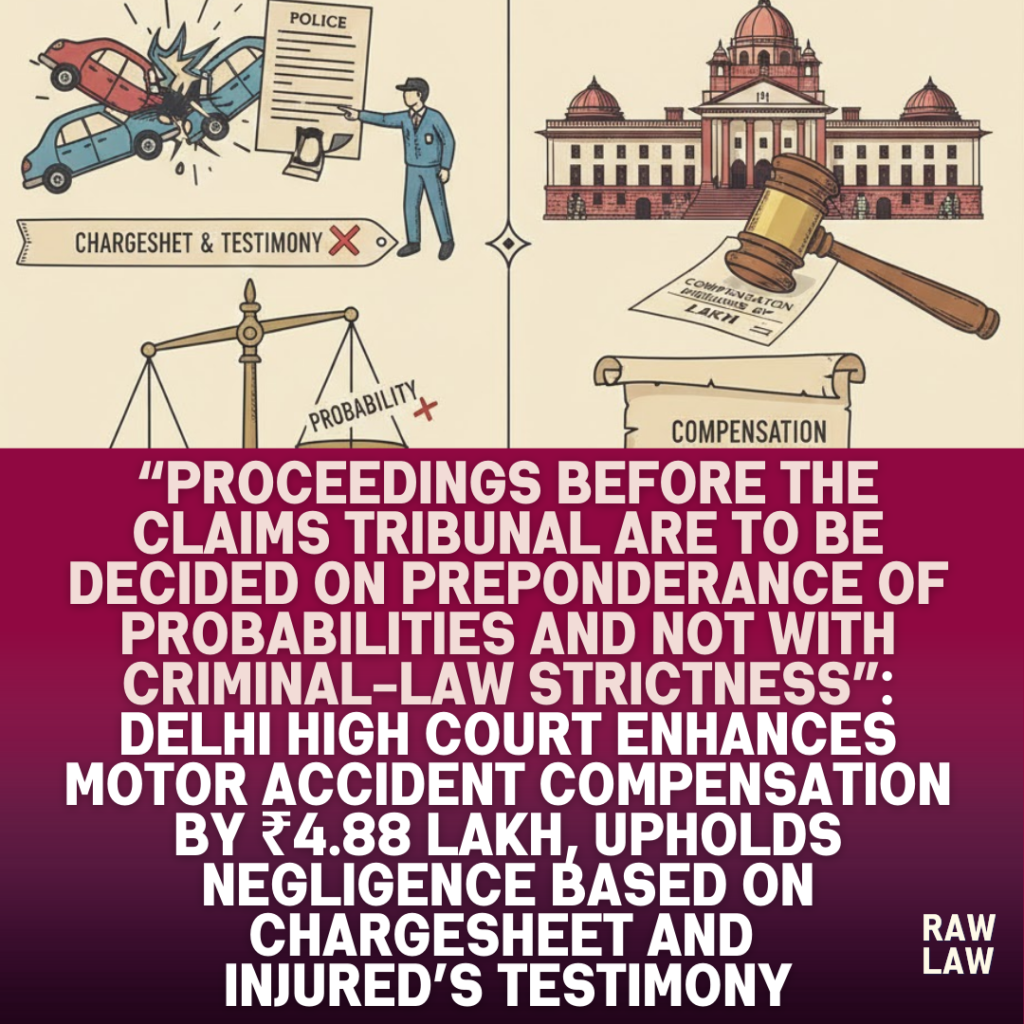
The Delhi High Court partly allowed cross-appeals arising from a MACT award of ₹4.47 lakh granted to an injured road accident victim, substantially enhancing compensation by ₹4.88 lakh. The Court upheld the Tribunal’s finding of negligence based on the claimant’s testimony and police chargesheet, reiterating that strict proof of eyewitness testimony is not required in motor accident claims. While rejecting the claimant’s assertion of a ₹24,000 monthly salary for lack of proof, the Court held that minimum wages applicable in Delhi—not Haryana—ought to be applied. It enhanced functional disability from 13% to 25%, granted future prospects in terms of Pranay Sethi, and increased non-pecuniary damages, reaffirming a victim-centric approach to “just compensation” under the Motor Vehicles Act.
Court’s decision
The Delhi High Court disposed of cross-appeals filed by the claimant and the insurer by substantially enhancing the compensation awarded by the Motor Accident Claims Tribunal. While the insurer’s challenge to the finding of negligence and alleged excessiveness of compensation was rejected, the claimant’s appeal seeking enhancement was partly allowed. The Court enhanced compensation by ₹4,88,587 over and above the Tribunal’s award of ₹4,47,844, directing the insurer to deposit the enhanced amount with interest at 9% per annum. The judgment reiterates that appellate courts must ensure “just compensation” by correcting errors in assessment of income, disability, and non-pecuniary damages.
Facts
The accident occurred on 12 March 2018 when the claimant, Naveen Kumar, then aged about 55 years, was waiting at a bus stop near Lajpat Nagar Flyover in Delhi. He was struck by a water tanker bearing registration number DL-1LP-4567, which was allegedly being driven rashly and negligently in reverse. The claimant sustained grievous injuries and was immediately taken to the Jai Prakash Narayan Apex Trauma Centre, AIIMS, New Delhi. He remained hospitalised for prolonged periods and continued medical treatment for several months. An FIR under Sections 279 and 338 IPC was registered against the driver, and a chargesheet was filed after investigation.
Issues
The High Court was called upon to determine multiple issues arising from the cross-appeals. First, whether the Tribunal was justified in holding the driver negligent in the absence of independent eyewitness testimony. Second, whether the Tribunal erred in computing the claimant’s income on the basis of minimum wages of an unskilled worker in Haryana instead of Delhi. Third, whether the assessment of functional disability at 13% was legally sustainable. Fourth, whether the Tribunal erred in not granting future prospects and in awarding inadequate compensation under non-pecuniary heads such as pain and suffering, loss of amenities, and gratuitous services.
Petitioner’s arguments (Insurance Company)
The insurer contended that the Tribunal had erred in returning a finding of negligence solely on the basis of the claimant’s testimony, without examination of any independent eyewitness. It was argued that the Tribunal failed to give detailed reasons and mechanically relied on the chargesheet. The insurer further submitted that the compensation awarded under non-pecuniary heads was excessive and disproportionate to the injuries proved on record. According to the insurer, the Tribunal’s award did not warrant any enhancement and, in fact, required reduction.
Petitioner’s arguments (Claimant)
The claimant sought enhancement of compensation on several grounds. He argued that the Tribunal erred in rejecting his claim of earning ₹24,000 per month as an Office Assistant in a private company and, in any case, wrongly applied minimum wages of Haryana instead of Delhi. He submitted that the Tribunal undervalued his functional disability by assessing it at only 13% despite a medical certificate certifying 26% permanent disability of the pelvis and lower limbs. The claimant further contended that the Tribunal failed to grant future prospects as mandated by Pranay Sethi and awarded wholly inadequate sums for pain and suffering, loss of amenities, conveyance, and attendant services.
Respondent’s arguments
The respondents, including the driver and owner of the offending vehicle, supported the Tribunal’s award and argued that the claimant had failed to prove his actual income through cogent documentary evidence such as salary slips, income tax returns, or employer testimony. It was contended that the Tribunal had already adopted a liberal approach by awarding compensation under multiple heads and that further enhancement would be unjustified. The respondents also supported the insurer’s argument that the finding of negligence was not backed by independent evidence.
Analysis of the law
The Court reiterated that proceedings before the Motor Accident Claims Tribunal are in the nature of an inquiry and are governed by the standard of preponderance of probabilities, not proof beyond reasonable doubt. It reaffirmed that strict rules of evidence applicable in criminal trials do not govern compensation proceedings. The Court relied on settled law that filing of an FIR and chargesheet against the driver, coupled with unshaken testimony of the injured claimant, is sufficient to establish negligence in motor accident claims unless rebutted by cogent contrary evidence.
Precedent analysis
On the issue of negligence, the Court relied on Supreme Court authority holding that absence of an independent eyewitness is not fatal where police investigation culminates in a chargesheet and the claimant’s testimony remains uncontroverted. On assessment of disability, the Court applied the principles laid down in Raj Kumar v. Ajay Kumar, emphasising that functional disability must be assessed with reference to the claimant’s avocation and the impact of injuries on earning capacity. For future prospects, the Court followed the Constitution Bench ruling in National Insurance Company Limited v. Pranay Sethi, which mandates addition of future prospects even for self-employed or non-permanent workers within the prescribed age brackets.
Court’s reasoning
Justice Prateek Jalan observed that neither the insurer nor the driver led any evidence to rebut the claimant’s version of the accident. The chargesheet filed by the police and the claimant’s consistent testimony were sufficient to establish negligence. On income, the Court agreed with the Tribunal that the claimant failed to prove his asserted salary of ₹24,000 per month. However, it found that the Tribunal committed an error in applying minimum wages of Haryana when the evidence clearly established that the claimant was employed in Delhi. The Court held that Delhi minimum wages of ₹13,584 per month ought to have been applied.
With respect to disability, the Court found the Tribunal’s assessment of functional disability at 13% to be inadequate. Given that both lower limbs and the pelvic region were affected, the Court enhanced functional disability to 25%, noting that such injuries would significantly impair even clerical or office-related work. The Court further held that failure to grant future prospects was contrary to binding precedent and accordingly added 10% towards future prospects, considering the claimant’s age bracket.
Conclusion
Applying the corrected parameters, the High Court recalculated compensation for loss of future income, loss of income during treatment, pain and suffering, loss of amenities, gratuitous services, and conveyance. The total enhancement amounted to ₹4,88,587. The insurer was directed to deposit the enhanced amount with interest at 9% per annum within eight weeks, and the remaining amount lying with the Tribunal was ordered to be released to the claimant forthwith. Both appeals were disposed of accordingly.
Implications
This judgment reinforces the pro-victim orientation of motor accident compensation law. It underscores that Tribunals and appellate courts must adopt a realistic and humane approach in assessing disability, income, and non-pecuniary damages. The ruling also reiterates that insurers cannot defeat claims by insisting on strict proof of negligence or income, while simultaneously clarifying that claimants must still meet the threshold of preponderance of probabilities. The decision will serve as guidance on proper application of minimum wages, functional disability, and future prospects in injury claims.
CASE LAW REFERENCES
• Raj Kumar v. Ajay Kumar – Functional disability must reflect impact on earning capacity
• National Insurance Co. Ltd. v. Pranay Sethi – Mandatory addition of future prospects
• Meera Bai v. ICICI Lombard General Insurance Co. Ltd. – Chargesheet sufficient to establish negligence in MACT cases
FAQs
Q1. Is an eyewitness mandatory to prove negligence in motor accident claims?
No. FIR and chargesheet, along with the claimant’s testimony, are sufficient under the standard of preponderance of probabilities.
Q2. Can minimum wages be applied if actual income is not proved?
Yes. Courts routinely apply minimum wages applicable at the place of employment when actual income is not established.
Q3. Are future prospects applicable in injury cases?
Yes. As per Pranay Sethi, future prospects must be added even for non-permanent workers, subject to age criteria.


