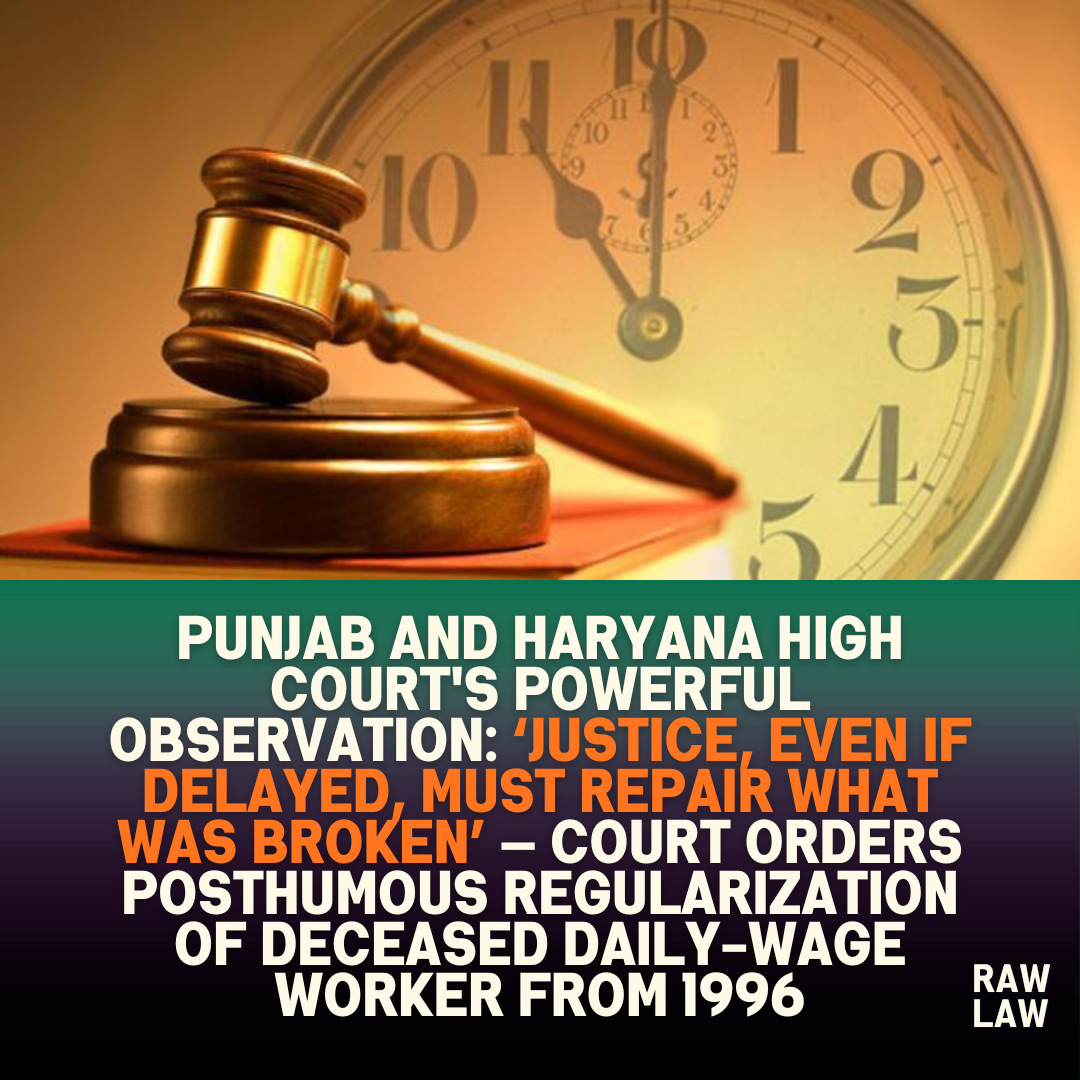
Punjab and Haryana High Court’s Powerful Observation: ‘Justice, Even if Delayed, Must Repair What Was Broken’ — Court Orders Posthumous Regularization of Deceased Daily-Wage Worker from 1996

Court’s Decision
In a landmark judgment, the Punjab and Haryana High Court at Chandigarh, presided over by Justice Sandeep Moudgil, held that the legal heirs of a deceased daily-wage employee are entitled to posthumous regularization if the employee had accrued a vested right to such benefit during his lifetime. The Court emphasized that “the right to regularization, when accrued, travels with the person and survives through their legal representatives.”
Setting aside the State’s rejection order dated 31 October 2012, the Court directed the Government of Haryana to regularize the deceased petitioner’s services from 1 January 1996 — the date when his juniors were regularized — and to release all consequential monetary benefits with 6% interest within three months.
Justice Moudgil profoundly observed:
“This case is a solemn reminder that the law, while clothed in the formalities of procedure, must never lose sight of its humane purpose.”
Facts
The petitioner had been engaged as a daily-wage Chokidar in 1978 with the Public Works Department (B&R), Haryana. Over the years, he served continuously across multiple divisions in Kurukshetra, Panipat, Kaithal, and Murthal. Despite decades of dedicated service, his employment remained temporary.
In 1994, his services were illegally terminated without notice, prompting him to raise an industrial dispute. The Labour Court, through its award dated 23 February 2001, held the termination to be illegal for violating Sections 25-F and 25-G of the Industrial Disputes Act, 1947, and ordered his reinstatement with continuity of service and full back wages from 7 December 1996.
The State challenged this award in the High Court (CWP 9996 of 2001), but the writ petition was dismissed in 2016 after the State admitted compliance — confirming that the petitioner had been reinstated and paid all dues.
Meanwhile, his juniors — Jagat Singh, Dharam Singh, Zile Singh, and Raju — were regularized under the 1996 regularization policy, leaving the petitioner without parity due to the pendency of litigation. When the department refused his claim for regularization, he filed the present writ petition in 2013, which remained pending even after his death in 2020. His widow and children were substituted as legal heirs.
Issues
- Whether the deceased daily-wage employee, whose termination had been set aside and who was reinstated with continuity, was entitled to regularization from the date his juniors were regularized.
- Whether the employee’s death extinguished his right to regularization, thereby barring his legal heirs from claiming consequential benefits.
Petitioner’s Arguments
Counsel for the petitioner argued that the employee’s right to regularization had crystallized in 1996, when juniors were regularized under the State policy. The delay in his case was solely due to illegal termination and protracted litigation, which could not be used against him.
Reliance was placed on Khajjan Singh v. State of Haryana (CWP 10017 of 2011), where the Court held that continuity in service must relate back to the original appointment, and benefits cannot be denied merely because of wrongful termination later set aside by judicial order.
It was further submitted that Umadevi (2006) did not override the statutory powers of labour courts or High Courts to grant relief against unfair labour practices, as clarified by Casteribe (2009). Thus, the petitioner’s long and continuous service made regularization a matter of right, not charity.
Respondent’s Arguments
The State contended that since the petitioner had died in 2020, his case for regularization could no longer be considered. It argued that regularization policies apply only to living employees, not their heirs.
However, the State’s counsel later fairly conceded that the case was covered by this Court’s earlier ruling in Shyam Lal (Deceased) through LRs v. State of Haryana (2025), where similar posthumous regularization was allowed.
Analysis of the Law
The Court delved into the interplay between the Industrial Disputes Act and the constitutional scheme of public employment, emphasizing that industrial adjudications granting continuity of service must be respected when considering regularization.
It held that Umadevi (2006) bars regularization only in cases of illegal appointments, not where continuity has been judicially affirmed. The Court reaffirmed that once reinstatement with continuity is ordered, the employee is to be treated as if he was never terminated. Therefore, denial of regularization on account of death would defeat the object of justice.
The judgment harmoniously applied Casteribe v. S.T. Corporation (2009) and Khajjan Singh v. State of Haryana (2011), clarifying that industrial rights remain unaffected by Umadevi and that unfair labour practices must be remedied with regularization when warranted.
Precedent Analysis
- Khajjan Singh v. State of Haryana (CWP 10017 of 2011) – Held that continuity in service after reinstatement relates back to the original appointment. Denial of benefits due to illegal termination constitutes discrimination.
- Casteribe v. S.T. Corporation (2009) 10 SCC 583 – Clarified that Umadevi does not curtail labour courts’ powers to order permanency in cases of unfair labour practice.
- State of Maharashtra v. R.S. Bhonde (2005) 6 SCC 751 and Aravali Golf Club v. Chander Hass (2008) 1 SCC 683) – Recognized limits of judicial interference in post creation but reaffirmed fairness in employment practices.
- Shyam Lal (Deceased) through LRs v. State of Haryana (2025) – The Court granted posthumous regularization to a similarly placed daily-wager, establishing that death does not extinguish vested service rights.
Court’s Reasoning
Justice Moudgil delivered a strongly worded judgment centered on equity, fairness, and the humane dimension of labour jurisprudence. He held that the petitioner had long crossed the threshold where “temporariness loses its meaning and regularization becomes a matter of right.”
Rejecting the State’s objection, the Court observed:
“The State, as a model employer, is bound to uphold not merely the letter of the contract but the spirit of fairness, equality, and compassion.”
The Court reasoned that the petitioner’s death did not extinguish his legal claim, as the right to regularization had already vested during his lifetime. His heirs, therefore, stood not merely as claimants to dues but as representatives of a moral wrong seeking redress.
Conclusion
The High Court allowed the writ petition, directing the State of Haryana to regularize the deceased petitioner’s services from 1 January 1996 — the date on which his juniors were regularized — and to release all consequential monetary benefits with 6% interest per annum within three months.
The Court’s closing observation encapsulated its humane approach:
“Justice, even if delayed, must be seen to repair what was broken not only in legality, but in principle.”
Implications
This decision reinforces judicial recognition of posthumous regularization as a continuing right where an employee’s service and reinstatement were undisputed. It underscores that the State cannot exploit technicalities or an employee’s death to evade its duty as a model employer.
The judgment also reiterates that Umadevi cannot override industrial adjudications ensuring fairness and parity, marking a progressive step in labour law where justice transcends procedural rigidity.