

HEADNOTE
Neelmani Electricals v. Commissioner of Delhi Goods and Services Tax & Ors.
Court: High Court of Delhi
Bench: Justice Prathiba M. Singh and Justice Shail Jain
Date of Judgment: 12 December 2025
Citation: W.P.(C) 16944/2025
Laws / Sections Involved: Articles 226 and 227 Constitution of India; Sections 73, 83, 107 and 168A CGST Act, 2017; GST DRC-22
Keywords: GST adjudication, ex parte order, natural justice, provisional attachment, Section 168A, remand to adjudicating authority
Summary:
The Delhi High Court set aside a GST adjudication order passed ex parte against Neelmani Electricals for the tax period April 2018 to March 2019, holding that the assessee had not been afforded a proper opportunity of hearing. While declining to rule on the constitutional validity of notifications extending limitation under Section 168A of the CGST Act—an issue pending before the Supreme Court—the Court remanded the matter to the adjudicating authority subject to conditions. These included payment of costs and partial maintenance of frozen bank balances, while lifting the provisional attachment. The Court emphasised adherence to principles of natural justice in tax adjudication and balanced revenue interests with taxpayer rights, keeping all substantive issues open pending final determination by higher courts.
Court’s decision
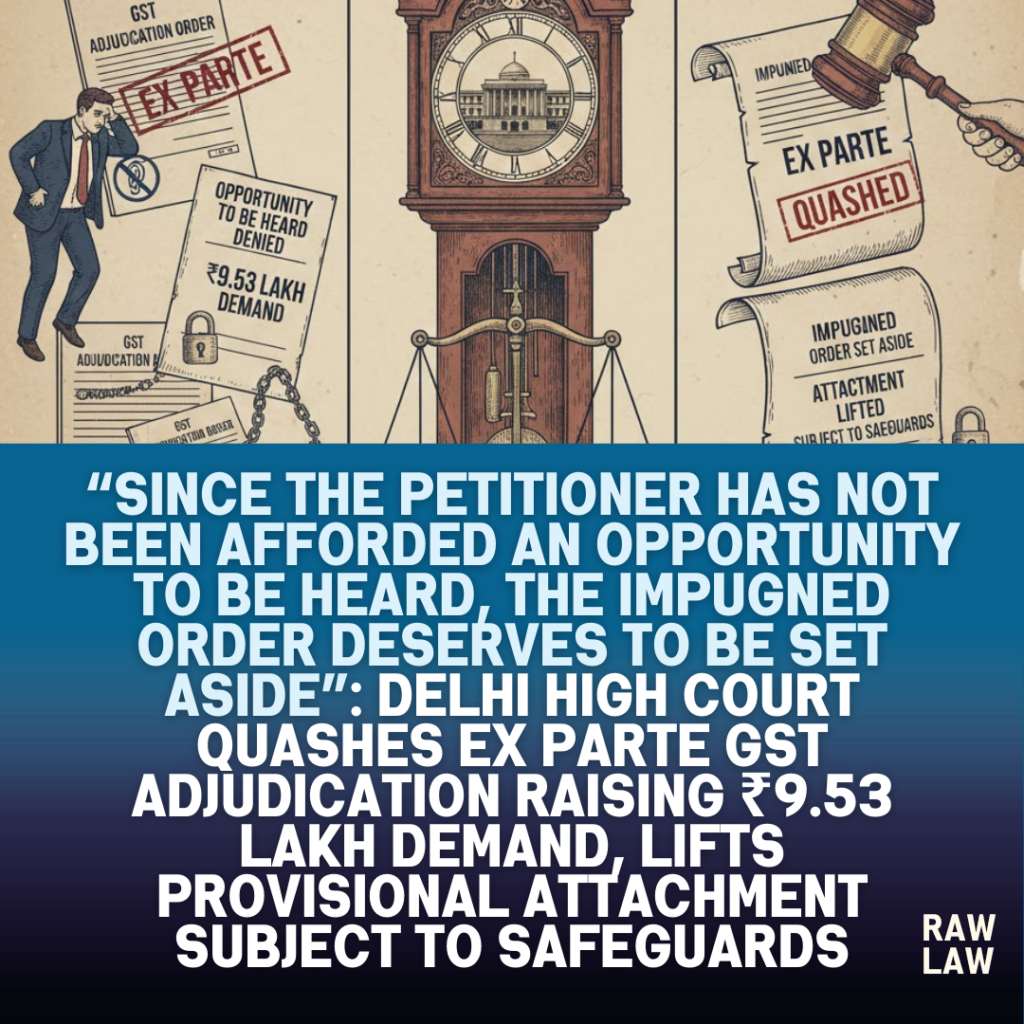
The Delhi High Court allowed the writ petition to the extent of setting aside the impugned GST adjudication order passed against Neelmani Electricals and remanded the matter to the adjudicating authority for fresh consideration. The Court held that the assessee had not been given a proper opportunity to file a reply to the show cause notice or to participate in personal hearing, thereby violating the principles of natural justice. While granting relief, the Court imposed conditions including payment of costs and partial safeguarding of revenue by maintaining a portion of the frozen bank balances. The Court expressly kept open the challenge to the validity of limitation-extension notifications under Section 168A of the CGST Act, making any fresh order subject to the outcome of pending proceedings before the Supreme Court.
Facts
Neelmani Electricals was issued a show cause notice dated 16 December 2023 for the tax period April 2018 to March 2019, alleging tax liability under the CGST regime. A reminder notice followed in February 2024. No reply was filed by the petitioner to the show cause notice, nor was any personal hearing attended. Consequently, an adjudication order dated 5 April 2024 was passed ex parte, raising a total demand of approximately ₹9.53 lakh, including tax, interest and penalty, as reflected in the tabular computation forming part of the order. Subsequently, on 9 September 2025, the department issued a provisional attachment order in Form GST DRC-22, freezing the petitioner’s bank accounts. It was only after this attachment that the petitioner approached the High Court challenging the show cause notice, adjudication order, attachment, and the validity of various notifications extending limitation under Section 168A of the CGST Act.
Issues
The principal issues before the High Court were whether the ex parte adjudication order could be sustained when the assessee had not been afforded an effective opportunity of hearing, and whether the provisional attachment of bank accounts was justified in such circumstances. Ancillary to these issues was the broader constitutional challenge to notifications issued under Section 168A of the CGST Act extending limitation periods for issuance of show cause notices and passing of adjudication orders. The Court was also required to consider whether it should rule on the vires of such notifications when the issue was already pending before the Supreme Court and other High Courts.
Petitioner’s arguments
The petitioner contended that the impugned show cause notice and adjudication order were never effectively brought to its notice, allegedly having been uploaded under an “Additional Notices” tab on the GST portal. It was argued that due to this, and alleged lapses by the Chartered Accountant handling the accounts, the petitioner was deprived of the opportunity to respond or seek a personal hearing. The petitioner further submitted that the adjudication order was non-speaking and passed mechanically, resulting in severe civil consequences including attachment of bank accounts. On merits, it was argued that the entire proceedings were vitiated due to expiry of limitation, as the notifications extending time under Section 168A were ultra vires the CGST Act.
Respondent’s arguments
The GST Department opposed the writ petition, submitting that the show cause notice and reminder were duly issued and available on the GST portal. It was argued that the petitioner failed to file any reply or attend personal hearings despite opportunities being granted. The Department contended that the provisional attachment was lawful and necessary to protect the interest of revenue, particularly in light of the confirmed demand raised by the adjudication order. On the question of limitation, the respondents submitted that the notifications extending time were validly issued and that the issue was pending consideration before the Supreme Court, warranting restraint by the High Court.
Analysis of the law
The Court analysed the statutory scheme governing GST adjudication, particularly Sections 73 and 168A of the CGST Act. It reiterated that while tax authorities are empowered to proceed ex parte in the absence of cooperation by the assessee, such power must be exercised consistently with principles of natural justice. The right to be heard, especially in proceedings resulting in substantial financial liabilities and coercive recovery measures, is a foundational requirement. The Court also noted that provisional attachment under Section 83, though preventive in nature, cannot be sustained where the underlying adjudication itself suffers from procedural infirmities. At the same time, the Court recognised the need to safeguard revenue interests pending fresh adjudication.
Precedent analysis
The Bench relied upon its earlier decision in Sugandha Enterprises v. Commissioner, Delhi GST, where under similar circumstances an ex parte GST order was set aside and the matter remanded for fresh adjudication. The Court emphasised that even where the assessee is at fault for not responding, the adjudicating authority must ensure that adequate opportunity is genuinely afforded and reflected in the record. The Court also referred to the batch of cases led by DJST Traders Pvt. Ltd. v. Union of India, dealing with challenges to Section 168A notifications, and noted the divergent views of various High Courts and the pendency of the issue before the Supreme Court in M/s HCC-SEW-MEIL-AAG JV v. Assistant Commissioner of State Tax.
Court’s reasoning
Justice Prathiba M. Singh, speaking for the Bench, held that irrespective of the petitioner’s delay or negligence, the adjudication order could not stand if it was passed without affording a meaningful opportunity of hearing. The Court found the petitioner’s explanation regarding lack of knowledge of the notices unconvincing, yet observed that the severity of consequences warranted a fresh opportunity. Balancing equities, the Court decided to remand the matter but imposed conditions to ensure seriousness on the part of the assessee and to protect revenue. These included payment of costs of ₹10,000 to the Delhi High Court Clerks Welfare Fund and maintenance of 25% of the balances in the attached bank accounts, while lifting the freeze on the remaining amounts.
Conclusion
The High Court set aside the impugned adjudication order dated 5 April 2024 and remanded the matter to the adjudicating authority for fresh consideration. The petitioner was granted time until 31 January 2026 to file a reply to the show cause notice, after which a personal hearing was directed to be granted and a reasoned order passed. The provisional attachment of bank accounts was lifted subject to compliance with conditions imposed by the Court. Importantly, the Court clarified that the validity of the impugned Section 168A notifications remained open and that any fresh order would be subject to the final outcome of pending proceedings before the Supreme Court and connected matters before the Delhi High Court.
Implications
This judgment reinforces the centrality of natural justice in GST adjudication, particularly in cases involving ex parte orders and coercive recovery measures like provisional attachment. While signalling that assessees cannot remain passive and later seek equitable relief, the Court has underscored that procedural fairness cannot be compromised even in revenue matters. The ruling also reflects judicial caution in refraining from deciding constitutional questions already pending before the Supreme Court, while ensuring that taxpayers are not irreversibly prejudiced in the interim. It offers a calibrated approach balancing revenue protection with fairness in tax administration.
CASE LAW REFERENCES
• Sugandha Enterprises v. Commissioner, Delhi GST – Ex parte GST order set aside for violation of natural justice
• DJST Traders Pvt. Ltd. v. Union of India – Lead case on challenge to Section 168A limitation-extension notifications
• M/s HCC-SEW-MEIL-AAG JV v. Assistant Commissioner of State Tax – Supreme Court seized of validity of Section 168A notifications
FAQs
Q1. Can a GST adjudication order be set aside if no reply was filed by the assessee?
Yes. Courts may set aside ex parte GST orders if principles of natural justice are violated, while imposing conditions to balance equities.
Q2. What happens to provisional attachment if the GST order is quashed?
The Court may lift or modify the attachment, often subject to safeguards to protect revenue interests.
Q3. Did the Court decide on the validity of Section 168A GST notifications?
No. The issue was kept open as it is pending before the Supreme Court.


