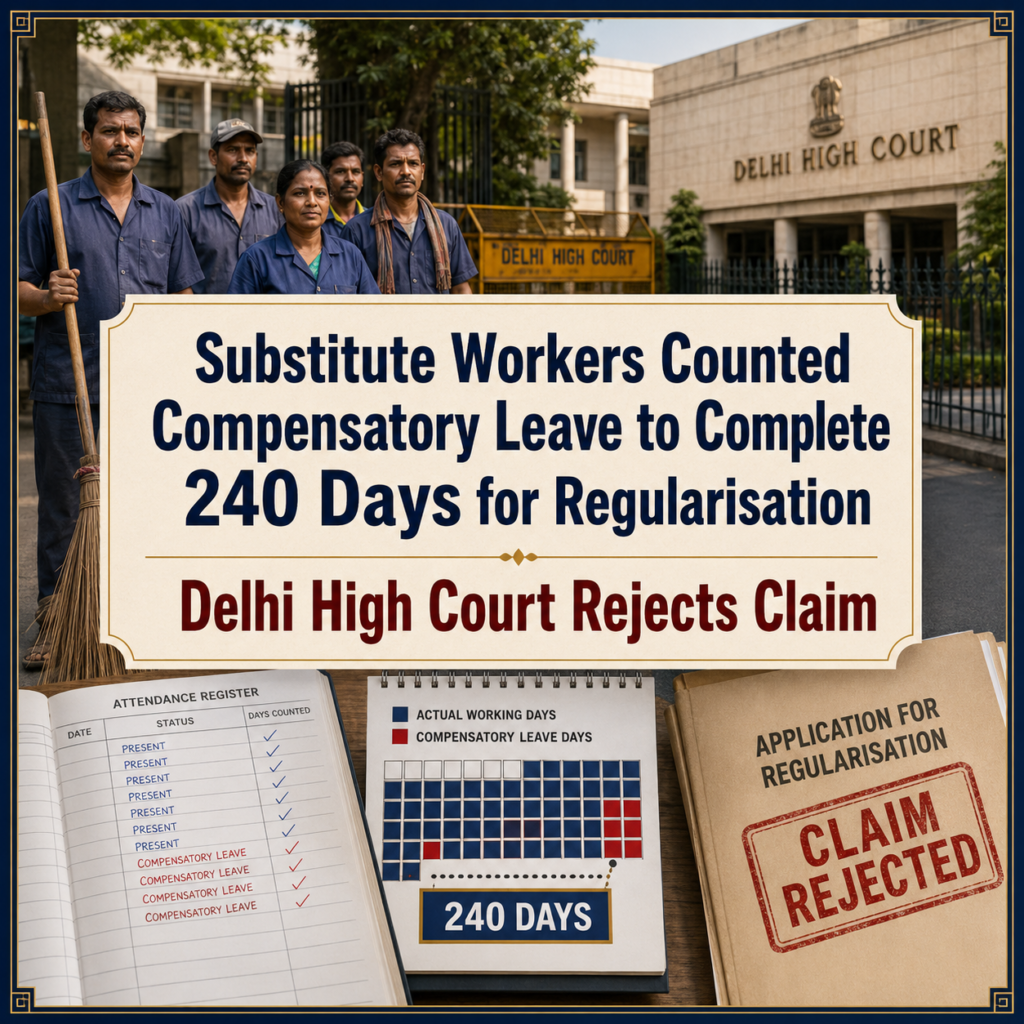
Substitute Workers Counted Compensatory Leave to Complete 240 Days for Regularisation; Delhi High Court Rejects Claim

Delhi Milk Scheme Workers Sought Permanent Jobs by Adding Weekly Offs and Compensatory Leave; Delhi High Court Dismisses Petition
Facts
Anil Kumar and the other petitioners were appointed as “Badli” workers by the Delhi Milk Scheme between 1 January and 31 December 1999.
A Badli worker is a substitute employee engaged to work in place of a regular employee who is temporarily absent.
The Delhi Milk Scheme is a factory under Section 2(m) of the Factories Act, 1948. The petitioners’ employment was governed by the Certified Standing Orders framed under the Industrial Employment (Standing Orders) Act, 1946.
Paragraph 4(iii) of the Standing Orders provided that a Badli worker who had “actually worked” for at least 240 days during any period of 12 months would be transferred to the regular establishment.
The petitioners claimed that they had completed more than 240 days when the following were included:
- Days on which they actually worked;
- Weekly holidays;
- Sundays or weekly off days on which they worked;
- National holidays; and
- Compensatory holidays granted because they worked on weekly off days.
Their argument was that when they worked on a Sunday or weekly holiday, both the day worked and the compensatory holiday subsequently granted in its place should be counted towards the 240-day requirement.
The Delhi Milk Scheme rejected this method of calculation.
The Central Administrative Tribunal agreed with the Delhi Milk Scheme. It held that where workers had already been paid wages for working on weekly off days, the compensatory holidays granted in lieu of those days could not also be counted as additional working days.
After excluding compensatory holidays, none of the petitioners completed 240 working days in a 12-month period.
The Tribunal consequently dismissed their applications for regularisation on 15 December 2016.
The workers challenged the Tribunal’s order before the Delhi High Court.
Issues
- Whether compensatory holidays granted to workers for working on Sundays or weekly off days could be counted towards the requirement of 240 days of actual work.
- Whether a worker could count both the weekly holiday on which work was performed and the compensatory holiday granted in its place.
- Whether Sections 52 and 53 of the Factories Act treated compensatory holidays as working days.
- Whether Rule 77 and Form No. 9 of the Delhi Factory Rules, 1950 governed the calculation of 240 days.
- What was the effect of the expression “actually worked” in the Certified Standing Orders.
- Whether exclusion of compensatory holidays amounted to denial of a statutory benefit.
- Whether the petitioners were entitled to regularisation as permanent employees of the Delhi Milk Scheme.
Petitioner’s Arguments
The petitioners argued that they had completed the required 240 days when weekly holidays, national holidays and compensatory holidays were correctly included.
Under Section 52 of the Factories Act, workers are entitled to a weekly holiday. If they are required to work on that day, Section 53 entitles them to an equivalent compensatory holiday.
According to the petitioners, the weekly off day on which they worked had to be counted because they physically performed work on that day.
The compensatory holiday granted in exchange should also be included because it was a statutory paid holiday provided under the Factories Act.
They relied upon Rule 77 of the Delhi Factory Rules and Form No. 9, which requires factories to maintain a register of weekly rest days lost and compensatory holidays granted.
They argued that the Central Administrative Tribunal failed to properly consider these statutory provisions.
The petitioners sought recomputation of their service and regularisation under the Certified Standing Orders.
Respondent’s Arguments
The Delhi Milk Scheme argued that Badli workers were temporary substitutes engaged only when regular employees were absent or on leave.
The petitioners could claim regularisation only if they strictly satisfied the requirement of 240 days of actual work.
When a worker performed work on a Sunday or weekly off day, that day could be counted as a day worked. However, the compensatory holiday subsequently granted was merely a replacement rest day and could not be counted as an additional working day.
The petitioners had also received wages for the work performed on weekly off days. Counting both the day worked and the replacement holiday would grant them a double benefit.
The respondent further stated that the system of engaging Badli workers was discontinued from 30 September 2000 because even regular staff had become surplus. There were no vacancies for the post of Mate.
It also argued that the petitioners were not appointed through a regular selection process and could not claim automatic regularisation merely because they had rendered temporary service.
Analysis of the Law
Section 52 of the Factories Act: Weekly Holidays
Section 52 ordinarily prevents an adult worker from being required or permitted to work on the first day of the week.
A worker may be required to work on that day only if a full-day holiday is provided immediately before or after it and the prescribed notice requirements are fulfilled.
The provision ensures that a factory worker receives weekly rest. It does not create two separately countable workdays when the weekly rest day is substituted.
Section 53: Compensatory Holidays
Section 53 applies where a worker loses a weekly holiday because the factory or workers are exempted from Section 52.
The worker must receive an equal number of compensatory holidays within the prescribed period.
The object is to restore the weekly rest that the worker lost. It does not declare that the compensatory holiday is a day on which the worker actually worked.
Rule 77 and Form No. 9
Rule 77 prescribes the manner in which compensatory holidays must be granted and recorded.
Form No. 9 contains separate columns for:
- Weekly rest days lost; and
- Dates on which compensatory holidays were granted.
This distinction supports the conclusion that the original working day and the replacement holiday are not two independent working days.
Rule 77 and Form No. 9 create an administrative mechanism to ensure that workers receive their compensatory rest. They do not prescribe how the 240-day requirement for regularisation must be calculated.
Meaning of “Actually Worked”
The Certified Standing Orders required a Badli worker to have “actually worked” for at least 240 days.
The word “actually” was decisive. It restricted the calculation to days legally countable as actual service and excluded a compensatory holiday on which no work was performed.
Weekly holidays and national holidays could be included under the applicable legal principles, but a compensatory holiday could not be added as a second benefit for the same Sunday or weekly off day.
Rule Against Double Counting
Where a worker worked on a Sunday:
- The Sunday could be counted as a working day;
- Wages were paid for that work; and
- A compensatory holiday was granted to replace the lost weekly rest.
Counting the compensatory holiday as another day worked would count the same employment event twice and artificially increase the total number of days.
Precedent Analysis
Union of India v. Shishpal
A Division Bench of the Delhi High Court directly considered the calculation of working days for similarly situated workers.
It held that workers who were paid for working on Sundays or weekly off days could not receive a double benefit by treating the replacement holiday as an additional working day.
While recomputing service, the employer must consider:
- Actual working days;
- Sundays;
- Weekly offs; and
- National holidays.
No additional day can be added for the compensatory holiday granted in place of a weekly rest day on which the worker performed work.
The Delhi High Court held that Shishpal directly governed the present case.
Secretary, State of Karnataka v. Uma Devi
The Delhi Milk Scheme relied upon the Constitution Bench decision to argue that temporary or casual workers do not acquire an automatic right to regularisation merely because they have continued in service.
Regularisation cannot ordinarily be granted where the original appointment was not made through the prescribed competitive selection process.
The Court noted this submission but decided the petition primarily on the narrower question of whether the workers had completed 240 days under the Standing Orders.
Court’s Reasoning
The Delhi High Court held that Sections 52 and 53 of the Factories Act serve different but connected purposes.
Section 52 grants weekly rest. Section 53 ensures that if a worker loses that rest by working on the weekly holiday, an equivalent holiday is provided later.
Neither provision states that the compensatory holiday must be counted as a day actually worked.
Rule 77 and Form No. 9 merely prescribe how lost holidays and replacement holidays must be recorded and administered. They contain no rule for calculating the 240 days required for regularisation.
The expression “actually worked” in Paragraph 4(iii) of the Standing Orders excluded compensatory holidays from the calculation.
The Court agreed with the Tribunal that a worker could not simultaneously count:
- The Sunday or weekly holiday on which work was performed; and
- The compensatory holiday granted in exchange.
Such counting would grant double benefit for the same lost weekly rest.
Once compensatory holidays were excluded, none of the petitioners had completed 240 days in any 12-month period.
The Tribunal’s decision was consistent with the earlier Division Bench ruling in Shishpal and disclosed no legal error.
Conclusion
The Delhi High Court dismissed the petition.
It held that compensatory holidays granted in place of Sundays or weekly off days on which the petitioners worked could not be counted as additional days of actual work.
The Court clarified that:
- Actual working days could be counted;
- Sundays, weekly offs and national holidays could be included where legally permissible;
- A Sunday on which work was performed could not be counted again through the compensatory holiday granted in its place; and
- Rule 77 and Form No. 9 did not alter the calculation of 240 days.
Since none of the petitioners completed 240 qualifying days after excluding compensatory holidays, they were not entitled to regularisation under the Certified Standing Orders.
Case Details
Case: Anil Kumar & Others v. Union of India & Another
Court: High Court of Delhi at New Delhi
Case Number: Writ Petition (Civil) No. 6102 of 2017
Judge: Justice C. Hari Shankar and Justice Vinod Kumar
Reserved On: 10 July 2026
Date: 17 July 2026
Result: Writ petition dismissed. The Central Administrative Tribunal’s order denying regularisation was upheld because compensatory holidays could not be counted as days actually worked for completing the 240-day requirement.