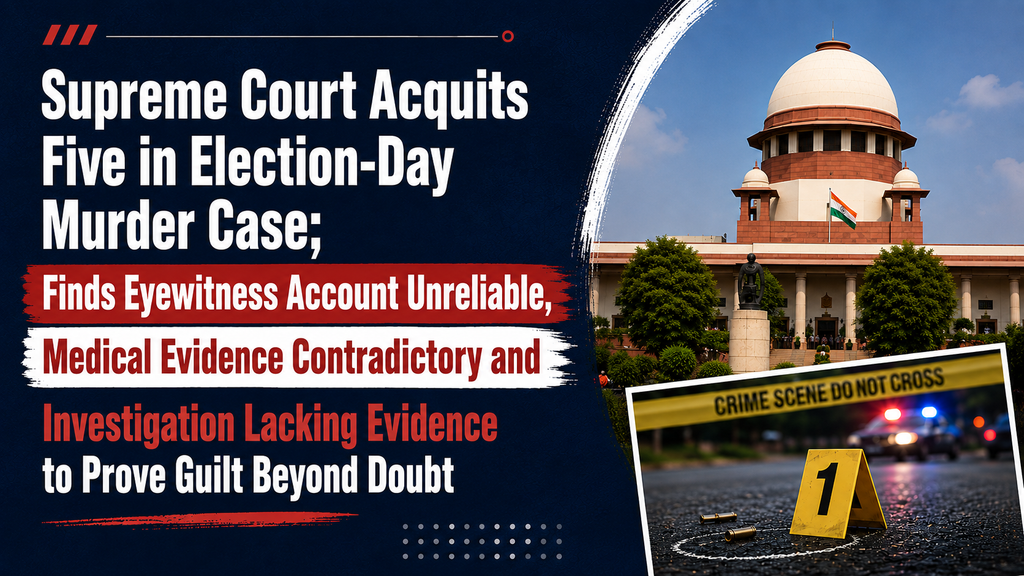
Supreme Court Acquits Five in Election-Day Murder Case; Finds Eyewitness Account Unreliable, Medical Evidence Contradictory and Investigation Lacking Evidence to Prove Guilt Beyond Doubt

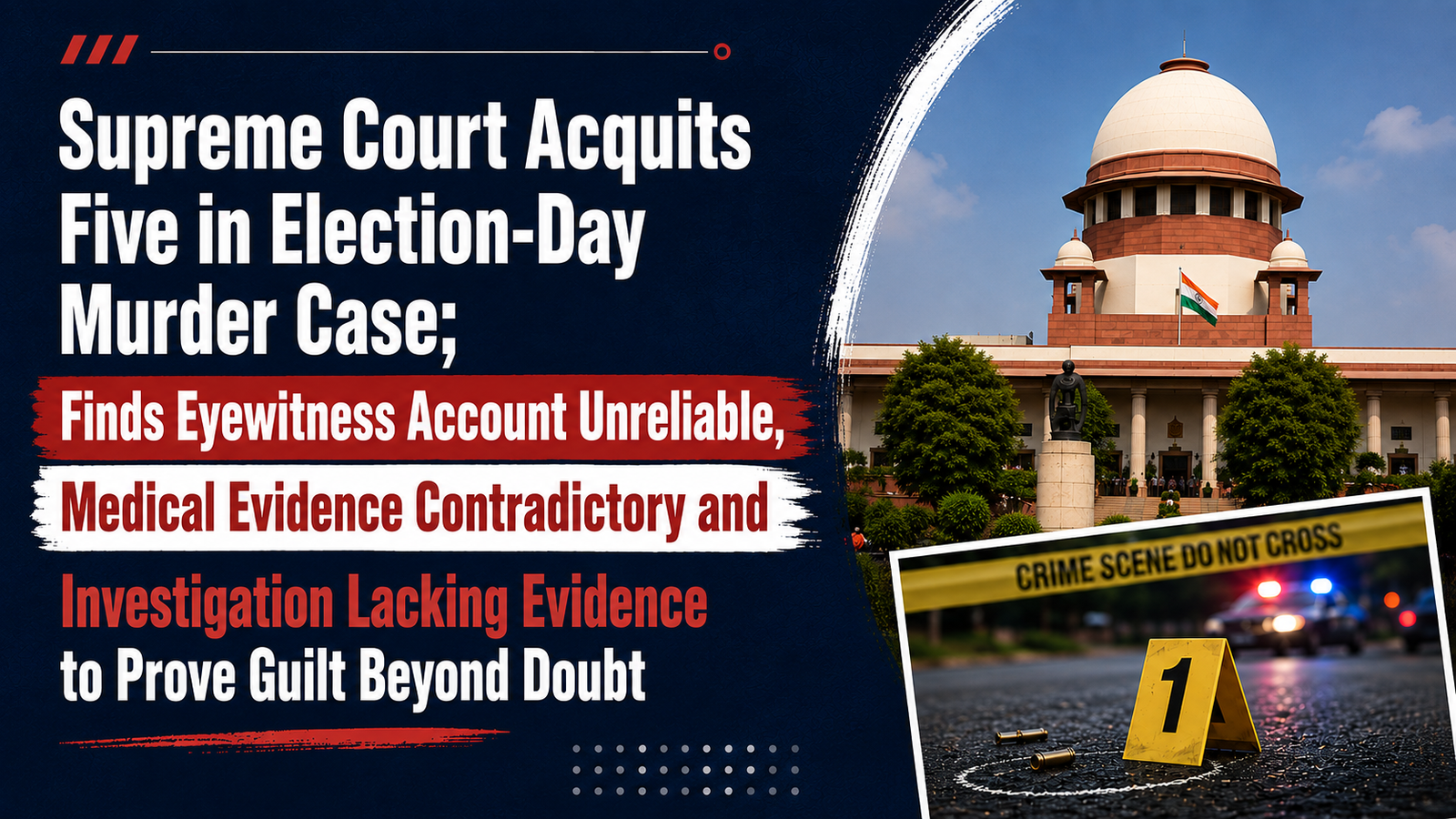
Supreme Court Overturns Murder Convictions in Daylight Shooting; Finds No Weapons or Cartridges Recovered and Eyewitness Testimony Failed to Inspire Confidence
Facts
The case arose from a broad-daylight murder stated to have occurred on an election day in Bihar. According to the prosecution, the deceased was proceeding towards his agricultural fields along with his son, an employee, a nephew/relative and another villager when the accused allegedly ambushed the group and opened indiscriminate fire. The deceased was shot in the back and subsequently declared dead at the hospital.
The prosecution examined nine witnesses. The accused were convicted under Sections 302 and 307 read with Section 149 IPC. Certain accused were additionally convicted under Sections 147/148 IPC and Section 27 of the Arms Act.
The principal eyewitnesses were PW1, an employee of the deceased; PW2, a relative; and PW7, the deceased’s son. Their accounts differed regarding who fired at the deceased and the precise sequence of events. The independent villager allegedly accompanying the deceased was not examined.
The investigation revealed significant deficiencies. Despite the allegation of indiscriminate firing, no cartridges were recovered from the scene, the fatal bullet was not recovered, and no attempt was made to recover the weapons allegedly used by the accused.
Further, although blood-stained earth was collected from the alleged scene, it was not sent for chemical examination. The Investigating Officer also admitted that the inquest had been conducted before the First Information Statement was obtained.
The medical evidence established that the deceased had suffered a gunshot wound, but indicated that he was likely sitting when shot from behind at a distance of approximately three to four feet. The Supreme Court found this medical evidence inconsistent with the eyewitness version of the occurrence.
Issues
The principal issues before the Supreme Court were:
- Whether the eyewitness testimony was sufficiently reliable to sustain the murder convictions despite inconsistencies and absence of independent corroboration.
- Whether the prosecution had proved the place and manner of occurrence beyond reasonable doubt.
- Whether the medical evidence contradicted the prosecution’s eyewitness account in a material manner.
- Whether the absence of cartridges, weapons, forensic examination and other physical evidence undermined the prosecution case.
- Whether deficiencies in investigation could be overlooked merely because allegations of collusion had been made against the Investigating Officer.
- Whether the prosecution had ultimately established the appellants’ guilt beyond reasonable doubt.
Petitioner’s/Appellants’ Arguments
The appellants essentially challenged the reliability of the prosecution’s eyewitness account and the quality of the investigation.
The defence relied upon discrepancies between the eyewitnesses concerning the identity of the shooter and the sequence of firing. It also questioned the presence and reliability of witnesses who were closely connected with the deceased.
The absence of cartridges despite allegations of indiscriminate firing, non-recovery of the weapons and fatal bullet, failure to scientifically examine blood-stained earth, non-seizure of blood-stained clothes and non-examination of independent witnesses were circumstances supporting the defence contention that the prosecution version had not been objectively corroborated.
The defence case was further strengthened by medical evidence indicating that the deceased was sitting when shot from behind at close range, which did not accord with the prosecution’s account of the deceased walking ahead of the group when the alleged ambush occurred.
Respondent’s Arguments
The State sought to sustain the convictions principally on the eyewitness testimony.
It argued that minor inconsistencies between eyewitnesses were natural in an incident involving a sudden ambush and indiscriminate firing, where witnesses would have been frightened and scattered.
Regarding the absence of cartridges, the State argued that the terrain made their recovery difficult because the victims had proceeded along an uneven ridge and the adjoining fields contained vegetation and partly harvested crops.
The prosecution also relied upon the alleged motive arising from local hostility connected with the kidnapping of a girl and political rivalry surrounding village elections. However, the Supreme Court found that these alleged motives were not satisfactorily established.
Analysis of the Law
The Supreme Court approached the matter through the fundamental criminal-law standard that guilt must be established beyond reasonable doubt.
The Court recognised that minor discrepancies in eyewitness accounts arising from a chaotic shooting incident would not, by themselves, justify rejecting the witnesses. The Court specifically observed that persons facing an ambush and indiscriminate firing cannot necessarily be expected to reproduce the incident in identical chronology or graphic detail.
The difficulty arose because the inconsistencies were accompanied by several other serious deficiencies: absence of physical evidence, doubtful presence of witnesses, lack of independent witnesses, questionable proof of motive and medical evidence inconsistent with the manner of occurrence alleged by the eyewitnesses.
The Court also drew an important distinction between a merely faulty investigation and a case where there is effectively no reliable investigation or evidence supporting the prosecution story. A deficient investigation does not automatically entitle an accused to acquittal; equally, allegations that the Investigating Officer was negligent or collusive cannot permit a court to presume guilt where reliable substantive evidence is absent.
Precedent Analysis
The judgment does not substantially turn upon or discuss any named prior Supreme Court precedent. Instead, the Court applied settled criminal-law principles directly to the evidentiary record.
The controlling principles applied were that the prosecution bears the burden of proving guilt beyond reasonable doubt; related witnesses are not automatically unreliable merely because of their relationship with the deceased; investigative lapses do not automatically benefit an accused where otherwise reliable evidence exists; and conviction cannot be sustained where the substantive evidence itself fails to inspire confidence.
The judgment is therefore significant primarily as a fact-and-evidence assessment, particularly concerning the interaction between unreliable eyewitness evidence, contradictory medical evidence and an investigation lacking objective corroboration.
Court’s Reasoning
The Supreme Court found several cumulative circumstances creating reasonable doubt.
First, although indiscriminate firing was alleged, no cartridges were recovered. Neither the fatal bullet nor the alleged weapons were recovered.
Second, blood-stained earth collected from the scene was never scientifically examined. Clothes of the deceased and witnesses who allegedly transported him were also not seized for forensic examination.
Third, the principal eyewitnesses were persons closely connected with the deceased, while the independent witness allegedly present during the incident was not examined. The Court considered the presence of the eyewitnesses itself doubtful in the circumstances.
Fourth, the alleged motive arising from kidnapping and political rivalry was not satisfactorily proved.
Fifth, and importantly, the medical evidence indicated that the deceased was likely sitting and was shot from behind from a distance of three to four feet. The Court considered this inconsistent with the eyewitness account concerning how the ambush and shooting occurred.
The Supreme Court criticised the High Court for relying upon a complaint alleging collusion by the Investigating Officer—when that complaint had not been produced during trial—to overcome deficiencies in the prosecution evidence. The Court held that allegations against an Investigating Officer cannot substitute proof of the accused’s culpability.
Ultimately, the Court concluded that the eyewitness testimony did not inspire confidence and that there was a complete lack of reliable evidence capable of proving guilt beyond reasonable doubt.
Conclusion
The Supreme Court allowed the criminal appeals and acquitted the appellants.
It directed that any appellant still in custody be released forthwith, unless required in another case. In respect of appellants already released on bail, their bail bonds were cancelled.
The judgment therefore establishes that serious investigative deficiencies assume decisive significance where the remaining eyewitness evidence is itself doubtful and contradicted by objective medical evidence. A court cannot compensate for the absence of reliable proof by presuming guilt merely because the investigation was allegedly negligent or collusive.
Case Details
Case: Dhrub Singh Etc. v. The State of Bihar
Court: Supreme Court of India, Criminal Appellate Jurisdiction
Case Number: Criminal Appeal Nos. 1434–1438 of 2017
Judge: Justice J.B. Pardiwala and Justice K. Vinod Chandran
Date: 1 September 2026
Result: Appeals allowed; appellants acquitted and those in custody directed to be released forthwith unless required in another case.