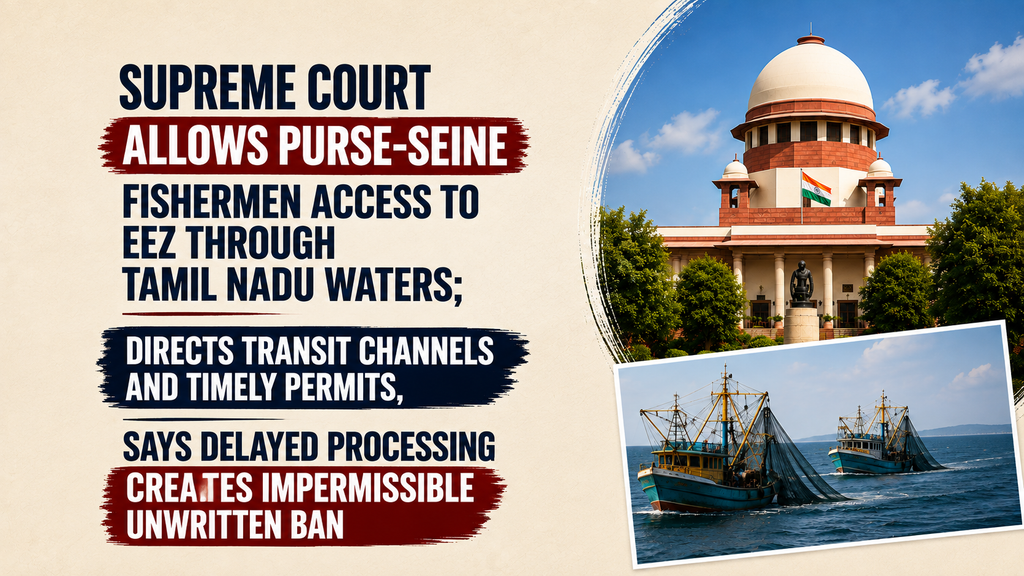
Supreme Court Allows Purse-Seine Fishermen Access to EEZ Through Tamil Nadu Waters; Directs Transit Channels and Timely Permits, Says Delayed Processing Creates Impermissible Unwritten Ban

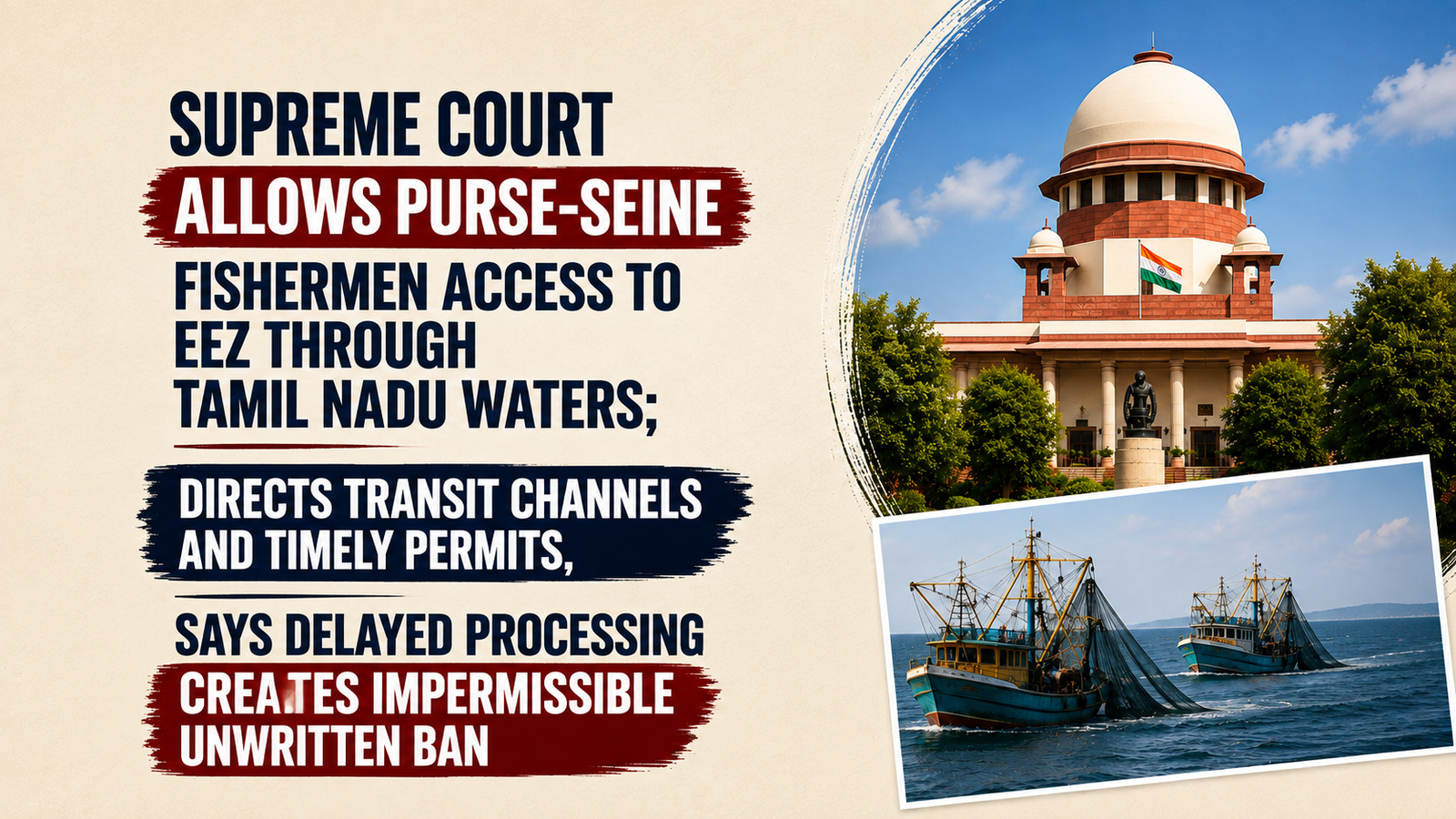
Supreme Court Says Tamil Nadu Cannot Effectively Ban Purse-Seine Fishing Beyond Territorial Waters by Delaying Access Pass Verification for Fishermen Seeking EEZ Access
Facts
The dispute concerned the right of fishermen using purse-seine nets to pass through Tamil Nadu’s territorial waters and undertake fishing in India’s Exclusive Economic Zone (EEZ) beyond the State’s territorial jurisdiction.
Tamil Nadu enacted the Tamil Nadu Marine Fishing Regulation Act, 1983, under which its regulatory jurisdiction extends to specified areas along the State’s coastline but not beyond territorial waters. Section 5 authorises regulation or prohibition of fishing activities within that area.
In March 2000, Tamil Nadu issued a Government Order completely prohibiting pair trawling and purse-seine fishing within its territorial waters as a measure to conserve fishery resources.
The prohibition was subsequently reinforced by Rule 17(7) of the Tamil Nadu Marine Fishing Regulation Rules, 2020.
The fishermen’s grievance was narrower: they did not claim an unrestricted right to purse-seine fishing within Tamil Nadu’s territorial waters. They wanted to carry purse-seine nets through those waters so that they could fish beyond 12 nautical miles in the EEZ, an area outside Tamil Nadu’s regulatory domain.
Tamil Nadu, however, contended that even carrying such nets violated the prohibition and expressed concern that fishermen might use them illegally within territorial waters while ostensibly travelling to the EEZ.
The Supreme Court had earlier constituted an Expert Committee to examine purse-seine fishing across maritime States and assess its impact upon fish populations and stakeholders.
The Expert Committee concluded that an outright ban on purse-seine fishing was not justified, though effective scientific regulation was necessary.
During pendency of proceedings, the Union Government ultimately notified the Sustainable Harnessing of Fisheries in the Exclusive Economic Zone Rules, 2025, creating a comprehensive regulatory framework for fishing in the EEZ.
Issues
The principal issues were:
Whether Tamil Nadu’s prohibition on purse-seine fishing within its territorial waters could effectively prevent fishermen from transiting through those waters to undertake lawful fishing in the EEZ.
Whether the Union Government and Tamil Nadu operated in competing or distinct constitutional spheres concerning fisheries.
Whether a regulatory mechanism now existed permitting purse-seine vessels to obtain access passes for fishing in the EEZ.
Whether Tamil Nadu’s prolonged failure to verify access-pass applications effectively created an unlawful or “unwritten ban” upon purse-seine fishing.
Petitioners’ Arguments
The fishermen contended that Tamil Nadu could legitimately regulate or prohibit purse-seine fishing within its territorial waters, but its jurisdiction ended there.
The State could not use its territorial-water regulations to prevent vessels from merely carrying purse-seine nets while passing through those waters to reach the EEZ.
Their fundamental grievance was therefore one of access, rather than a claim to fish using purse-seine nets within Tamil Nadu’s prohibited zone.
They sought permission to undertake purse-seine fishing beyond the State’s territorial waters, which had also formed the basis of their Article 32 proceedings before the Supreme Court.
Respondents’ Arguments
Tamil Nadu relied upon Rule 17(7) of the 2020 Rules and maintained that even carrying purse-seine nets on fishing vessels violated the prohibition.
The State expressed a practical enforcement concern: fishermen claiming to be travelling to the EEZ could deploy purse-seine nets within the first 12 nautical miles, making enforcement of the State’s prohibition difficult.
The Union Government, meanwhile, developed a separate regulatory framework governing fishing in the EEZ through the 2025 Rules.
Analysis of the Law
Two Separate Constitutional Regulatory Spheres
The most significant legal finding concerns the constitutional division of legislative power over fisheries.
The Supreme Court held that two distinct legal regimes operate in two separate regulatory provinces.
Fishing in the EEZ beyond territorial waters is governed by the Union’s EEZ Rules, 2025.
Fishing within Tamil Nadu’s territorial waters remains governed by the Tamil Nadu Marine Fishing Regulation Rules, 2020.
The Court expressly found no conflict between the two regimes.
Under Entry 57 of List I, legislative competence over fishing and fisheries beyond territorial waters lies with Parliament and the executive power of the Union.
Under Entry 21 of List II, regulation of fisheries within territorial waters belongs to the State Legislature and State executive.
The Court described these powers as “co-equal and autonomous” within their respective constitutional spheres.
Cooperative Federalism
Although the Union and State exercise separate powers, the Court held that practical implementation requires cooperative federalism.
Tamil Nadu controls the waters through which the fishermen must pass, while the Union regulates the EEZ in which they ultimately intend to fish.
The two administrations therefore have an obligation to coordinate so that stakeholders can efficiently obtain the necessary clearances and pursue their fundamental right under Article 19(1)(g), subject to reasonable regulatory restrictions.
Precedent Analysis
Union of India v. Mohit Minerals Pvt. Ltd., (2022) 10 SCC 700
The Court relied upon Mohit Minerals while discussing the constitutional relationship between the Union and States.
The judgment supports the proposition that Indian federalism recognises distinct constitutional spheres of authority rather than treating States as administratively subordinate to the Union.
State of Kerala v. Joseph Antony, (1994) 1 SCC 301
This authority was relied upon in the context of the constitutional and regulatory framework governing fisheries and the respective jurisdictional spheres of governments.
Kerala Swathanthra Malaya Thozhilali Federation v. Kerala Trawlnet Boat Operators’ Association, (1994) 5 SCC 28
The judgment was also cited in connection with the regulation of fishing activities and the State’s authority over fisheries within its constitutionally assigned territorial domain.
Expert Committee and the 2025 EEZ Rules
The Expert Committee’s recommendations significantly influenced the regulatory solution.
Its interim assessment found that purse-seine nets did not cause major environmental harm to fish stocks warranting a blanket prohibition, although their use required effective regulation.
The final report recommended, among other measures:
- special annual permits for innocent passage through State territorial waters;
- designated landing centres and harbours;
- Vessel Monitoring Systems;
- mandatory catch-reporting;
- a national permit system; and
- centralised registration and licensing for vessels fishing in the EEZ.
The Union thereafter framed the EEZ Rules, 2025.
Those Rules provide for an Access Pass for fishing vessels, document verification, physical inspection, Vessel Monitoring Systems, sustainable fisheries-management plans, catch reporting and measures against juvenile and illegal fishing.
Court’s Reasoning
A particularly significant aspect of the judgment was the Supreme Court’s examination of how the new regulatory regime was actually functioning.
As of 3 August 2026, there were 257 applications for Access Passes on the ReALCRaft Portal.
Of those, approximately 226 applications remained pending verification with Tamil Nadu, while only six Access Passes had been issued—stated to be the lowest number among all coastal States.
The Supreme Court found this situation disturbing and indicative of inadequate coordination between the Union’s Issuing Authority and Tamil Nadu’s Verifying Authority.
Most importantly, the Court held:
“Not processing the applications in time, virtually amounts to imposing an unwritten ban”
Such an indirect prohibition was impermissible in law.
Tamil Nadu was therefore directed to ensure effective, efficient and timely clearance of applications under the governing rules.
The Court thus balanced three interests: Tamil Nadu’s legitimate authority to prohibit purse-seine fishing within its territorial waters; the Union’s authority to regulate fishing in the EEZ; and fishermen’s right to access the EEZ through a workable, regulated transit mechanism.
Conclusion
The Supreme Court did not invalidate Tamil Nadu’s prohibition on purse-seine fishing within territorial waters.
Instead, it harmonised the State and Central regulatory regimes.
It directed that the parties’ rights and liabilities would henceforth be governed by the EEZ Rules, 2025 and Tamil Nadu Marine Fishing Regulation Rules, 2020.
Crucially, Tamil Nadu was directed to frame necessary rules or regulations designating a specified channel through its territorial waters for purse-seine fishing vessels travelling to the EEZ. The State could take the Expert Committee’s recommendations into account while framing that mechanism.
The application was accordingly disposed of.
Case Details
Case: Fisherman Care v. Government of India, Department of Animal Husbandry, Dairying and Fisheries & Ors. with Gnanasekar & Ors. v. Union of India & Ors.
Citation: 2026 INSC 937
Court: Supreme Court of India
Jurisdiction: Civil Appellate/Original Jurisdiction
Lead Case: Special Leave Petition (C) No. 8442 of 2021
Connected Matter: Writ Petition (C) No. 262 of 2022; judgment disposed of I.A. No. 190882/2024 and sufficiently encompassed the pending batch.
Bench: Justice Pamidighantam Sri Narasimha and Justice Alok Aradhe
Date: 2 September 2026
Result: Tamil Nadu directed to process EEZ Access Pass applications efficiently and timely and frame rules designating transit channels through its territorial waters for purse-seine vessels travelling to the EEZ. The Court held that delayed processing cannot operate as an impermissible unwritten ban.