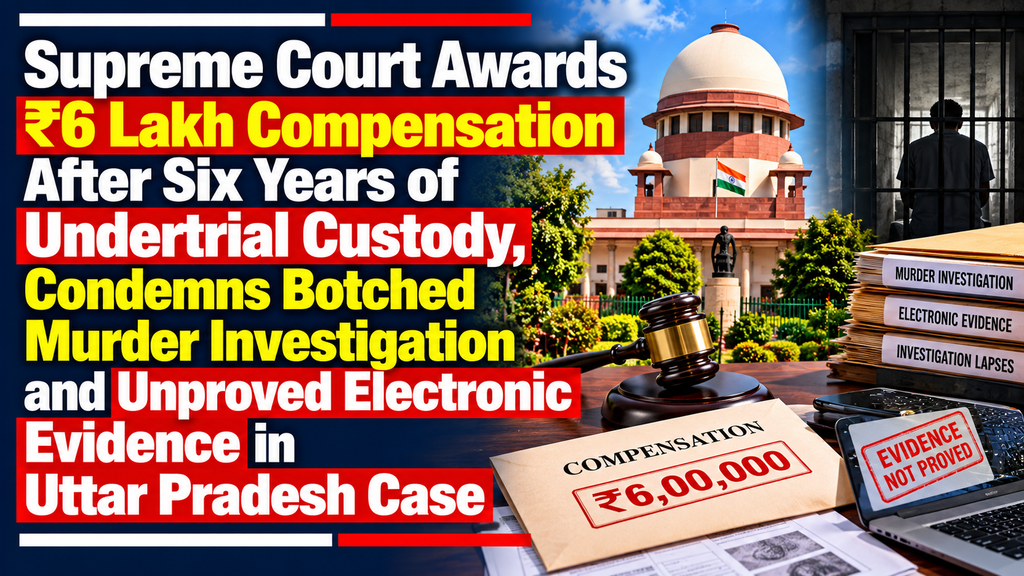
Supreme Court Awards ₹6 Lakh Compensation After Six Years of Undertrial Custody, Condemns Botched Murder Investigation and Unproved Electronic Evidence in Uttar Pradesh Case

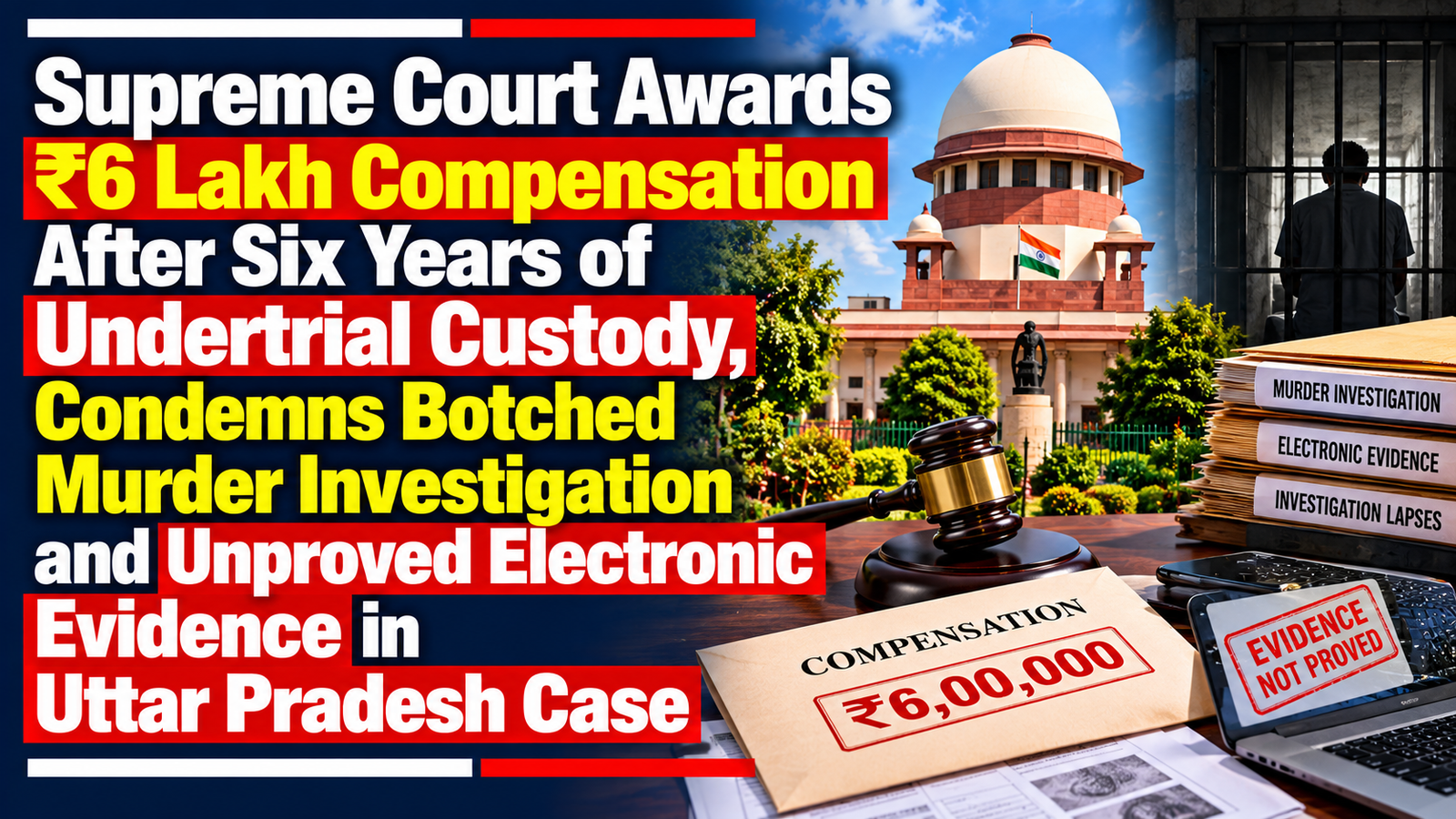
Supreme Court Orders Uttar Pradesh to Pay ₹6 Lakh to Acquitted Murder Accused, Condemns Six Years Behind Bars After Flawed Investigation and Unverified Electronic Evidence
Facts
Arun alias Deepak was arrested on 14 November 2019 in FIR No. 367/2019, Police Station Achhnera, Agra, concerning an alleged kidnapping and murder under Sections 364, 302 and 201 IPC. He was not named in the FIR or the initial Section 161 statement; police implicated him through unclear CCTV footage, a co-accused’s alleged confession and supposed joint recoveries. Having remained an undertrial for over six years, he sought bail before the Supreme Court. On 23 March 2026, the Court directed completion of trial within three months. The Trial Court thereafter acquitted him. The Supreme Court obtained and examined the translated trial judgment to assess the conduct of the investigation and prosecution.
Issues
Whether the circumstances relied upon by the prosecution were supported by legally proved evidence; whether the investigation and prolonged undertrial incarceration warranted judicial censure and reparation after acquittal; and what consequential directions should issue in the pending special leave petition, which had originally sought bail.
Petitioner’s Arguments
The petitioner approached the Supreme Court for bail after more than six years in custody in a wholly circumstantial case. As recorded by the Court, he had not been named in the first police accounts; the recovered charred bones were never identified as those of the missing person; the medical evidence did not establish the cause of death; and the purported incriminating electronic material and recoveries lacked proof. The judgment does not separately reproduce detailed oral submissions on compensation.
Respondent’s Arguments
The State’s prosecution theory was that the missing man had been abducted for ransom, drugged and suffocated, and that his body was burned using petrol. It relied on an alleged ₹50 lakh ransom demand, police confessions, CCTV identification, call-detail records and seizures of bones and belongings. The Supreme Court recorded these as the prosecution’s case, not as facts proved at trial; the judgment does not separately set out a detailed counterargument to the eventual compensation direction.
Analysis of the Law
Circumstantial allegations must be proved through a coherent chain of admissible, reliable evidence. The Court noted the absence of certificates under Section 65B of the Evidence Act for CCTV footage and call-detail records. The alleged recoveries lacked evidence of a preceding disclosure or concealment statement satisfying Section 27; police confessions were inadmissible as proof of guilt. DNA identification, forensic evidence of cause of death, verification of mobile subscribers and proof of the alleged petrol purchase were missing. Presumption of innocence and personal liberty informed the Court’s condemnation of an investigation resulting in years of unjustified undertrial detention.
Precedent Analysis
The judgment does not cite or examine any reported judicial precedent. Instead, it scrutinises the record by reference to familiar evidentiary safeguards under Sections 27 and 65B of the Evidence Act and the foundational principle that an accused remains innocent until proved guilty. It does not pronounce a new rule of admissibility or revisit the Trial Court’s acquittal; the core contribution is the pointed institutional criticism and the compensatory order following the failed prosecution.
Court’s Reasoning
Only six witnesses were examined. The purported ransom demand was first narrated in court and never reported to police; it was not an extra-judicial confession. CCTV identification was unreliable, and neither CCTV nor CDR material had the necessary Section 65B certification. The charred bones were not linked by DNA to the missing man; the alleged scene of burning, purchase of 55 litres of petrol and other forensic details were unverified. Belongings were reportedly found at a co-accused’s house, not the petitioner’s. Even the recovered motorcycle was not proved at trial. All four circumstances advanced by the prosecution failed. The Court called the investigation slipshod, stressed the State’s duty to protect the accused as well as victims, and found reparation necessary for six lost years.
Conclusion
By judgment dated 26 October 2026, the Supreme Court recorded the petitioner’s acquittal by the Trial Court and disposed of SLP (Crl.) No. 4859/2026. It directed the State of Uttar Pradesh to pay ₹6,00,000 to Arun alias Deepak within one month; failing payment within that period, the sum would carry interest at 18% per annum. A copy of the judgment was directed to the Director General of Police and Home Secretary, Uttar Pradesh, to prompt improvement in investigative practice. The Court did not grant bail after acquittal or itself pronounce the acquittal.
Case: Arun @ Deepak v. State of U.P.
Court: Supreme Court of India
Case Number: Special Leave Petition (Criminal) No. 4859 of 2026; 2026 INSC 1150
Judge: Justice J. B. Pardiwala and Justice K. Vinod Chandran
Date: 26 October 2026
Result: SLP disposed of after Trial Court acquittal; Uttar Pradesh directed to pay ₹6 lakh within one month, failing which 18% annual interest applies.