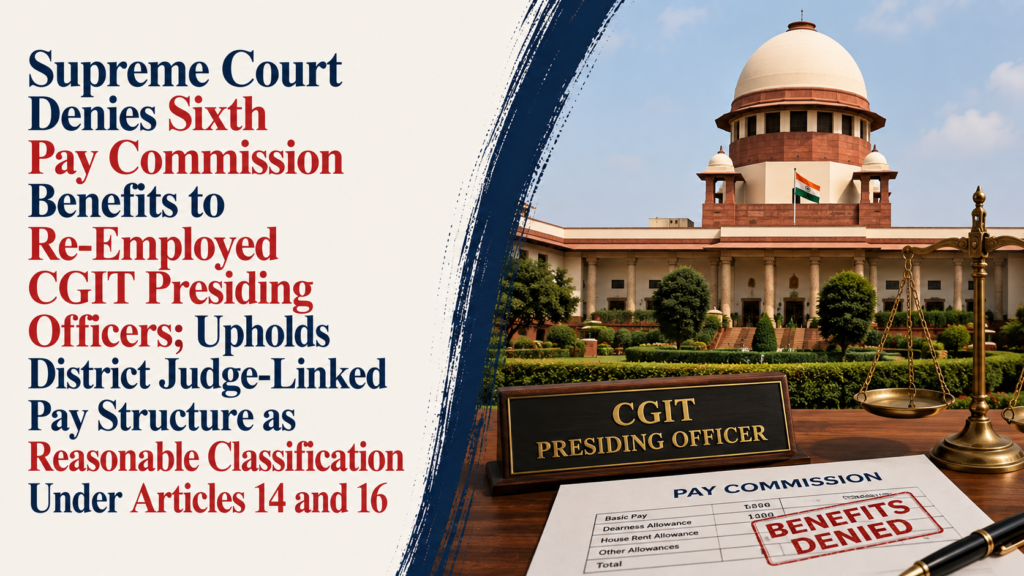
Supreme Court Denies Sixth Pay Commission Benefits to Re-Employed CGIT Presiding Officers; Upholds District Judge-Linked Pay Structure as Reasonable Classification Under Articles 14 and 16

Re-Employed CGIT Presiding Officers Not Entitled to Sixth Pay Commission Parity With Other Tribunals: Supreme Court Dismisses Article 32 Petition
Facts
The petitioners, R.K. Yadav and another, were appointed as Presiding Officers of Central Government Industrial Tribunals-cum-Labour Courts (CGIT-cum-LCs) at New Delhi and Hyderabad. They invoked the Supreme Court’s jurisdiction under Article 32, alleging violation of their fundamental rights under Articles 14 and 16 concerning fixation of their pay scales.
Their principal grievance was that although tribunals such as the Central Administrative Tribunal, Income Tax Appellate Tribunal, Railway Claims Tribunal and Debt Recovery Tribunal had received pay scales based upon the recommendations of the Sixth Central Pay Commission, CGIT-cum-LC Presiding Officers were instead granted pay scales corresponding to the District Judiciary.
The petitioners argued that CGIT-cum-LCs were Central Government tribunals falling within the constitutional framework of Articles 247 and 323-B and therefore stood on the same footing as other Central tribunals. According to them, applying the Justice E. Padmanabhan Committee scales applicable to District Judges amounted to treating unequals equally and arbitrarily denying them Sixth Pay Commission benefits.
Petitioner No. 1 had initially joined CGIT-I, New Delhi, on deputation on 21 April 2009 until his superannuation on 30 June 2009 and thereafter continued from 1 July 2009 on a re-employment basis up to the age of 65 years. Petitioner No. 2 was similarly appointed as Presiding Officer at CGIT, Hyderabad.
Their pay was fixed equivalent to the Super Time Scale of a District Judge. Despite several representations seeking Sixth Pay Commission scales, the Government declined to alter the pay structure.
Issues
The principal issues before the Supreme Court were:
- Whether re-employed Presiding Officers of CGIT-cum-LCs were entitled to Sixth Central Pay Commission pay scales at par with members of other Central tribunals;
- Whether granting them pay scales corresponding to the District Judiciary under the Justice E. Padmanabhan Committee recommendations was arbitrary or discriminatory;
- Whether re-employed officers constitute a distinct class for purposes of pay fixation; and
- Whether the existing pay classification violated Articles 14 and 16 of the Constitution.
Petitioner’s Arguments
The petitioners contended that CGIT-cum-LCs were Central Government tribunals constituted within the framework of Articles 247 and 323-B and should therefore receive treatment comparable to other Central tribunals.
They argued that the Government had accepted Sixth Pay Commission recommendations for officers of several other tribunals but denied the same treatment to CGIT-cum-LC Presiding Officers.
According to the petitioners, grouping them with members of the District Judiciary was constitutionally impermissible because CGIT-cum-LCs and District Courts belonged to different institutional structures.
They consequently alleged that the Government had effectively treated unequals as equals, resulting in arbitrary discrimination contrary to Articles 14 and 16. Their principal relief was implementation of Sixth Pay Commission recommendations for CGIT-cum-LCs at par with other tribunals.
Respondent’s Arguments
The Union of India contended that the petitioners were re-employed pensioners, not regular government employees, and their pay therefore had to be determined under the specific statutory framework governing re-employed personnel.
The Government relied upon the Central Civil Services (Fixation of Pay of Re-employed Pensioners) Orders, 1986, under which a re-employed pensioner is entitled to draw pay in the prescribed scale of the post in which he is re-employed and cannot demand protection of the pay structure of the post held before retirement.
The Union further explained that the pay scales of CGIT Presiding Officers had historically been linked with those of District Judges. Their scales were initially revised following the Shetty Commission recommendations and subsequently revised in accordance with the Justice E. Padmanabhan Committee recommendations.
The Government had also referred the petitioners’ request for Sixth Pay Commission scales to the Ministry of Finance and Department of Personnel and Training, but neither supported revision of the existing pay structure.
Analysis of the Law
Re-Employed Officers Form a Separate Class
The Supreme Court considered the petitioners’ status as re-employed pensioners to be crucial.
The Court found that the CCS (Fixation of Pay of Re-employed Pensioners) Orders, 1986 specifically govern the pay structure and fixation applicable to re-employed officers.
Under this regime, re-employed pensioners draw pay in the prescribed structure of the post to which they are re-employed. They cannot claim protection of the pay scale attached to the post they occupied before retirement.
The Court observed that pay fixation for re-employed personnel operates through a special scheme, including specific treatment of pension and retirement benefits.
Pay Fixation Is Primarily an Executive Function
The Supreme Court reiterated that determination and fixation of pay scales is principally an executive function involving specialised assessment.
Courts ordinarily lack the institutional expertise necessary to compare different posts, responsibilities, qualifications and service conditions merely on the basis of pleadings and affidavits.
Unless mala fides, manifest arbitrariness or an apparent anomaly is demonstrated, courts should ordinarily respect pay structures determined by expert bodies and Pay Commissions.
The Court therefore emphasized that judicial review of classification of posts and determination of salaries is very limited, since equation of posts and fixation of remuneration are complex exercises best undertaken by expert bodies and the executive.
Articles 14 and 16 — Reasonable Classification
The Court rejected the constitutional challenge under Articles 14 and 16.
It reiterated that Article 14 prohibits class legislation but permits reasonable classification where the classification rests upon an intelligible differentia and bears a rational connection with the purpose sought to be achieved.
Re-employed officers possess materially different service characteristics from regular government employees. Their previous retirement, pensionary benefits, subsequent re-employment and specialised rules governing pay fixation constitute a rational basis for treating them as a separate category.
The Court therefore held that re-employed officers cease to form a homogeneous class with regular government officers for purposes of pay fixation.
Linking CGIT Officers With District Judiciary Is Not Arbitrary
The Court specifically rejected the contention that CGIT-cum-LC Presiding Officers had been wrongly equated with District Judges.
It held that linking their pay structure with the District Judiciary, except in relation to the National Tribunals functioning at Mumbai and Kolkata, was reasonable and did not disclose arbitrariness.
The linkage was not an ad hoc executive decision. It resulted from recommendations of specialised bodies including the Shetty Commission and Justice E. Padmanabhan Committee.
Precedent Analysis
The Court relied upon State of U.P. v. J.P. Chaurasia, (1989) 1 SCC 121, for the proposition that courts are ordinarily not suited to undertake detailed evaluation and comparison of posts and pay scales. Such matters should generally be left to executive authorities and expert bodies unless mala fides or manifest illegality is established.
In Union of India v. Dineshan K.K., (2008) 1 SCC 586, the Court acknowledged that judicial review over pay structures is not completely excluded. Intervention may be justified where there is an apparent anomaly or disparity, particularly one acknowledged by the Government itself. The present case, however, disclosed no comparable anomaly.
The Court referred to Union of India v. Indian Navy Civilian Design Officers Association, (2023) 19 SCC 482, where judicial equation of different posts was disapproved, particularly where recruitment rules and other relevant service conditions differed.
In Union of India v. T.V.L.N. Mallikarjuna Rao, (2015) 3 SCC 653, the Court reiterated that classification of posts and determination of pay structures fall within the executive domain and tribunals cannot sit in appeal over executive wisdom concerning service grades and remuneration.
The Court also referred to Charanjit Lal Chowdhury v. Union of India, 1950 SCC 833, reiterating that Article 14 does not prohibit legitimate classification. Different classes may lawfully receive different treatment where the classification has a rational foundation.
Court’s Reasoning
The Court found that the petitioners’ claim fundamentally overlooked their status as re-employed officers after superannuation.
Their pay fixation was governed by a distinct statutory regime applicable to re-employed pensioners. Consequently, they could not automatically compare themselves with regular government officers or members of other Central tribunals for claiming Sixth Pay Commission scales.
The Court further found that the pay structure applicable to CGIT-cum-LC Presiding Officers had evolved through expert recommendations rather than arbitrary executive action.
Indeed, the pay scales recommended by the Justice E. Padmanabhan Committee for District Judges had been extended to CGIT-cum-LC Presiding Officers. The table reproduced on page 12 of the judgment shows the revised scales, including ₹51,550–63,070 for District Judge Entry Level, ₹57,700–70,290 for Selection Grade and ₹70,290–76,450 for Super Time Scale.
Subsequent statutory developments also demonstrated continuing governmental regulation of tribunal remuneration. Under the 2017 and 2020 Rules and subsequently the Tribunal (Conditions of Service) Rules, 2021, Presiding Officers of Central Industrial Tribunals were placed in the salary level of ₹1,44,200–₹2,18,200.
The Court therefore concluded that there was neither arbitrary discrimination nor any constitutional basis for compelling the Government to extend Sixth Pay Commission scales claimed by the petitioners.
Conclusion
The Supreme Court dismissed the writ petition.
It held that re-employed officers after retirement constitute a separate and rationally distinguishable class for purposes of pay fixation. Their treatment differently from regular government employees is constitutionally permissible.
The Court further upheld the linkage of the pay scales of CGIT-cum-LC Presiding Officers with the District Judiciary and held that such classification did not violate either Article 14 or Article 16 of the Constitution.
Accordingly, the petitioners had no fundamental or other legal right to claim Sixth Pay Commission pay scales, and no relief could be granted.
Case Details
Case: R.K. Yadav & Anr. v. Union of India & Others
Court: Supreme Court of India
Case Number: Writ Petition (Civil) No. 193 of 2012; 2026 INSC 848
Judge: Justice S.V.N. Bhatti and Justice N.V. Anjaria
Date: 12 August 2026
Result: Writ petition dismissed; claim for Sixth Pay Commission scales rejected; separate pay classification of re-employed CGIT-cum-LC Presiding Officers upheld under Articles 14 and 16.