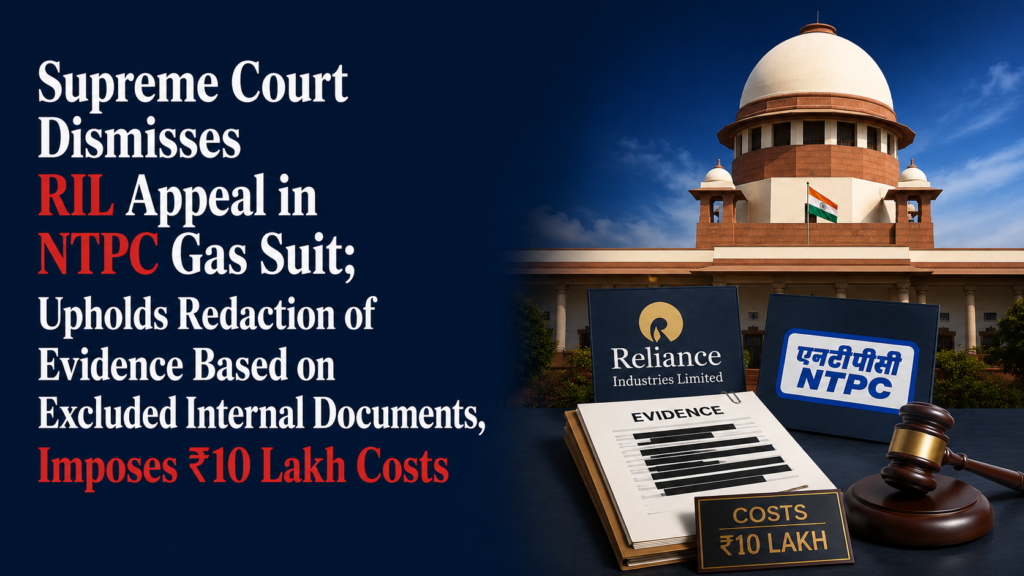
Supreme Court Dismisses RIL Appeal in NTPC Gas Suit; Upholds Redaction of Evidence Based on Excluded Internal Documents, Imposes ₹10 Lakh Costs

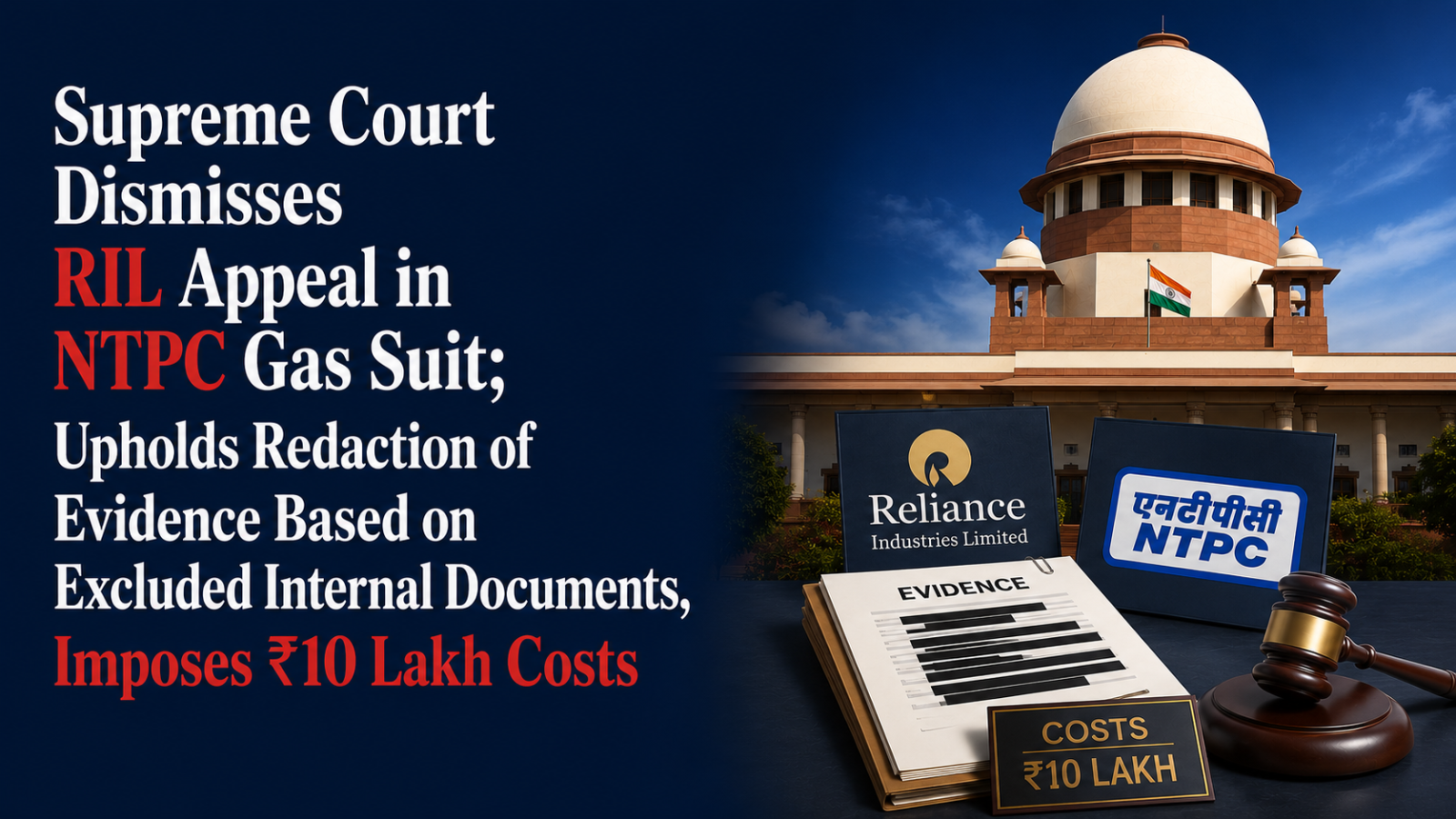
Supreme Court Rejects Reliance Industries’ Third-Round Evidence Challenge; Holds Internal Emails and Meeting Contents Cannot Be Smuggled Into Record Indirectly
Facts
The Supreme Court considered an appeal by Reliance Industries Limited (RIL) arising from a Bombay High Court order in a long-running commercial suit filed by NTPC Limited. The immediate dispute concerned redaction of portions of two examination-in-chief affidavits of RIL witness B.K. Ganguly.
The underlying dispute traces back to an NTPC Request for Qualification inviting bids for supply of natural gas to its power plants. RIL submitted a financial proposal and NTPC issued a Letter of Intent dated 16 June 2004, which RIL accepted subject to negotiation and finalisation of a draft Gas Sale and Purchase Agreement.
NTPC later sued for a declaration that a binding contract existed for supply of 132 trillion BTU of natural gas for 17 years, asserting that the contractual terms contained in the LOI had been unconditionally accepted by RIL.
The litigation thereafter became heavily procedural. RIL repeatedly sought discovery, inspection and production of internal documents. The Bombay High Court had earlier held that internal notings and correspondence were irrelevant to determining whether the LOI amounted to a concluded contract because that question had to be decided from the contractual documents exchanged between the parties.
A Division Bench upheld that view and cautioned that repetitive applications could not be used to frustrate progress of the trial.
RIL later attempted to introduce its own internal documents through evidence affidavits. Those efforts were also restricted, and the dispute eventually reached the Supreme Court in 2019. The Supreme Court then held that oral evidence could not be used to indirectly bring on record the contents of documents already held irrelevant and excluded from evidence.
Following that mandate, the Bombay High Court in 2024 undertook a paragraph-by-paragraph scrutiny of RIL’s first and second evidence affidavits and redacted only those portions which fell within the category previously excluded by the Supreme Court.
RIL challenged that order before the Supreme Court.
Issues
The principal issues were:
- Whether the Bombay High Court correctly understood and applied the Supreme Court’s 2019 judgment concerning excluded internal documents.
- Whether RIL could lead oral testimony regarding the contents of internal emails, communications and meetings even though the underlying documents had already been held irrelevant and excluded.
- Whether Section 60 of the Indian Evidence Act permitted reopening of the issue through direct oral testimony.
- Whether the High Court had exceeded its jurisdiction by redacting portions of the evidence affidavits.
- Whether the repetitive litigation over evidentiary issues justified costs and renewed directions for expeditious disposal of the commercial suit.
Appellant’s Arguments
RIL argued that the High Court had gone too far in redacting portions of B.K. Ganguly’s examination-in-chief affidavits.
It sought to rely on Section 60 of the Indian Evidence Act, 1872, contending that a witness who personally participated in meetings or discussions could directly testify to what he perceived or what transpired, even if some internal communications or documents relating to those meetings had been excluded.
RIL further contended that the High Court had exceeded the limited scope of the Supreme Court’s 2019 directions by removing portions of oral testimony which, according to RIL, were independently admissible.
Respondent’s Arguments
NTPC maintained that RIL was attempting once again to do indirectly what courts had repeatedly prohibited directly.
Its position was that internal emails, internal correspondence and internal deliberations had already been held irrelevant to the issue of whether the parties had entered into a concluded contract.
Therefore, RIL could not circumvent those binding orders by putting the contents of the excluded documents into the mouth of a witness and presenting them as oral evidence.
NTPC supported the Bombay High Court’s detailed, paragraph-wise scrutiny and redaction.
Analysis of the Law
Prior Evidentiary Orders Bind the Trial Court
The Supreme Court reaffirmed the central principle from its own 2019 ruling:
once an evidentiary issue has been finally decided between the same parties, the trial court cannot reopen it at a later stage.
The earlier orders excluding the internal documents had attained finality and were binding on the trial court.
The Court therefore rejected any attempt to revisit those rulings under a fresh evidentiary formulation.
What Cannot Be Done Directly Cannot Be Done Indirectly
The Court stressed that if internal emails and correspondence have already been excluded as irrelevant, a party cannot use oral testimony to reproduce their substance.
The Supreme Court’s 2019 decision had already made clear that:
- internal notings and correspondence were irrelevant;
- those documents could not be taken on record;
- their contents could not be reintroduced through oral evidence; and
- the trial court could not reopen the issue by an indirect method.
The Court therefore upheld the principle that excluded documentary content cannot be “smuggled” into evidence through witness narration.
High Court’s Redaction Exercise Was Carefully Limited
The Supreme Court noted that the Bombay High Court had not mechanically struck out every reference to internal discussions.
Instead, it undertook a detailed paragraph-by-paragraph exercise.
For example:
- portions referring directly to internal emails were redacted;
- statements reflecting the witness’s own perception or state of mind were retained;
- references to admissible correspondence between NTPC and RIL were retained;
- portions reproducing the substance of excluded internal communications were removed.
The High Court similarly retained parts of the second affidavit where the witness merely described his perception, while striking out passages that sought to recreate internal discussions or the contents of excluded documents.
The Supreme Court expressly agreed with that approach.
Section 60 Evidence Act Did Not Permit Reopening
RIL again relied upon Section 60 of the Evidence Act.
The Supreme Court rejected the submission because that very argument had substantially been advanced earlier.
The present appeal could not be used as a vehicle to revisit or review the binding 2019 judgment.
The Court held that it was neither in a position nor inclined to reopen the issue and found the High Court fully justified in its conclusions.
Precedent Analysis
Earlier Supreme Court Judgment Between RIL and NTPC — 28 February 2019
This earlier decision was the controlling authority.
The Supreme Court had held that previous orders excluding internal documents had attained finality and bound the trial judge.
Accordingly, oral evidence relating to the contents of those excluded documents could not be permitted because that would amount to reopening an already concluded evidentiary issue.
The present judgment is essentially an enforcement of that earlier mandate.
Res Judicata Within the Same Trial
The Court reiterated that earlier final orders on evidentiary matters can operate as binding determinations at later stages of the same proceedings.
The trial court cannot permit a party to circumvent them under a different procedural label.
This is particularly significant where the same party repeatedly attempts to reintroduce material already ruled inadmissible or irrelevant.
Court’s Reasoning
The Supreme Court found that the Bombay High Court had correctly understood the 2019 ruling and applied it with precision.
It specifically noted that the High Court did not redact the affidavits wholesale.
Large portions of both evidence affidavits remained intact. Only those passages which directly or indirectly reproduced internal communications, emails or discussions already excluded were removed.
The Court therefore found no jurisdictional error, no misunderstanding of its earlier directions and no basis to interfere.
Strong Criticism of Litigation Delay
A notable part of the judgment is the Supreme Court’s criticism of the extraordinary delay.
The Court observed that NTPC’s suit, filed in 2005, remained at the evidence stage more than two decades later.
It traced the delay through three rounds of procedural litigation:
- discovery and inspection litigation taking approximately four years;
- internal-document production litigation taking more than one year; and
- redaction litigation commencing in 2016 and consuming several more years.
The Court noted that in 2019 it had already directed the trial to be completed within nine months, yet seven years had passed since that direction.
It therefore once again requested the High Court to take up and dispose of the suit as expeditiously as possible.
The Supreme Court also made the pointed observation that allowing a party to prolong litigation reflects poorly upon the manner in which courts themselves manage proceedings.
Costs of ₹10 Lakh
The Supreme Court did not merely dismiss the appeal.
It imposed costs of ₹10 lakh upon Reliance Industries Limited, payable to the Supreme Court Advocates-on-Record Association within five weeks.
The quantum of costs reflects the Court’s evident disapproval of repeated attempts to relitigate evidentiary questions already settled by binding orders.
Conclusion
The Supreme Court held that the Bombay High Court had correctly applied the Supreme Court’s earlier 2019 mandate and committed no error in redacting portions of RIL witness B.K. Ganguly’s evidence affidavits.
It reaffirmed that material already excluded as irrelevant cannot be introduced indirectly through oral testimony.
The appeal was accordingly dismissed with ₹10 lakh costs, and the Bombay High Court was requested to proceed with and conclude the long-pending commercial suit as expeditiously as possible.
Case Details
Case: Reliance Industries Limited v. NTPC Limited
Court: Supreme Court of India
Case Number: Civil Appeal of 2026 arising out of SLP (C) No. 23417 of 2024; 2026 INSC 862
Judges: Justice Pamidighantam Sri Narasimha and Justice Alok Aradhe
Date: 14 August 2026
Result: Appeal dismissed; Bombay High Court’s redaction order upheld; ₹10 lakh costs imposed on RIL and expeditious disposal of NTPC’s commercial suit directed