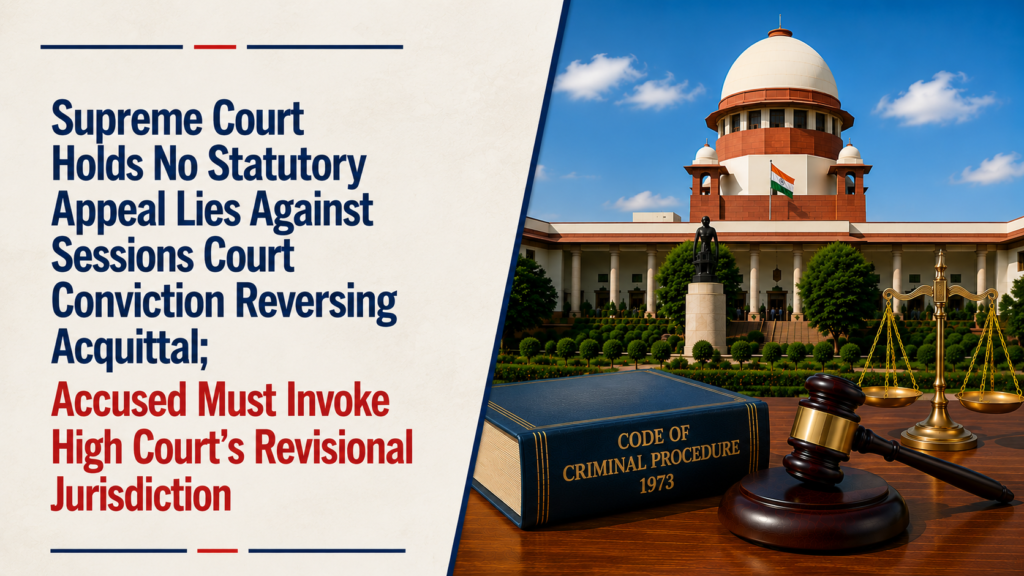
Supreme Court Holds No Statutory Appeal Lies Against Sessions Court Conviction Reversing Acquittal; Accused Must Invoke High Court’s Revisional Jurisdiction

No Appeal Under Section 374 CrPC Against Appellate Conviction, Holds Supreme Court; Revision Before High Court Is Proper Remedy
Facts
The appellant, Vishnu Kumar Gupta, was prosecuted for offences under Sections 498-A, 323 read with Section 34 IPC and Sections 3 and 4 of the Dowry Prohibition Act based on a complaint lodged by his wife.
The Judicial Magistrate First Class acquitted the appellant and his parents after trial. The complainant preferred an appeal before the Sessions Court under Section 378 CrPC (Section 419 BNSS). The Sessions Court partly allowed the appeal, maintained the acquittal of the parents but reversed the acquittal of the husband, convicting him under Section 498-A IPC and Section 4 of the Dowry Prohibition Act.
The appellant thereafter filed an appeal before the High Court under Section 374 CrPC (Section 415 BNSS). The High Court dismissed the appeal as not maintainable, holding that only a criminal revision could be maintained against such an appellate conviction. The appellant challenged that decision before the Supreme Court.
Issues
- Whether an appeal under Section 374 CrPC (Section 415 BNSS) lies against a conviction recorded by a Sessions Court while reversing an acquittal.
- Whether such conviction gives rise to a fresh statutory right of appeal.
- Whether the accused’s remedy lies by way of appeal or criminal revision before the High Court.
Appellant’s Arguments
The appellant contended that:
- The conviction recorded by the Sessions Court was his first conviction, and therefore he should have one complete appellate remedy.
- Revision is much narrower than an appeal and cannot substitute a full reconsideration on facts and law.
- Section 374 uses the expression “convicted on a trial”, which should include convictions recorded by an appellate court after re-appreciating evidence.
- Denial of an appeal violated the valuable statutory safeguard and fair procedure under Article 21.
- Procedural rules regarding surrender could not override a substantive right of appeal.
Respondents’ Arguments
The State and the complainant argued that:
- The right of appeal exists only where expressly conferred by statute.
- Section 374 applies only to convictions recorded by courts exercising original trial jurisdiction.
- No second statutory appeal is contemplated after a Sessions Court reverses an acquittal.
- The proper remedy is to invoke the revisional jurisdiction of the High Court.
- The High Court therefore correctly dismissed the appeal as not maintainable.
Analysis of the Law
The Supreme Court extensively analysed:
- Sections 372, 374, 378, 386, 397 and 401 CrPC.
- Corresponding provisions under the BNSS.
- The distinction between appellate and revisional jurisdiction.
- The meaning of the expression “trial” in criminal procedure.
The Court reiterated that:
- The right of appeal is entirely statutory.
- Courts cannot create appellate remedies which the legislature has consciously omitted.
- A conviction recorded by an appellate court while hearing an appeal against acquittal does not automatically create another statutory appeal merely because it is the accused’s first conviction.
Precedent Analysis
The Court relied upon, inter alia:
- National Commission for Women v. State of Delhi — Appeal is purely a creature of statute.
- Mallikarjun Kodagali v. State of Karnataka — Right of appeal exists only where the statute expressly provides.
- Parvinder Kansal v. State (NCT of Delhi) — No appeal lies unless authorised by statute.
- State of Bihar v. Ram Naresh Pandey — Meaning of the expression “trial” depends upon statutory context.
- Hardeep Singh v. State of Punjab — Explained commencement of trial.
- Jamin v. State of Uttar Pradesh — Trial concludes upon acquittal or, where convicted, upon imposition of sentence.
Court’s Reasoning
The Supreme Court held that:
- Section 374 expressly contemplates appeals against convictions recorded by courts exercising trial jurisdiction, not appellate jurisdiction.
- If the legislature intended to provide another appeal against convictions recorded while reversing acquittals, it would have expressly enacted such a provision.
- Judicial interpretation cannot create an additional appellate remedy.
- A conviction by the Sessions Court while hearing an appeal against acquittal does not confer a further statutory right of appeal.
- The accused’s remedy lies in invoking the High Court’s revisional jurisdiction under Sections 397 and 401 CrPC (corresponding BNSS provisions).
- Since no statutory appeal existed, the High Court correctly declined to entertain the appeal under Section 374.
Conclusion
The Supreme Court dismissed the appeal and affirmed the High Court’s interpretation.
It held that no appeal under Section 374 CrPC (Section 415 BNSS) lies against a conviction recorded by a Sessions Court while exercising appellate jurisdiction after reversing an acquittal. The proper remedy available to the accused is to invoke the revisional jurisdiction of the High Court in accordance with law.
Case Details
Case: Vishnu Kumar Gupta v. State of Madhya Pradesh & Anr.
Court: Supreme Court of India
Case Number: Criminal Appeal arising out of SLP (Crl.) No. 13891 of 2025
Bench: Hon’ble Justice Aravind Kumar and Hon’ble Justice K. Vinod Chandran
Date: 30 July 2026
Citation: 2026 INSC 770
Result: Appeal dismissed. The Supreme Court held that an appeal under Section 374 CrPC (Section 415 BNSS) is not maintainable against a conviction recorded by a Sessions Court while reversing an acquittal in appeal. The accused’s remedy is to invoke the High Court’s revisional jurisdiction, not a second statutory appeal.