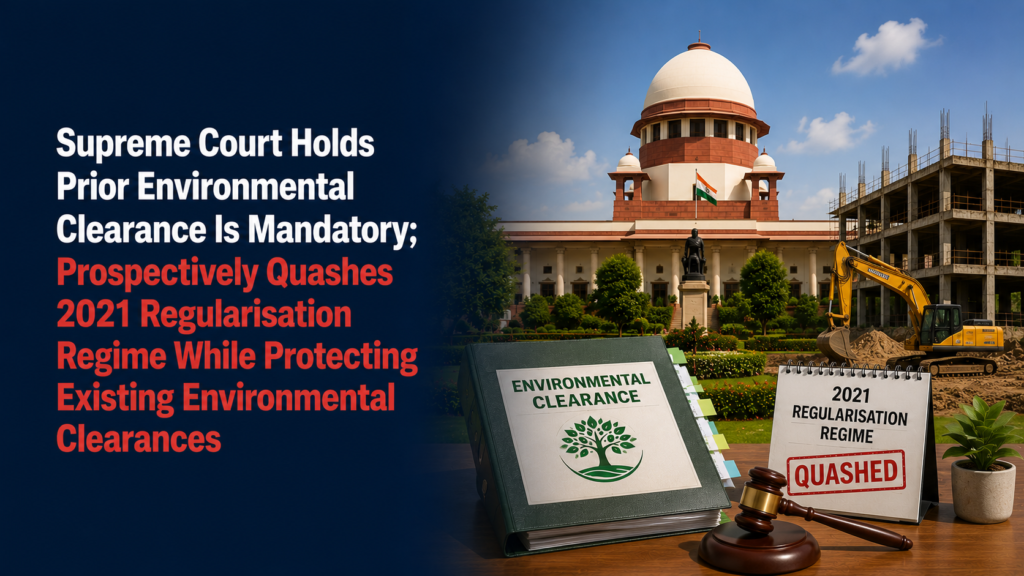
Supreme Court Holds Prior Environmental Clearance Is Mandatory; Prospectively Quashes 2021 Regularisation Regime While Protecting Existing Environmental Clearances

Developers Cannot Expect Permanent ‘Violate First, Regularise Later’ Policy; Supreme Court Prospectively Invalidates 2021 Environmental Clearance SOP.
Facts
The Supreme Court was called upon to decide the validity of the Central Government’s framework permitting ex post facto Environmental Clearances (ECs) to projects that had commenced construction or operations without obtaining the mandatory prior Environmental Clearance under the Environment Impact Assessment (EIA) Notification, 2006.
Three writ petitions challenged the 2017 Notification and the 2021 Office Memorandum (OM) issued by the Ministry of Environment, Forest and Climate Change (MoEFCC). These instruments created mechanisms through which projects that had violated the prior EC requirement could subsequently seek environmental clearance.
The controversy arose after a two-Judge Bench in Vanashakti-I had struck down both the 2017 Notification and the 2021 OM, holding that ex post facto environmental clearance was alien to environmental jurisprudence and restraining the Government from issuing similar measures in future. That judgment was later recalled in review, and the matter was referred for fresh consideration by a larger Bench.
The Court therefore had to determine whether the Central Government possessed statutory authority to create a regularisation mechanism for projects commenced without prior environmental clearance and, if so, the limits of that power.
Issues
The Supreme Court framed the following principal questions:
- Whether prior Environmental Clearance under the EIA Notification, 2006 is mandatory.
- Whether projects commenced without prior EC can subsequently obtain environmental clearance.
- Whether the 2017 Notification permitting a one-time regularisation of existing violations is valid.
- Whether the 2021 Office Memorandum creating a continuing mechanism for ex post facto EC is ultra vires the Environment (Protection) Act, 1986.
- What should happen to environmental clearances already granted and applications pending under the impugned regime.
Petitioners’ Arguments
The petitioners argued that the entire architecture of the 2006 EIA Notification is founded upon the precautionary principle, requiring environmental impacts to be assessed before any construction or industrial activity begins.
According to them, allowing projects to seek environmental clearance after construction had commenced defeated public consultation, environmental appraisal and preventive environmental regulation. Such a regime rewarded violators while placing law-abiding project proponents at a disadvantage.
They relied heavily upon Common Cause, Alembic Pharmaceuticals and other Supreme Court decisions which described ex post facto environmental clearance as being fundamentally inconsistent with environmental jurisprudence.
The petitioners further contended that although the 2017 Notification was presented as a one-time amnesty, the 2021 Office Memorandum converted that limited exception into a permanent policy of “violate first, regularise later”, thereby defeating both the Environment (Protection) Act and the EIA Notification, 2006.
Respondents’ Arguments
The Union Government submitted that neither the Environment (Protection) Act nor the EIA Notification expressly prescribed what should happen to projects that had already violated the prior EC requirement.
It argued that Sections 3 and 5 of the Environment (Protection) Act confer broad powers to regulate pollution and protect the environment. Those powers include framing mechanisms to assess environmental damage, impose penalties, require remediation and determine whether environmentally sustainable projects may continue.
According to the respondents, the 2017 Notification was merely a one-time statutory amnesty intended to bring defaulting projects within the regulatory framework. Likewise, the 2021 Office Memorandum was framed pursuant to directions issued by the National Green Tribunal and sought to fill a regulatory gap by prescribing a structured process for handling violation cases.
The Government also highlighted the enormous public consequences that would follow if hospitals, airports, irrigation projects, medical colleges and other public infrastructure projects were demolished merely because prior environmental clearance had not been obtained.
Analysis of the Law
The Supreme Court undertook an extensive examination of the Environment (Protection) Act, 1986, the EIA Notification, 1994 and the EIA Notification, 2006.
The Court held that the requirement of obtaining prior Environmental Clearance is unquestionably mandatory. The repeated use of the expression “prior” in the 2006 Notification, coupled with the precautionary principle embedded in environmental law, makes prior appraisal an indispensable pre-condition before environmentally sensitive projects can commence.
The Court observed that environmental clearance is not merely a procedural formality but represents the implementation of constitutional environmental principles flowing from Articles 21, 48A and 51A(g).
At the same time, the Court distinguished between two separate issues:
- whether prior EC is mandatory; and
- whether the Central Government possesses statutory authority to formulate limited amnesty schemes for existing violations.
According to the Court, Section 3 of the Environment (Protection) Act grants wide powers enabling the Central Government not merely to prevent pollution but also to regulate existing violations through damage assessment, environmental compensation, remediation and restoration.
The Court further noted that Parliament, through the Jan Vishwas (Amendment) Act, 2023, replaced criminal prosecution with civil penalties for environmental violations. While this amendment did not dilute the mandatory character of prior environmental clearance, it indicated legislative recognition that violations could be dealt with through graded regulatory responses rather than automatic demolition in every case.
Accordingly, the Court concluded that Parliament had left sufficient statutory space for the Government to issue carefully designed amnesty notifications in exceptional circumstances, provided they remain narrowly tailored and serve genuine public interest.
Precedent Analysis
The judgment undertakes one of the most detailed reconciliations of prior environmental decisions rendered by the Supreme Court.
The Court explained that Common Cause and Alembic Pharmaceuticals correctly held that ex post facto environmental clearance is contrary to the normal statutory scheme under the EIA Notification, 2006. Those decisions established the governing legal principle that prior environmental appraisal remains the rule.
However, later decisions such as Electrosteel, Pahwa Plastics and D. Swamy dealt primarily with the consequences of completed violations rather than the validity of the statutory framework itself. Those cases balanced environmental protection with practical considerations and moulded relief in their peculiar factual situations instead of insisting upon demolition in every case.
The Court held that Electrosteel incorrectly suggested that the Environment (Protection) Act inherently accommodates ex post facto environmental clearance. According to the present Bench, that observation overlooked the mandatory nature of the prior EC regime and therefore does not correctly interpret the statutory scheme.
Nevertheless, Pahwa Plastics and D. Swamy were approved insofar as they recognised the validity of the 2017 Notification, which constituted a narrowly tailored, one-time statutory amnesty rather than a permanent regularisation mechanism.
Court’s Reasoning
The Court drew a sharp distinction between the two impugned instruments.
Validity of the 2017 Notification
The Court upheld the 2017 Notification because it was issued as delegated legislation under Section 3 of the Environment (Protection) Act after following the statutory procedure prescribed under the Rules. It applied only to violations existing on a specified cut-off date and created a limited window for compliance subject to environmental appraisal, remediation, compensation and safeguards.
Since it constituted a narrowly tailored one-time statutory measure, it fell within the powers conferred upon the Central Government.
Invalidity of the 2021 Office Memorandum
The Court, however, struck down the 2021 Office Memorandum.
Unlike the 2017 Notification, the 2021 OM was merely an executive administrative instruction issued by the Ministry. It effectively created a perpetual mechanism permitting projects commenced without prior environmental clearance to subsequently seek regularisation.
The Court held that an executive office memorandum cannot substantially amend or override delegated legislation. Since the 2021 OM fundamentally altered the mandatory prior clearance regime established by the EIA Notification, 2006, it exceeded executive authority and was therefore ultra vires.
At the same time, the Court recognised that thousands of projects, including hospitals, airports, medical colleges, irrigation works and public infrastructure, had proceeded relying upon the prevailing legal framework. Immediate invalidation of existing clearances would have caused enormous public prejudice and potentially greater environmental harm.
Balancing environmental protection with public interest, the Court therefore adopted the doctrine of prospective overruling.
It protected:
- all environmental clearances already granted under the 2017 Notification and 2021 OM (unless independently challenged on merits);
- all pending applications filed under those instruments;
- applications rejected solely because of the interim stay or the earlier Vanashakti-I judgment.
However, it prohibited the filing of any fresh applications under the 2021 regime and restrained the Government from issuing future administrative office memoranda creating similar ex post facto clearance mechanisms.
Conclusion
The Supreme Court partly allowed the challenge.
It held that obtaining prior Environmental Clearance under the EIA Notification, 2006 remains mandatory and is a fundamental component of India’s environmental regulatory framework.
The Court upheld the 2017 Notification as a valid, narrowly tailored statutory amnesty issued under delegated legislative powers.
However, it declared the 2021 Office Memorandum ultra vires because an executive instruction cannot create a permanent ex post facto environmental clearance regime contrary to delegated legislation.
Applying prospective overruling, the Court protected environmental clearances already granted and pending applications under the earlier framework but prohibited fresh applications under the impugned regime and restrained the Government from issuing similar executive regularisation schemes in future.
Case Details
Case: Vanashakti v. Union of India & Others
Court: Supreme Court of India
Case Number: Writ Petition (Civil) No. 1394 of 2023 (along with connected matters)
Judge: Justice Joymalya Bagchi (for the Bench)
Date: 29 July 2026
Result: The Supreme Court upheld the 2017 Notification as a valid one-time statutory amnesty, prospectively quashed the 2021 Office Memorandum permitting continuing ex post facto environmental clearances, protected existing clearances and pending applications, and restrained the Government from issuing future administrative regularisation schemes