

Court’s decision
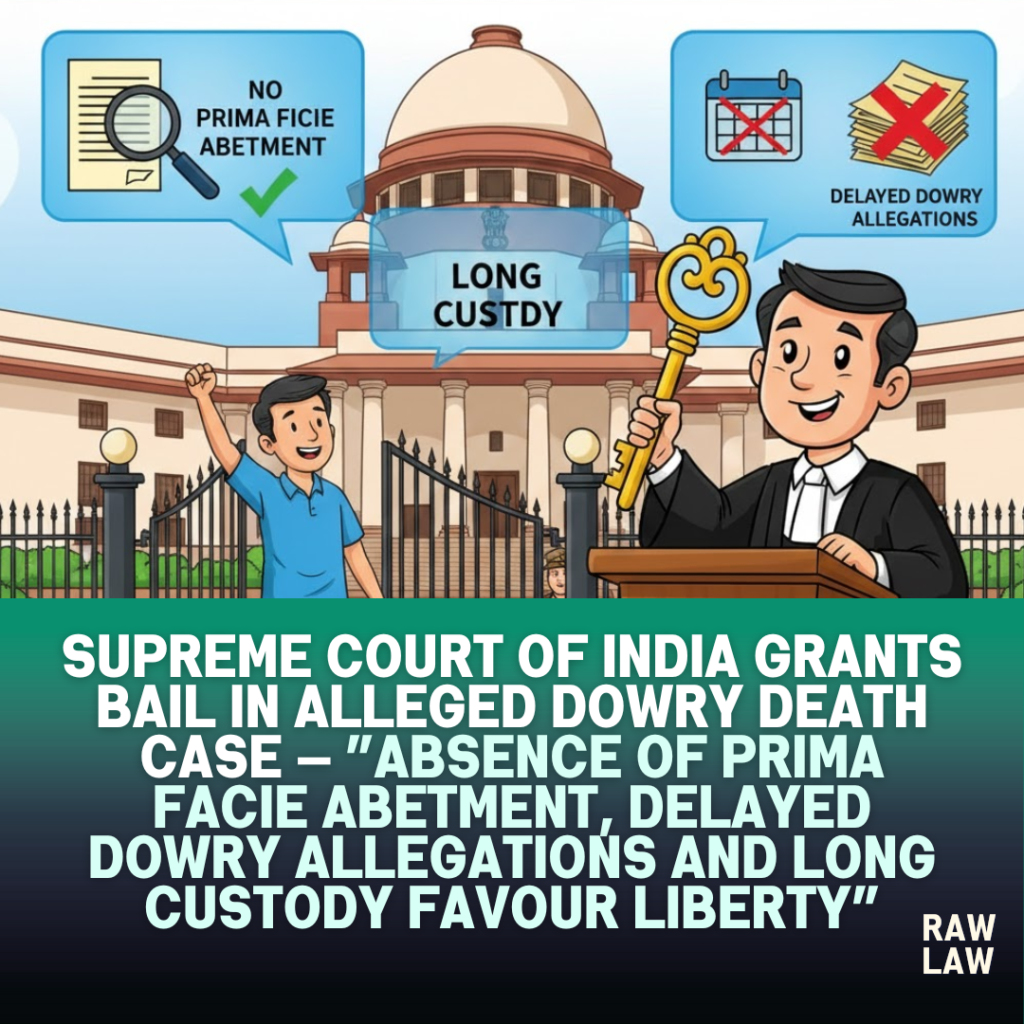
The Supreme Court of India allowed a criminal appeal and granted regular bail to an accused husband in a case involving allegations of abetment to suicide, dowry death, and murder under the new penal framework. Setting aside the High Court’s refusal of bail, the Court held that continued incarceration was unwarranted where the material on record did not prima facie establish abetment or dowry demand, and where crucial allegations appeared as subsequent improvements. Emphasising that bail jurisprudence must not be driven by the gravity of accusations alone, the Court reaffirmed that personal liberty cannot be curtailed mechanically once investigation is complete and the accused is not a flight risk.
Facts
The deceased and the accused were both medical professionals who met during the course of professional engagement and entered into a relationship, which culminated in marriage in December 2024. They began their matrimonial life in Bhopal. In March 2025, the deceased was found unresponsive inside her locked room and was later declared dead at the hospital. The incident was initially treated as a case of suicide. An FIR was subsequently lodged alleging that the deceased took her life due to mental harassment arising from the accused’s alleged relationship with another woman working at his clinic. The accused was arrested and remained in custody thereafter.
Issues
The principal issue before the Court was whether the accused was entitled to regular bail in a case where the allegations had evolved from abetment to suicide into charges of dowry death and murder, despite the absence of such allegations in the initial FIR. The Court also examined whether the nature of medical and digital evidence, the timing of dowry allegations, and the period of incarceration justified denial of bail after filing of the charge-sheet and framing of charges.
Petitioner’s arguments
The accused argued that the case was one of suicide triggered by marital discord and emotional distress, not abetment, murder, or dowry death. It was contended that there was no material demonstrating instigation, intentional aid, or cruelty sufficient to constitute abetment. The defence highlighted that allegations of dowry demand were completely absent in the FIR and the earliest statements, surfacing only later as improvements. Stressing that the accused was a professional, not a hardened criminal, and that the investigation was complete, the petitioner asserted that continued custody would amount to pre-trial punishment.
Respondent’s arguments
The State and the complainant opposed bail, contending that the deceased was murdered through administration of an anaesthetic drug and that multiple ante-mortem injuries indicated physical assault. It was argued that digital evidence, including messages, audio recordings, and a handwritten suicide note, revealed persistent cruelty and harassment. The prosecution further relied on statements of the deceased’s family members alleging demand of money and dowry, submitting that a prima facie case of dowry death was made out and that the seriousness of the offence justified continued detention.
Analysis of the law
The Court analysed the settled principles governing bail in serious offences, reiterating that seriousness of allegations cannot eclipse the presumption of innocence. In offences relating to abetment of suicide and dowry death, courts must carefully scrutinise whether the essential ingredients are prima facie established. The Court underscored that improvements in witness statements, especially concerning dowry demand, weaken the prosecution’s case at the bail stage. It also noted that once the charge-sheet is filed, the likelihood of tampering diminishes, shifting the balance towards liberty unless specific risks are demonstrated.
Precedent analysis
While deciding the appeal, the Court applied established bail jurisprudence that distinguishes between moral blame and legal culpability at the pre-trial stage. Courts have consistently held that mere marital discord or emotional distress, without clear instigation or cruelty, does not amount to abetment. The present decision aligns with precedents cautioning against treating every unnatural death within marriage as a dowry death unless statutory ingredients are prima facie satisfied. The Court also relied on precedent that delayed and improved allegations must be viewed with caution while considering bail.
Court’s reasoning
The Court found it significant that the FIR and the earliest statements attributed the death to suicide allegedly arising from suspicion of an extra-marital relationship, with no mention of dowry demand. It noted that medical evidence suggested the possibility of self-inflicted injuries and that the drug allegedly causing death was accessible to the deceased, who herself was a medical professional. The Court also took into account the accused’s prolonged custody, the completion of investigation, and the absence of flight risk. These factors cumulatively persuaded the Court to grant bail.
Conclusion
Allowing the appeal, the Supreme Court set aside the High Court’s order rejecting bail and directed the release of the accused on regular bail subject to conditions imposed by the trial court. It clarified that the observations made were confined to the bail determination and would not influence the merits of the trial. The ruling reiterates that deprivation of liberty before conviction must be justified by compelling reasons rooted in evidence, not merely in the gravity of accusations.
Implications
This judgment carries significant implications for bail jurisprudence in dowry death and abetment to suicide cases under the new criminal statutes. It reinforces judicial scrutiny of improved and delayed allegations, especially in matrimonial disputes. The ruling also highlights the Court’s cautious approach in cases involving medical evidence and digital material, ensuring that bail decisions remain evidence-driven. For trial courts, the judgment serves as a reminder that pre-trial detention should not become punitive when investigation is complete and liberty can be safeguarded through conditions.
Case law references
- Bail as a rule, jail as an exception: Reaffirmed that pre-trial detention must be justified by concrete risks, not seriousness alone. Applied to grant bail after filing of charge-sheet.
- Abetment to suicide principles: Mere emotional distress or marital discord does not constitute abetment without instigation or intentional aid. Applied to assess prima facie case.
- Dowry death allegations: Delayed and improved statements regarding dowry demand weaken prosecution at bail stage. Applied to discount subsequent allegations.
FAQs
1. Can bail be granted in dowry death cases?
Yes. Courts assess whether statutory ingredients are prima facie established. Absence of early dowry allegations and weak evidence can justify bail.
2. Do improved witness statements affect bail?
Yes. Allegations introduced later as improvements are viewed cautiously and can weaken opposition to bail.
3. Does completion of investigation favour bail?
Once the charge-sheet is filed and the accused is not a flight risk, continued custody is generally disfavoured.


