

Court’s decision
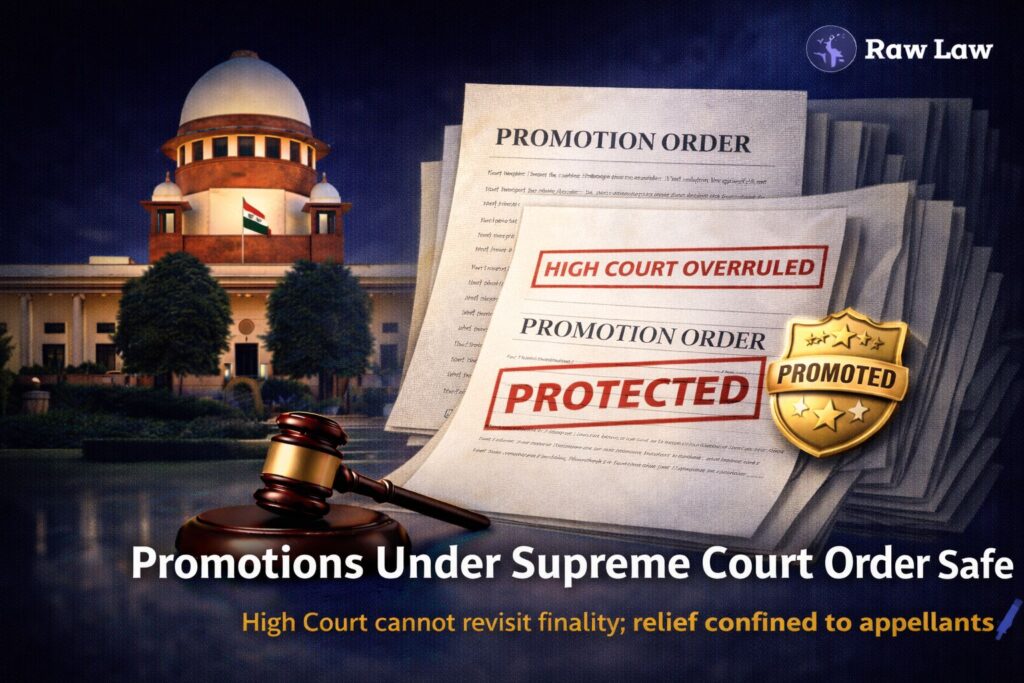
The Supreme Court of India allowed the civil appeal filed by certain lecturers in the Kerala Technical Education Service, holding that the High Court could not pass directions that effectively undermined or revisited the Supreme Court’s earlier binding judgment in their favour.
Justice Dipankar Datta, speaking for the Bench, ruled that nothing in the High Court’s impugned order dated 03.12.2020 shall affect the appellants’ career prospects, since their promotions had already been granted in compliance with the Supreme Court’s prior order and had attained finality. The connected special leave petition was disposed of with liberty to pursue appropriate remedies .
Facts
The dispute arose from Rule 6A of the Kerala Technical Education Service (Amendment) Rules, 2004, which granted exemption from acquiring a Ph.D. qualification for certain lecturers appointed prior to 27.03.1990 and provided a seven-year window for others to acquire the qualification in line with AICTE regulations.
The Rule was initially struck down by the Kerala High Court. However, in Christy James Jose v. State of Kerala, the Supreme Court set aside the High Court’s judgment and upheld appointments and promotions made under Rule 6A, holding that non-acquisition of Ph.D. could at best result in stoppage of increment but not invalidation of appointment .
Following this, the appellants were promoted to the cadre of Associate Professor with retrospective effect pursuant to a Government Order dated 07.03.2019. A contempt petition filed before the Supreme Court was disposed of after noting compliance.
Issues
The Supreme Court examined:
- Whether the Kerala High Court, in subsequent proceedings, could issue directions affecting promotions already protected by the Supreme Court’s earlier judgment.
- Whether appellants, who were not parties before the High Court, could be adversely affected by its findings.
- What remedy is available to non-parties affected by judicial decisions in service matters.
Appellants’ arguments
The appellants contended that their promotions had been granted in direct compliance with the Supreme Court’s order dated 28.04.2016 and had attained finality.
They argued that the High Court’s judgment dated 03.12.2020, while dealing with other service disputes, effectively diluted the benefit conferred upon them.
It was submitted that the High Court could not, in essence, revisit or override a binding decision of the Supreme Court, especially when the appellants were not even parties to those proceedings.
Respondents’ position
The State and other parties relied on the High Court’s findings that after 05.03.2010, Ph.D. qualification became mandatory under AICTE Regulations, and that State Rules would be void to the extent of repugnancy.
They argued that promotions and regular selections must align with AICTE Regulations and that qualification requirements could not be diluted beyond the permissible period.
Analysis of the law
The Court reaffirmed the doctrine of finality of Supreme Court judgments under Article 141 of the Constitution. Once relief has been granted by the Supreme Court and complied with, subordinate courts cannot indirectly unsettle that relief.
It noted that if the appellants had been impleaded and the earlier Supreme Court order had been brought to the High Court’s notice, the impugned situation may not have arisen.
The Court limited its interference to safeguarding the appellants’ rights flowing from its earlier decision.
Precedent analysis
The Court relied on:
• K. Ajit Babu v. Union of India (1997) – Recognised remedies available to non-parties affected by tribunal or court decisions, including limited review.
• Rama Rao v. M.G. Maheshwara Rao (2007) – Permitted affected non-parties to approach the tribunal afresh under Section 19 of the Administrative Tribunals Act.
• Union of India v. Nareshkumar Badrikumar Jagad (2019) – Held that even non-parties, if genuinely aggrieved, may seek review upon satisfying the court.
These decisions clarified that affected persons are not remediless but must adopt appropriate procedural routes.
Court’s reasoning
The Bench observed that the appellants’ promotions were granted pursuant to its own earlier judgment and that a contempt petition had been disposed of after noting compliance.
Therefore, the High Court could not disturb the finality attached to the Supreme Court’s decision.
At the same time, the Court clarified that other aggrieved persons, including intervenors and petitioners in connected proceedings, are free to pursue remedies before appropriate forums if they perceive adverse impact.
Conclusion
The Supreme Court allowed the appeal and held that nothing in the High Court’s judgment shall affect the appellants’ career prospects.
The connected special leave petition and interim applications were disposed of with liberty to pursue appropriate remedies in accordance with law .
Implications
This ruling reinforces:
• Finality and supremacy of Supreme Court judgments.
• Subordinate courts cannot indirectly revisit binding orders.
• Service law disputes may affect non-parties, but remedies exist through review or fresh applications.
• AICTE regulations must be harmonised with judicial precedents.
The judgment safeguards vested service benefits flowing from Supreme Court orders while balancing procedural remedies for other affected employees.
Case law references
- Christy James Jose v. State of Kerala (2024) 16 SCC 718 – Non-acquisition of Ph.D. cannot invalidate appointments under Rule 6A.
- K. Ajit Babu v. Union of India (1997) 6 SCC 473 – Review remedy for non-parties affected by tribunal decisions.
- Rama Rao v. M.G. Maheshwara Rao (2007) 14 SCC 54 – Fresh application under Section 19 permissible for aggrieved non-parties.
- Union of India v. Nareshkumar Badrikumar Jagad (2019) 18 SCC 586 – Even non-parties may seek review if aggrieved.
FAQs
1. Can a High Court override a Supreme Court judgment indirectly?
No. Once the Supreme Court grants relief and it attains finality, subordinate courts cannot dilute or revisit it.
2. What remedy is available to employees affected by a judgment where they were not parties?
They may seek review on limited grounds or file fresh proceedings before the appropriate forum, as recognised by Supreme Court precedent.
3. Does AICTE regulation automatically override State service rules?
State rules are subject to central regulations to the extent of repugnancy, but judicial pronouncements interpreting such interplay are binding.


