

Court’s decision
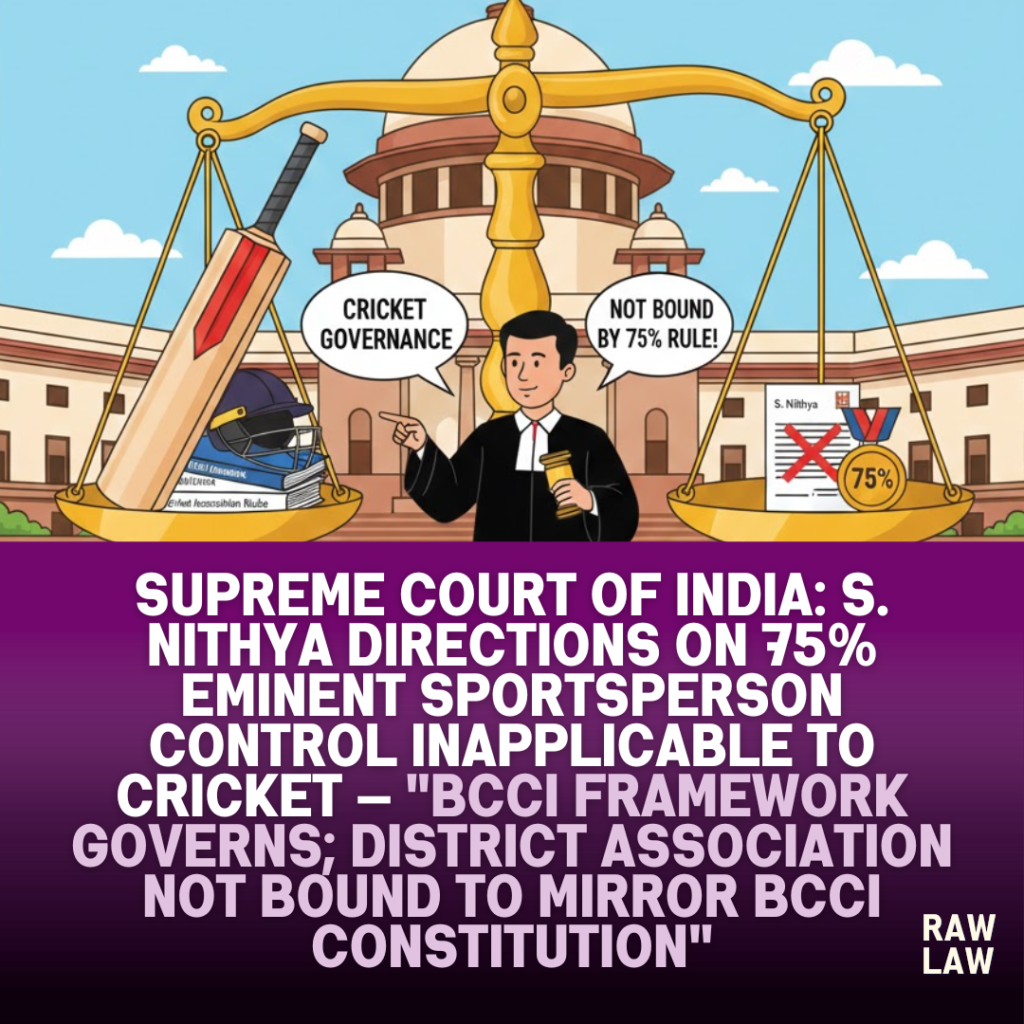
The Supreme Court of India partly allowed appeals filed by the Tiruchirappalli District Cricket Association, holding that the sweeping governance directions issued in S. Nithya concerning 75% eminent sportsperson representation and mandatory sportsperson office-bearers do not apply to cricket associations governed by the regulatory framework settled in BCCI v. Cricket Association of Bihar. The Court clarified that district cricket associations are not judicially mandated to restructure their constitutions strictly in line with the BCCI Constitution. The High Court’s order was set aside to that extent, while election oversight and voting rights issues were left open for expeditious adjudication.
Facts
The appeals arose from a common judgment of the Madurai Bench of the Madras High Court dated 12.06.2024 disposing of two writ appeals concerning the functioning of the Tiruchirappalli District Cricket Association. The Association, formed in 1958 and affiliated with the Tamil Nadu Cricket Association, was challenged on issues of membership, voting rights, and compliance with governance norms.
In Writ Appeal (MD) No. 896 of 2024, a cricket club sought membership and voting rights. The High Court held that the club was entitled to vote and participate.
In Writ Appeal (MD) No. 915 of 2024, a former office-bearer sought directions for conducting free and fair elections and compliance with governance norms laid down in S. Nithya, including mandatory representation of eminent sportspersons in sports bodies.
Aggrieved by the application of S. Nithya to cricket associations, the District Association approached the Supreme Court.
Issues
The principal issue was whether the governance directions issued in S. Nithya v. Union of India, including the mandate that 75% of members and key office-bearers of sports associations be eminent sportspersons, apply to cricket associations already governed by the framework approved in BCCI v. Cricket Association of Bihar.
A related issue was whether district cricket associations must compulsorily amend their constitutions to conform strictly with the BCCI Constitution.
The Court also considered whether the High Court could impose structural reforms based on precedents concerning athletics governance.
Appellant’s arguments
The District Association contended that S. Nithya arose from the peculiar context of athletics governance and could not be mechanically extended to cricket. It argued that the regulatory regime for cricket stands settled by the Supreme Court in BCCI v. Cricket Association of Bihar, where no requirement was imposed that 75% of members be eminent sportspersons or that all key office-bearers must be former players.
It was further argued that imposing state-level participation qualifications for district-level governance would be impractical and counterproductive to decentralised sports administration.
On the question of constitutional restructuring, reliance was placed on BCCI itself, which had held that internal composition of associations is protected under Article 19(1)(c) and that regulatory control does not extend to altering voluntary composition unless expressly mandated.
Respondents’ arguments
The respondents contended that sports bodies must adhere to modern governance standards and that the pyramidical structure of cricket requires district associations to align with BCCI norms.
They argued that reforms promoting transparency, athlete representation, and democratic functioning are essential for good governance and should extend to district associations as well.
It was urged that the High Court’s reliance on S. Nithya was justified in promoting accountability in sports administration.
Analysis of the law
The Supreme Court examined the directions issued in S. Nithya, which mandated sweeping reforms including 75% representation of eminent sportspersons and exclusive sportsperson control of key positions. The Court noted that S. Nithya arose in the specific context of athletics governance and National Sports Development Code implementation.
Crucially, when S. Nithya was decided, the BCCI Constitution had already received judicial approval. The Court found no direction in BCCI requiring such 75% sportsperson dominance in cricket bodies.
The Court reaffirmed that BCCI did not mandate district associations to replicate the BCCI Constitution. The earlier ruling had specifically clarified that regulatory reform does not interfere with the voluntary internal composition of associations under Article 19(1)(c).
Precedent analysis
In BCCI v. Cricket Association of Bihar (2016), this Court approved structural reforms for cricket governance but stopped short of altering the voluntary composition of state and district associations. It held that regulatory oversight cannot extinguish associational autonomy beyond permissible limits.
The Court distinguished its recent judgment in AIFF v. Rahul Mehra, noting that football governance is influenced by international regulatory frameworks and cannot be equated with cricket’s regulatory context.
Thus, while AIFF justified structural alignment in football’s pyramidical regime, the same logic did not automatically extend to cricket associations governed by BCCI.
Court’s reasoning
The Court held that the High Court erred in mechanically applying S. Nithya to cricket associations. There being no prescription in BCCI mandating 75% eminent sportsperson membership or exclusive athlete control of office-bearer positions, the directions in S. Nithya were inapplicable.
It further clarified that district associations are not judicially compelled to mirror the BCCI Constitution absent a specific mandate.
However, the Court emphasized that good governance reforms remain desirable. It encouraged transparency, conflict-of-interest safeguards, and professional management in district associations.
Given pending proceedings before statutory authorities under the Tamil Nadu Societies Registration Act concerning membership and composition, the Court refrained from adjudicating those issues and directed expeditious disposal.
Conclusion
The Supreme Court partly allowed the appeals, set aside the High Court’s reliance on S. Nithya insofar as it imposed structural mandates on the District Cricket Association, and directed expeditious adjudication of pending membership and election-related proceedings. The ruling clarifies that cricket governance remains anchored in the BCCI framework and that district associations retain structural autonomy subject to law.
Implications
This landmark ruling settles an important question in sports governance jurisprudence: reform precedents from one sport cannot be transplanted wholesale into another without examining the governing regulatory framework.
The judgment reinforces associational autonomy under Article 19(1)(c) while encouraging voluntary governance reforms. It also delineates the limits of judicial intervention in sports administration, particularly in district-level cricket bodies.
For cricket associations nationwide, the ruling provides clarity that the BCCI regime—not S. Nithya—governs structural requirements.
Case law references
- BCCI v. Cricket Association of Bihar (2016) 8 SCC 535
Approved structural reforms in cricket governance while preserving voluntary composition of associations. - AIFF v. Rahul Mehra (2025 INSC 1131)
Distinguished football governance framework and upheld mandatory structural alignment in that context. - S. Nithya v. Union of India (Madras High Court)
Issued sweeping governance reforms for athletics bodies; held inapplicable to cricket associations.
FAQs
1. Are cricket associations required to have 75% eminent sportsperson representation?
No. The Supreme Court has clarified that such directions issued in S. Nithya do not apply to cricket associations governed by the BCCI framework.
2. Must district cricket associations amend their constitutions to mirror BCCI’s Constitution?
Not compulsorily. The Court held that BCCI does not mandate district associations to replicate its constitutional structure.
3. Does the judgment prevent governance reforms in cricket bodies?
No. The Court encouraged transparency, professionalism, and good governance but declined to impose mandatory restructuring absent statutory or judicial mandate.


