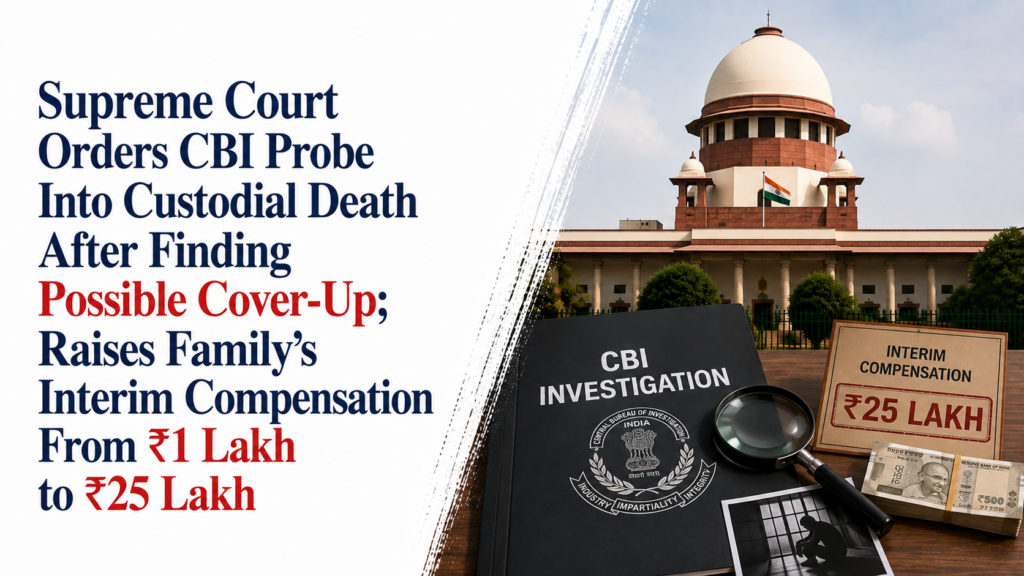
Supreme Court Orders CBI Probe Into Custodial Death After Finding Possible Cover-Up; Raises Family’s Interim Compensation From ₹1 Lakh to ₹25 Lakh

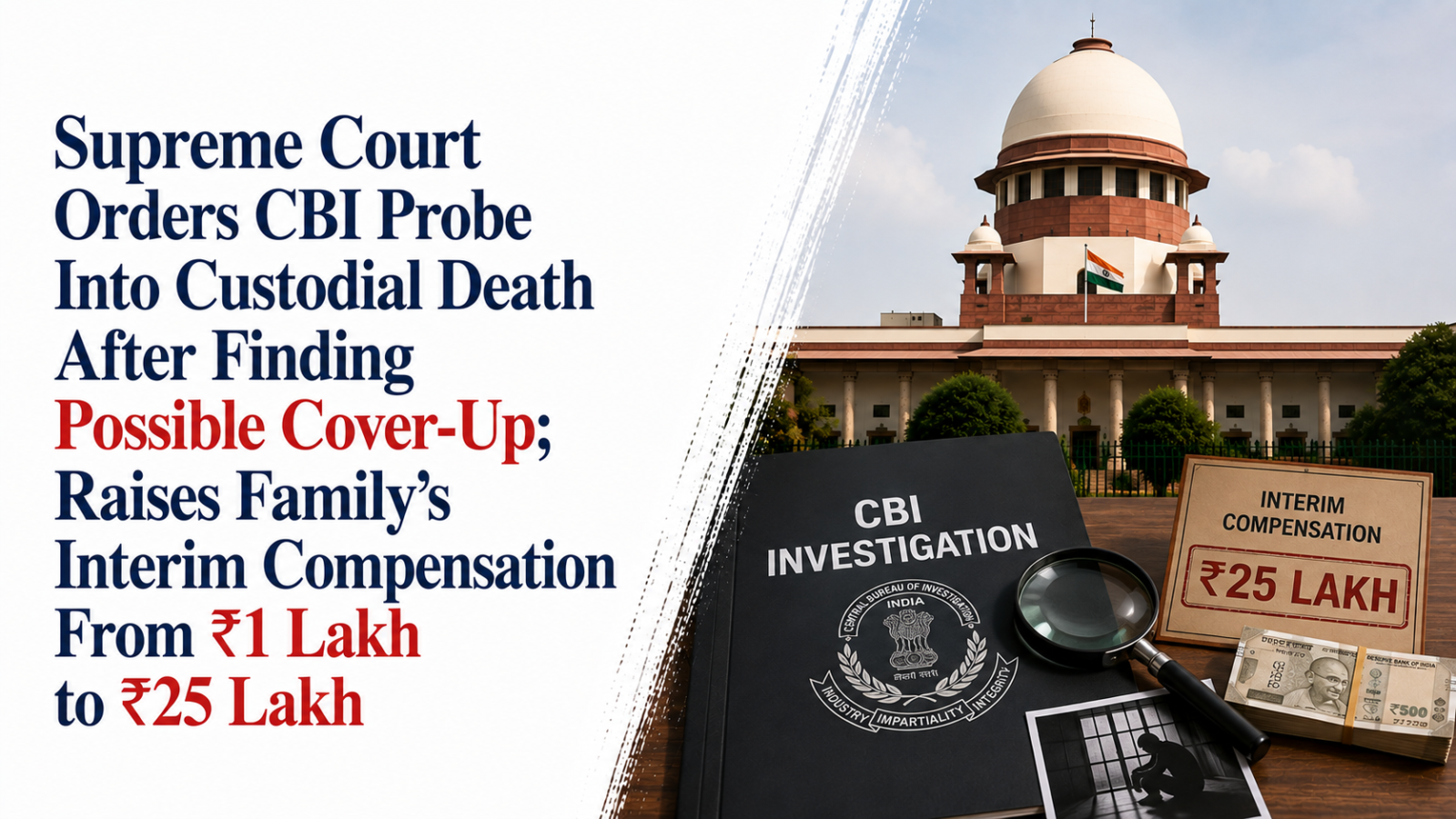
Supreme Court Finds Possible Deliberate Cover-Up of Custodial Death Evidence; Directs CBI Criminal Case and Awards Widow and Children ₹25 Lakh Interim Compensation
Facts
The petitioners were the wife and children of Late Shravan Suryavanshi @ Sarvan Tamre, who died while in State custody. They approached the Chhattisgarh High Court alleging custodial death, seeking investigation/prosecution of those responsible and compensation of ₹50 lakh.
The deceased had been apprehended in connection with FIR No. 47 dated 18 January 2024, registered at Police Station Seepat, District Bilaspur, under Section 34(2) of the Chhattisgarh Excise Act, 1915.
The allegation was that he possessed three bottles containing six litres of raw Mahua liquor valued at ₹1,200. He was arrested by Head Constable Uma Shankar Rathore and taken to Police Station Seepat. After remand, he was lodged at Central Jail, Bilaspur.
His health deteriorated and he was referred to CIMS Hospital, Bilaspur, on 21 January 2024. He died the following morning, 22 January 2024 at about 6:00 a.m.
The post-mortem disclosed several injuries, including a laceration on the occipital scalp, swelling above the wrist and on both legs, and contusions on the right thigh and nape of the neck.
The post-mortem attributed death to cardio-respiratory arrest resulting from complications of a head injury caused by a hard and blunt object. The injuries were antemortem, with their estimated ages indicating that some could have been inflicted during the period of custody.
Since the death occurred in custody, the Jail Superintendent requested a judicial inquiry. An inquiry under Section 176 CrPC was conducted by the Judicial Magistrate First Class, Bilaspur, who submitted a report dated 22 July 2024 stating that the death appeared to have resulted from complications arising from the head injury.
Despite the judicial inquiry, according to the petitioners, no effective criminal action was taken against those responsible.
They therefore approached the Chhattisgarh High Court.
The High Court recognised that the deceased had suffered custodial violence and that his death had resulted from it. Nevertheless, it awarded his family only ₹1 lakh as compensation and did not direct registration of an FIR or investigation against the responsible officials.
Aggrieved by the inadequate compensation and absence of criminal investigation, the family approached the Supreme Court.
Issues
The principal issues before the Supreme Court were:
- Whether the State authorities’ failure to register an FIR and investigate the circumstances surrounding the custodial death, despite the judicial inquiry and medical evidence, was legally sustainable;
- Whether the investigation should remain with State authorities or be transferred to an independent agency such as the CBI;
- Whether the High Court’s award of only ₹1 lakh compensation was adequate for the custodial death of a 34-year-old man who was the family’s sole breadwinner;
- Whether the conduct of police, prison and senior State officials suggested an attempt to suppress, delay or cover up the circumstances surrounding the death; and
- What immediate measures were necessary to secure an effective investigation and compensate the deceased’s family.
Petitioner’s Arguments
The petitioners’ case was that Shravan Suryavanshi died because of violence inflicted during State custody and that the authorities had failed to investigate those responsible despite compelling medical and judicial material.
They relied upon the post-mortem findings, which revealed multiple antemortem injuries and attributed death to complications from a head injury caused by a hard and blunt object.
They contended that despite the judicial inquiry under Section 176 CrPC, no FIR was registered and no effective investigation was initiated.
The family further contended that the ₹1 lakh compensation awarded by the High Court was grossly inadequate considering:
- the gravity of a custodial death;
- the deceased’s age of 34 years;
- his status as the family’s breadwinner;
- the loss suffered by his widow and children; and
- the State’s constitutional responsibility for violence occurring in its custody.
Their original writ petition had sought compensation of ₹50 lakh.
Respondent’s Arguments
The State of Chhattisgarh filed a counter-affidavit before the Supreme Court, but the Court found that it did not disclose what steps had been taken regarding registration of an FIR or investigation into the custodial death.
When senior State officials appeared before the Supreme Court, the Director General of Police took the position that the police had not received the judicial inquiry report under Section 176 CrPC and therefore there was no occasion to register a criminal case.
The Director General (Prisons) also attempted to explain why the judicial inquiry report had not been forwarded to the concerned police officials for follow-up action.
A similar explanation was offered by the Principal Secretary (Home).
The Supreme Court found these explanations wholly unacceptable.
Analysis of the Law
Custodial Death Engages the State’s Public Law Liability
The High Court itself had recognised that compensation can be awarded in public law where State officials violate a person’s fundamental rights.
Such compensation operates as public law or constitutional compensation and is independent of:
- a private law claim for damages in tort; and
- criminal prosecution of the officials responsible.
The High Court had also recognised that compensation for custodial death should have a deterrent effect on the State and its officials.
Despite those findings, however, it awarded only ₹1 lakh.
₹1 Lakh Compensation Was Grossly Inadequate
The Supreme Court noted that the deceased was only 34 years old and was the sole breadwinner of his family.
More importantly, the State did not dispute the High Court’s finding that he had suffered an unnatural death due to violence while in State custody.
The Supreme Court had already observed during an earlier hearing that the ₹1 lakh award was “completely inadequate” and not commensurate with the gravity of the family’s loss.
Accordingly, it directed payment of ₹25 lakh as interim compensation, expressly leaving the final amount to be determined when the petition is finally adjudicated.
Failure to Act on Judicial Inquiry Was Unacceptable
The Supreme Court was particularly critical of the State’s claim that the police had not acted because the Section 176 CrPC judicial inquiry report had not formally reached them.
The judicial inquiry had been completed on 22 July 2024, and the State itself had informed the High Court that such an inquiry was underway and its report was awaited.
The Supreme Court therefore found the senior officials’ claimed ignorance inconsistent with the record.
It described the State’s explanation as a “cover-up story” and an attempt to mislead the Court.
The Court further held that the DGP’s statement that there was no occasion to register a criminal case because the inquiry report had not reached the police was “patently false and wholly reprehensible.”
Medical Records Raised Serious Concerns About Suppression
The Supreme Court identified a disturbing discrepancy between the jail medical records and the post-mortem report.
The jail medical report had recorded the cause of death as cardiopulmonary arrest with aspiration pneumonitis, with a diagnosis of alcoholic withdrawal and delirium tremens.
However, it made no reference to the head injury or the multiple other injuries subsequently documented during post-mortem.
The post-mortem, in contrast, attributed death to cardio-respiratory arrest resulting from the head injury and its complications caused by a hard and blunt object.
The post-mortem report was placed before the Supreme Court only through an additional affidavit filed pursuant to its directions in July 2026.
These circumstances reinforced the Court’s concern that relevant evidence had not been appropriately acted upon or disclosed.
Injuries Could Have Been Sustained During Custody
The timing of the injuries was also significant.
The occipital scalp injury was assessed as being approximately within one day old, while two contusions were estimated to be between two and six days old.
Given the chronology of arrest, incarceration, hospitalisation and death, the Supreme Court held that the possibility that the deceased suffered these multiple injuries during the period of custody could not be ruled out.
The circumstances therefore warranted immediate registration of an FIR and a thorough criminal investigation.
The Court went further and observed that State authorities had “conveniently and deliberately” attempted to cover up the matter.
CBI Investigation Was Necessary
Considering the seriousness of the allegations and the conduct of State authorities, the Supreme Court concluded that the investigation could not appropriately be left with the same State machinery whose conduct itself required scrutiny.
The Court therefore transferred the investigation to the Central Bureau of Investigation.
It directed the CBI Director to:
- immediately ensure registration of a regular criminal case;
- entrust the investigation to a senior CBI officer;
- conduct the investigation expeditiously;
- examine the conduct of State officials who failed to act after the judicial inquiry report; and
- place the Investigating Officer’s report before the Supreme Court on the next date.
The Chhattisgarh DGP was directed to transmit the complete records to the CBI through a special messenger within one week.
Precedent Analysis
The order does not undertake an extensive fresh discussion of individual Supreme Court precedents on custodial compensation. Instead, it records and proceeds from the High Court’s public-law analysis that constitutional courts can award compensation where fundamental rights are violated by the State or its servants.
The High Court had recognised that such compensation constitutes exemplary public-law damages and exists independently of private tort remedies and criminal prosecution. The Supreme Court did not disturb that proposition; rather, its intervention concerned the gross inadequacy of the compensation and failure to direct criminal investigation.
The order therefore applies the established constitutional principle that custodial violence resulting in death is not adequately addressed merely by monetary compensation. Where circumstances disclose a cognizable criminal offence and potential involvement or inaction of State officials, criminal accountability through a fair and independent investigation remains necessary alongside compensation.
Court’s Reasoning
The Supreme Court considered the case especially grave because a man arrested for an offence carrying a maximum sentence of only three years, arising from alleged possession of six litres of raw Mahua liquor worth ₹1,200, ultimately died while in State custody.
The medical evidence disclosed multiple injuries and attributed death to complications from a blunt-force head injury.
A judicial inquiry had been completed.
The High Court itself had found custodial violence.
Yet no FIR had been registered and no effective criminal investigation had followed.
When called upon to explain the failure, senior State officials relied upon non-receipt of the judicial inquiry report—an explanation the Supreme Court found contradicted by the record and indicative of an attempted cover-up.
In these circumstances, an investigation by the same State machinery could not adequately address the Court’s concerns.
The CBI was therefore directed to investigate not only the custodial violence itself but also the conduct of State officials responsible for failing to take action after the judicial inquiry.
Simultaneously, the Court found the ₹1 lakh compensation wholly disproportionate to the death of a 34-year-old sole breadwinner in State custody.
It consequently ordered ₹25 lakh interim compensation, while expressly reserving determination of the final compensation for later adjudication.
Conclusion
The Supreme Court passed strong interim directions in favour of the deceased’s family.
It ordered the CBI to forthwith register a regular criminal case concerning Shravan Suryavanshi’s custodial death and directed that the investigation be entrusted to a senior CBI officer.
The investigation must also examine the role and conduct of State officials who failed to act after completion of the judicial inquiry.
The Supreme Court further directed the State of Chhattisgarh to pay ₹25 lakh as interim compensation to the petitioners within four weeks. The final compensation will be determined when the petition is finally adjudicated.
Accordingly, the matter remains pending before the Supreme Court and has been directed to be listed again on 13 October 2026.
Case Details
Case: Lahra Bai Tamre & Others v. State of Chhattisgarh & Others
Court: Supreme Court of India
Case Number: SLP (Criminal) No. 728 of 2026; 2026 INSC 840
Judge: Justice Vikram Nath and Justice Sandeep Mehta
Date: 12 August 2026
Result: CBI directed to register and investigate the custodial-death case; conduct of State officials also to be investigated; ₹25 lakh awarded as interim compensation; final compensation kept open; matter listed for 13 October 2026.