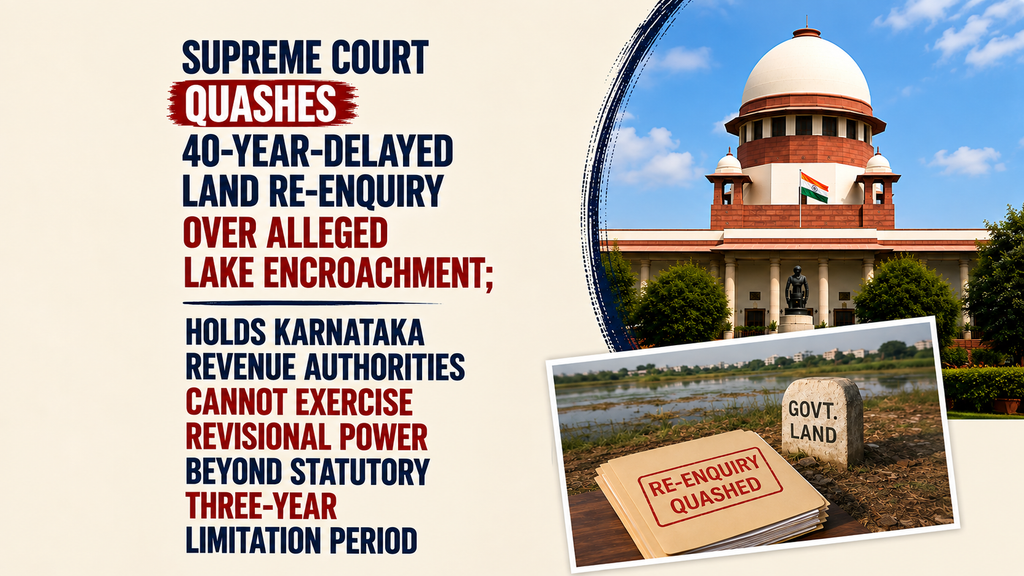
Supreme Court Quashes 40-Year-Delayed Land Re-Enquiry Over Alleged Lake Encroachment; Holds Karnataka Revenue Authorities Cannot Exercise Revisional Power Beyond Statutory Three-Year Limitation Period

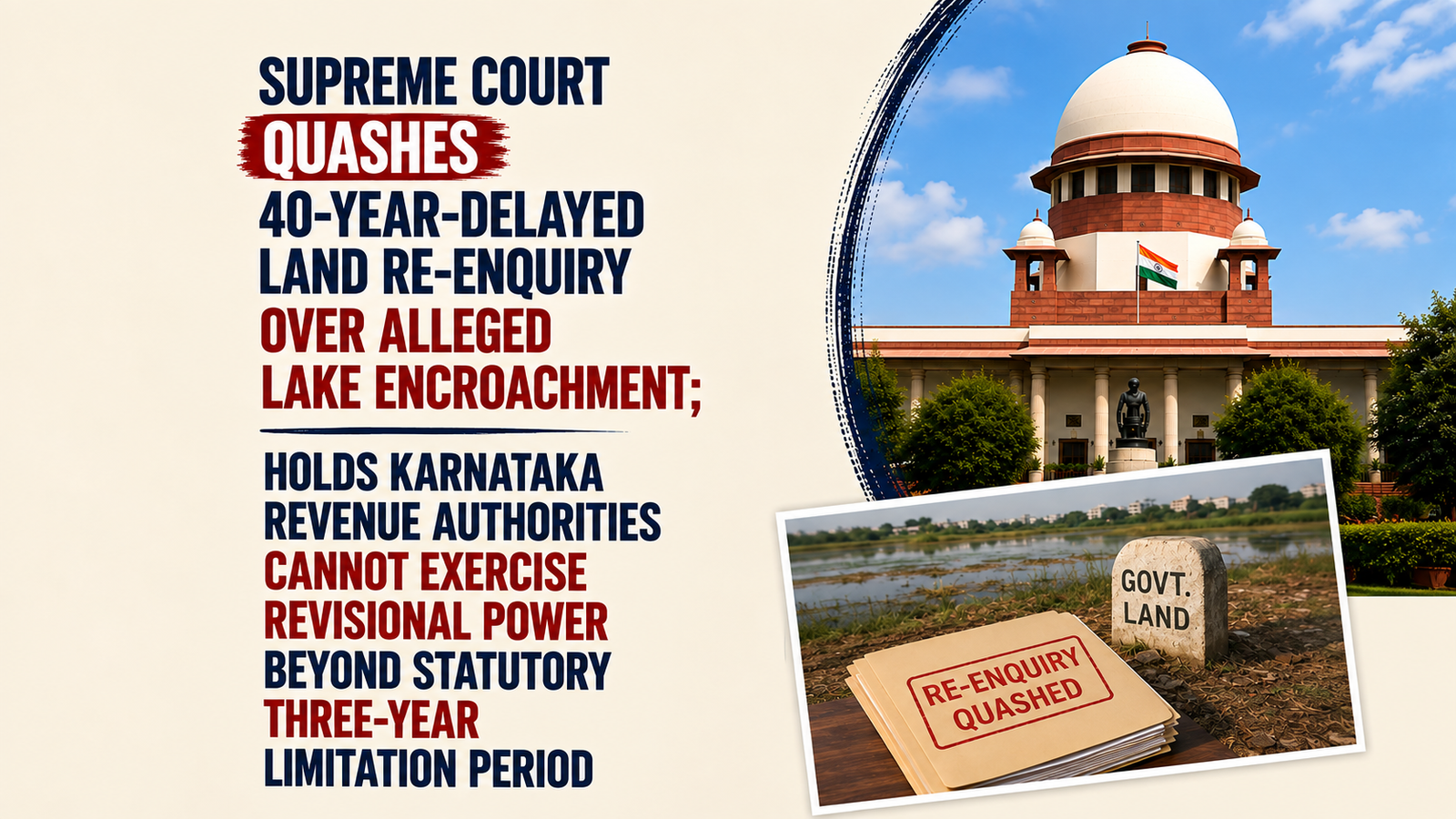
Supreme Court Quashes Re-Enquiry Into Bengaluru Land Ordered 40 Years After CTS Allotment; Holds Three-Year Limitation on Revenue Revision Is Mandatory
Facts
M.R.R. Setty claimed ownership of 28 guntas of land in Survey No. 2 of Dasarahalli Village, Bengaluru, purchased under eight sale deeds executed in 1929. During a City Title Survey conducted in 1974, the property was allotted CTS Nos. 174/1 to 174/5.
In 2004, Setty sought permission to develop the property by constructing a residential apartment building called “Gokul Lake View.” The municipal authority sanctioned the construction plan on 8 July 2004, permitted commencement of construction in May 2005 and issued an Occupancy Certificate in June 2006.
Nearly four decades after the CTS allotment, the Joint Director/Registrar of Land Records issued a notice dated 26 April 2014 under Section 56 of the Karnataka Land Revenue Act, 1964. The notice cancelled an earlier Enquiry Officer’s order and directed a fresh inquiry into several CTS properties.
The proceedings arose from a third-party complaint alleging that members of the public, including Setty, had encroached upon Yediyur Lake.
Setty challenged the notice, contending that the exercise of revisional jurisdiction was hopelessly barred by the express three-year limitation period under the proviso to Section 56(3).
A Single Judge of the Karnataka High Court accepted this contention and quashed the notice. However, the Division Bench reversed that decision, reasoning that the alleged encroachment of Yediyur Lake justified a fresh inquiry into the true nature of the properties.
Setty approached the Supreme Court.
Issues
The principal issue was:
Whether revisional jurisdiction under Section 56 of the Karnataka Land Revenue Act, 1964 could be exercised decades after the original land-record determination despite the express three-year limitation prescribed under Section 56(3).
The Court also considered:
- whether an allegation concerning encroachment of a public lake could justify departure from the statutory limitation;
- whether provisions of the Limitation Act could extend or override the express three-year period; and
- whether the Karnataka Land Revenue (Amendment) Act, 2025 and inherent powers under Section 25 could validate the proposed re-enquiry.
Appellants’ Arguments
The appellants contended that the proposed re-enquiry was without jurisdiction from its inception.
The CTS numbers had been allotted in 1974, whereas the revisional proceedings were initiated only in 2014—approximately four decades later.
Section 56(3) expressly provides that suo motu revisional power against an order not appealed against may be exercised only within three years from the date of that order.
The appellants further relied on the long history of governmental recognition of their property: development permission had been granted, a residential building had been constructed, an Occupancy Certificate had been issued and third-party rights had arisen long before the 2014 notice.
Respondents’ Arguments
The Government of Karnataka defended the re-enquiry principally on the ground that the controversy involved alleged encroachment upon Yediyur Lake and therefore required factual verification rather than termination solely on limitation.
The State relied upon Section 52 of the Karnataka Land Revenue Act, dealing with application of Sections 4, 5 and 12 of the Limitation Act, 1963.
It also relied upon the Karnataka Land Revenue (Amendment) Act, 2025, particularly the amended Section 25 concerning inherent powers of Revenue Courts to prevent or correct abuse of process.
Analysis of the Law
The Supreme Court found the language of Section 56(3) unequivocal.
Its proviso permits a Revenue or Survey Officer to exercise revisional power against an unappealed order only within three years from the date of the order sought to be revised.
Limitation Act Could Not Extend the Period
The State’s reliance upon Section 52 was rejected.
Section 52 concerns application of specified provisions of the Limitation Act to appeals, whereas the present proceedings involved the exercise of revisional jurisdiction under Section 56.
More importantly, once the legislature expressly prescribed a three-year limitation, provisions of the Limitation Act could not be imported to “negate and defeat” that statutory restriction.
Amended Inherent Powers Could Not Save the Proceedings
The Court also rejected reliance on amended Section 25.
The 1974 allotment of CTS numbers was merely an administrative exercise by a Revenue/Survey Officer, not an adjudication by a “Revenue Court” determining a dispute between parties.
Therefore, the inherent review powers available to Revenue Courts under amended Section 25 could not be used to reopen the CTS exercise.
Precedent Analysis
State of Gujarat v. Patil Raghav Natha, (1969) 2 SCC 187
The Supreme Court reiterated that even where a statute prescribes no limitation for suo motu revision, such power must nevertheless be exercised within a reasonable period.
SEBI v. Sunil Krishna Khaitan, (2023) 2 SCC 643
The Court relied upon this judgment for the broader proposition that statutory authorities cannot initiate action whenever they choose.
Even where no limitation is expressly provided, powers must be exercised within a reasonable time, taking into account the nature of the statute, prejudice caused and creation of third-party rights.
The Court noted that this principle had also been affirmed in:
- Mansaram v. S.P. Pathak;
- Government of India v. Citedal Fine Pharmaceuticals;
- State of Orissa v. Brundaban Sharma; and
- State of Punjab v. Bhatinda District Cooperative Milk Producers Union Ltd.
The present case was even stronger because it was not a situation where the statute was silent. Section 56 expressly imposed a three-year limit.
Court’s Reasoning
The Supreme Court emphasized three circumstances.
First, the land had been purchased as far back as 1929.
Second, the State’s own revenue machinery had recognized its private character through the allotment of specific CTS numbers in 1974.
Third, public authorities thereafter granted construction permissions and an Occupancy Certificate, resulting in third-party rights being created long before the 2014 notice.
Against this background, the statutory three-year limit could not be ignored merely because a third party subsequently alleged lake encroachment.
The Court held that invocation of revisional power after the statutory period had expired was “without any mooring in the statute.”
Since the proceedings were vitiated at their very inception, requiring Setty or his successors to participate in the re-enquiry itself would be legally impermissible.
The Division Bench therefore erred in reasoning that judicial interference was premature merely because no final adverse order had yet been passed.
Conclusion
The Supreme Court allowed the appeals.
It set aside:
- the Karnataka High Court Division Bench judgment dated 9 January 2020; and
- the order dated 16 June 2023 dismissing the review petition.
Consequently, the 26 April 2014 notice was quashed insofar as it concerned the appellants’ land.
The judgment establishes a significant limitation principle: where legislation expressly fixes a period for exercise of revisional jurisdiction, authorities cannot reopen decades-old land records beyond that period merely because a subsequent complaint raises an issue of public or environmental importance.
Case Details
Case: M.R.R. Setty (Dead), by LRs v. Government of Karnataka & Ors.
Citation: 2026 INSC 944
Court: Supreme Court of India
Case Number: Civil Appeals arising out of SLP (C) Nos. 23954–23955 of 2023
Bench: Justice Sanjay Kumar and Justice Sanjeev Sachdeva
Judgment by: Justice Sanjay Kumar
Date: 2 September 2026
Result: Appeals allowed; 2014 notice reopening decades-old CTS records quashed as the Section 56 revisional power was exercised far beyond the mandatory three-year limitation period