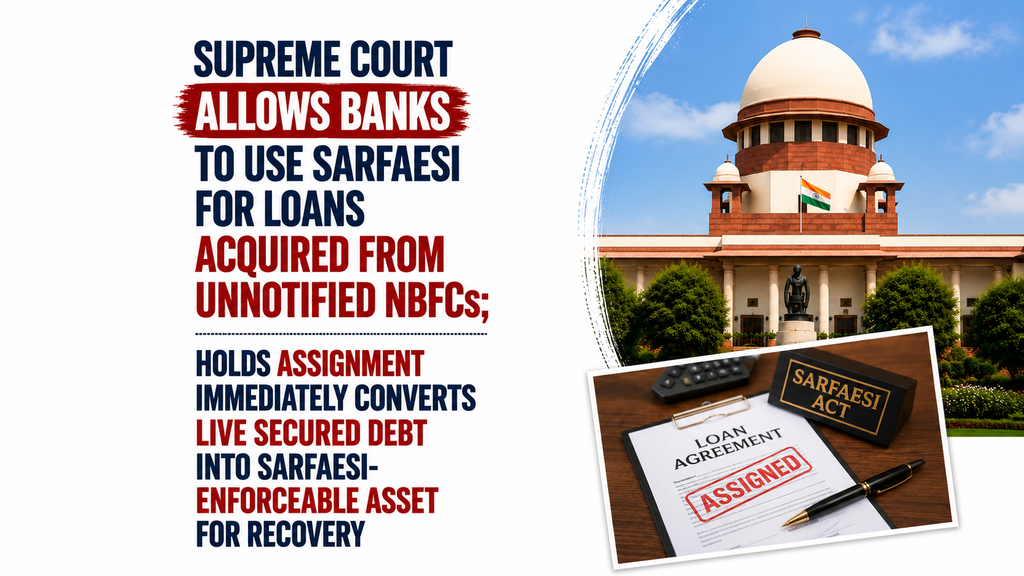
Supreme Court Allows Banks to Use SARFAESI for Loans Acquired From Unnotified NBFCs; Holds Assignment Immediately Converts Live Secured Debt Into SARFAESI-Enforceable Asset for Recovery

Supreme Court Allows Kotak Mahindra Bank to Invoke SARFAESI for Loans Acquired From NBFC Not Covered by Act When Original Loans Were Granted
Facts
The Supreme Court considered three connected appeals raising a common question: whether a bank governed by the SARFAESI Act can invoke its recovery machinery for a debt assigned to it by a financial entity which was not covered by SARFAESI when that debt was originally created.
The lead appeal involved Kotak Mahindra Bank Ltd. (KMBL) and a home loan originally granted by City Financial Consumer Finance Ltd. (CFCFL), an NBFC which was not then notified as a “financial institution” under Section 2(1)(m) of SARFAESI.
Amit Bipin Shah had obtained a home loan of ₹69.60 lakh from CFCFL for purchasing a residential flat from Trupti Sanjay Mehta and Sanjay Walchand Mehta. Upon default, an arbitral award directed him to pay approximately ₹75.30 lakh with interest.
KMBL took over the loan account from CFCFL on 13 July 2012. It thereafter issued a Section 13(2) demand notice claiming approximately ₹1.10 crore and obtained an order under Section 14 permitting possession of the secured flat.
The Mehtas challenged KMBL’s action before the DRT. The DRT held that because CFCFL was not covered by SARFAESI when the debt originated, KMBL could not invoke SARFAESI merely by taking over that debt. The DRAT and Bombay High Court affirmed that view.
Two connected cases concerned other loans originally granted by CFCFL and subsequently assigned to KMBL.
Issues
The principal question was:
Can a loan secured by a mortgage, originally granted by an NBFC which was not a “financial institution” under SARFAESI, subsequently become a “secured debt” enforceable under SARFAESI when acquired by a bank already governed by the Act?
The Court also examined whether the character of the debt is permanently fixed at its inception or whether its statutory status can change when the loan is assigned to an entity entitled to invoke SARFAESI.
Appellant – Kotak Mahindra Bank’s Arguments
KMBL relied upon the assignment of the loan accounts and argued that once the secured debts were legally transferred to it, it acquired the corresponding rights of the original lender.
The bank maintained that the borrowers could not avoid repayment merely because the loans originated with an NBFC which was not covered by SARFAESI.
KMBL also relied upon the contractual assignment clauses in the underlying loan agreements. In the Sables’ case, for instance, the agreements expressly authorised assignment and permitted the assignee to exercise the original lender’s rights.
The Reserve Bank of India supported this interpretation. It stated that it had no objection to banks purchasing NPAs from financial institutions and NBFCs and that assignment of debt is a permissible banking activity.
RBI further argued that preventing an assignee bank from enforcing the acquired security under SARFAESI would undermine the financial system and the secondary market for distressed assets.
Borrowers’ Arguments
The borrowers argued that the character of the debt had to be examined when it was originally created.
Because CFCFL was not a notified financial institution when the loans were advanced, the loans were not originally “secured debts” within the statutory framework of SARFAESI.
According to them, assignment of such a debt to a bank could not retrospectively transform it into a SARFAESI-enforceable secured debt.
Poorti Rent A Car further argued that allowing banks to deliberately acquire NPAs from entities outside SARFAESI and then invoke the Act’s stringent recovery machinery would effectively expand the legislation beyond its intended scope.
Analysis of the Law
The Supreme Court rejected the borrowers’ interpretation.
It emphasized that SARFAESI was enacted to provide banks and financial institutions with an expeditious mechanism for recovering secured debts and reducing non-performing assets, thereby improving liquidity in the financial system.
The Court accepted that SARFAESI provides stringent recovery powers with significantly reduced judicial intervention. However, this feature could not justify an interpretation inconsistent with the Act’s legislative purpose.
The borrowers’ argument would produce an anomalous result: a borrower taking a loan from an NBFC outside SARFAESI would effectively enjoy greater protection against expeditious recovery than a borrower whose loan originated with a notified financial institution.
The Court held that such a distinction had no legal foundation. Every borrower remains legally and morally obliged to repay the loan and interest, regardless of the mode eventually available for its recovery.
Precedent Analysis
M.D. Frozen Foods Exports Pvt. Ltd. v. Hero Fincorp Ltd., (2017) 16 SCC 741
This was a central precedent.
There, the original lender was an NBFC which became a notified financial institution after the loan had already been granted and become an NPA.
The Supreme Court held that SARFAESI applies to all existing loan agreements which are “alive” when the Act becomes applicable to the financial institution.
Therefore, it was immaterial that the lender lacked SARFAESI status when the original loan agreement was executed.
Indiabulls Housing Finance Ltd. v. Deccan Chronicle Holdings Ltd., (2018) 14 SCC 783
In Indiabulls, a loan had originally been granted by an NBFC not covered by SARFAESI. That NBFC subsequently merged with an entity which was covered by the Act.
The Supreme Court held that the successor-in-interest could invoke SARFAESI, notwithstanding the status of the original lender when financial assistance was granted.
The Court held that M.D. Frozen Foods and Indiabulls effectively clinched the present controversy.
Mardia Chemicals Ltd. v. Union of India, (2004) 4 SCC 311
The borrowers relied upon Mardia Chemicals to emphasize the stringent nature of SARFAESI.
The Supreme Court acknowledged that the legislation grants drastic recovery powers but reiterated that its purpose is to address mounting NPAs and ensure liquidity and healthy financial flows in the economy. At the same time, persons affected by those powers must receive a fair deal.
ICICI Bank Ltd. v. Official Liquidator of APS Star Industries Ltd., (2010) 10 SCC 1
The Court noted RBI’s reliance on this judgment, which recognized assignment of debts as a permissible banking activity and acknowledged the statutory force of RBI guidelines concerning purchase and sale of NPAs.
Court’s Reasoning
The Supreme Court formulated the decisive principle clearly.
Once a claim is “live and owing”, SARFAESI becomes available when the legislation becomes applicable to the institution holding that loan account.
Taking that logic further, where a bank already covered by SARFAESI acquires a non-performing secured loan from an entity outside SARFAESI, the acquisition:
immediately clothes the loan account with the attributes of a “secured debt” covered by SARFAESI.
Thus, it makes no material difference whether:
- the original lender itself subsequently comes within SARFAESI;
- the original lender merges into a covered institution; or
- the loan alone is assigned to a bank already governed by SARFAESI.
In each situation, SARFAESI becomes available for recovery once the live secured debt comes into the hands of the qualifying institution.
The Court further rejected attempts to dissect individual statutory definitions of “borrower,” “security arrangement,” “secured creditor” and similar expressions to defeat recovery. The purposive interpretation adopted in earlier Supreme Court decisions foreclosed such arguments.
Accordingly, the Bombay High Court’s contrary judgment in the Mehtas’ case was held to be incorrect.
Conclusion
The Supreme Court held that KMBL was legally entitled to invoke SARFAESI in respect of the secured loans acquired from CFCFL, notwithstanding that CFCFL was not a notified financial institution when those loans originated.
However, the consequences differed across the three connected matters.
In the Mehtas’ case, the Bombay High Court, DRAT and DRT orders were set aside. Because the DRT had never considered their other factual and legal objections on merits, S.A. No. 39 of 2014 was restored for fresh consideration. The Mehtas were permitted to deposit an additional ₹25 lakh with KMBL within eight weeks, without prejudice to their rights.
In the Sables’ case, the Court held that KMBL was legally entitled to invoke Section 14 SARFAESI to obtain physical possession. Their earlier securitisation application had already been dismissed as delayed.
In Poorti Rent A Car, the Court upheld the Bombay High Court’s conclusion that the matter was governed by M.D. Frozen Foods and Indiabulls. The secured property had already been sold in 2023.
Ultimately, KMBL’s Civil Appeal No. 8531 of 2015 was allowed, while the other two appeals were dismissed.
Case Details
Case: Kotak Mahindra Bank Limited v. Trupti Sanjay Mehta & Ors.
Citation: 2026 INSC 943
Court: Supreme Court of India
Case Number: Civil Appeal No. 8531 of 2015 with connected Civil Appeals arising from SLP (C) Nos. 33113/2018 and 9399/2022
Bench: Justice Sanjay Kumar and Justice Sanjeev Sachdeva
Judgment by: Justice Sanjay Kumar
Date: 2 September 2026
Result: Kotak Mahindra Bank’s appeal allowed; Supreme Court held that a bank covered by SARFAESI can invoke the Act to recover a live secured debt acquired from an NBFC that was outside SARFAESI when the loan originated. Connected appeals dismissed.