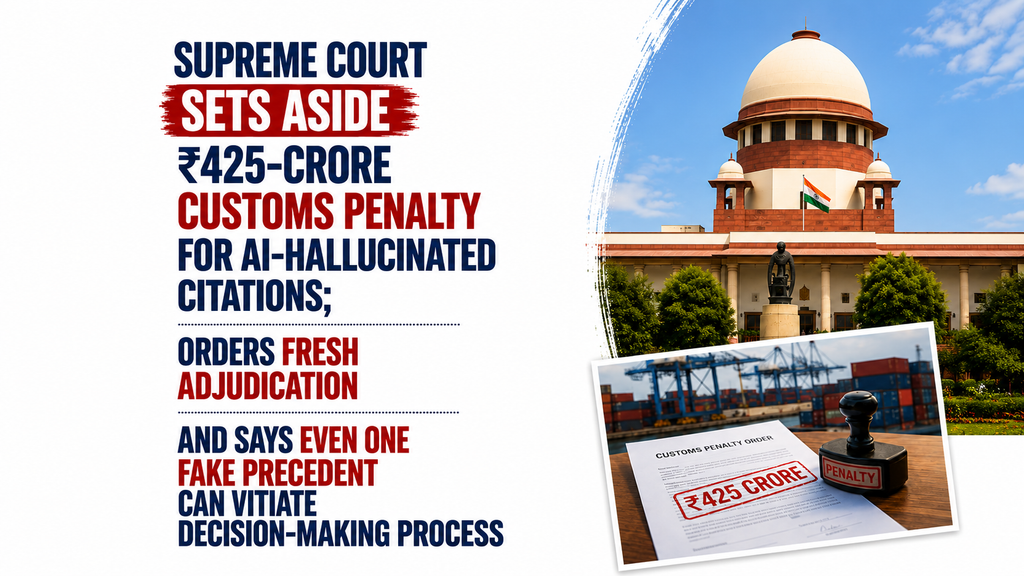
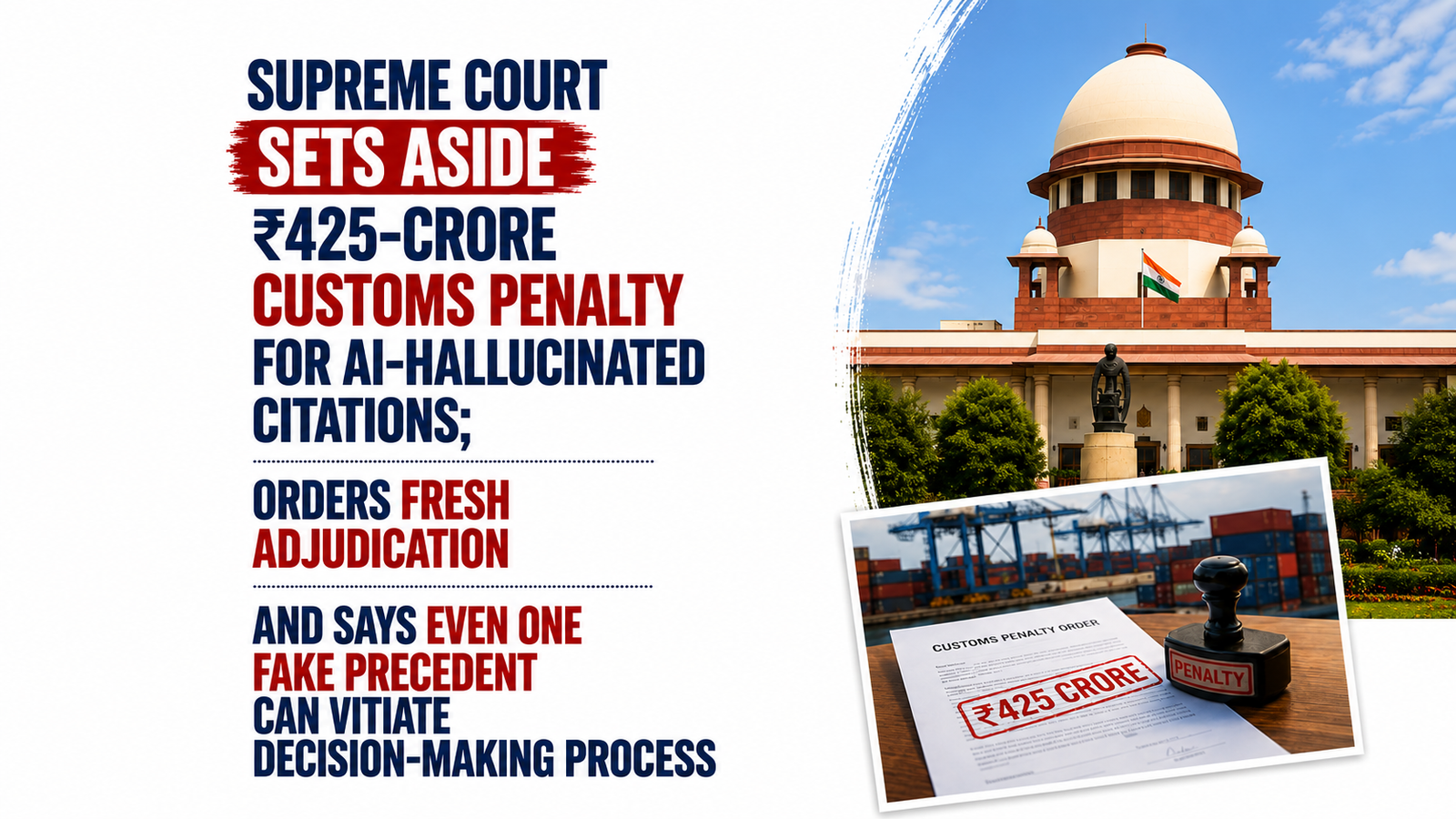
Supreme Court Sets Aside ₹425-Crore Customs Penalty for AI-Hallucinated Citations; Orders Fresh Adjudication and Says Even One Fake Precedent Can Vitiate Decision-Making Process

Supreme Court Sets Aside ₹425-Crore Customs Penalty for AI-Hallucinated Citations; Orders Fresh Adjudication and Says Even One Fake Precedent Can Vitiate Decision-Making Process
Facts
The appellant, Vijay Ghanshyam Gadiya, challenged a customs penalty imposed by the Additional Commissioner of Customs, Surat. By an Order-in-Original dated 8 October 2025, the authority imposed a penalty of ₹425,27,99,100 under Section 114 of the Customs Act, 1962 for allegedly mis-declaring a consignment of natural diamonds as lab-grown diamonds to obtain a lower tariff. The Gujarat High Court dismissed his challenge on 20 January 2026.
Before the Supreme Court, the appellant raised a striking objection: several judgments and articles relied upon in the customs adjudication order had apparently been generated using Artificial Intelligence.
The Supreme Court itself undertook verification.
It found that some cited cases were non-existent, some carried fake citations, and even some genuine judgments did not contain the legal propositions attributed to them. The Court described this as appearing to be an AI hallucination.
Issues
The main issues were whether an adjudicatory order can survive where it relies upon fake or hallucinated AI-generated legal authorities; whether use of AI in judicial or quasi-judicial decision-making is permissible; and what consequence follows where artificial intelligence-generated research contaminates the reasoning process.
Importantly, the Supreme Court held that it was unnecessary to enter into the underlying merits of the customs dispute once the integrity of the adjudication itself was compromised.
Appellant’s Arguments
The appellant contended that several judgments and articles relied upon in the Order-in-Original were generated through AI and were either fabricated or incorrectly represented.
In substance, the challenge was that the adjudicating authority had built part of its reasoning upon legal material which was not authentic, making the penalty order legally unreliable.
Respondents’ Position
The judgment records that once the Supreme Court verified the authorities and found the AI-related defects, the learned Additional Solicitor General did not join issue with the Court’s conclusion that the matter required interference and remand.
Analysis of the Law
The Court relied upon its recent decision in Pooja Ramesh Singh v. Jammu & Kashmir Bank Ltd., which dealt directly with AI-generated precedents.
The governing principle is one of zero tolerance toward fake or hallucinated AI-generated authorities.
The Court reiterated that an advocate citing an AI-generated judgment without verification commits misconduct. Equally, it is a serious lapse for a judge or adjudicator to rely upon fake or hallucinated material as precedent.
Most significantly, the Court stated that where fake or hallucinated legal material enters the adjudicatory process, the resulting decision is vulnerable irrespective of whether that material ultimately had a direct or indirect effect upon the outcome.
Precedent Analysis
Pooja Ramesh Singh v. Jammu & Kashmir Bank Ltd., 2026 SCC OnLine SC 1258
This precedent supplied the controlling legal principle.
The Supreme Court reiterated that courts must adopt a zero-tolerance approach toward unverified AI-generated precedents.
The judgment distinguishes between the legitimate use of AI as an aid and illegitimate reliance on fabricated output masquerading as authoritative legal precedent.
The present case extended that principle beyond conventional court judgments to a quasi-judicial customs adjudication order.
Court’s Reasoning
The Supreme Court expressly acknowledged that use of Artificial Intelligence in adjudicatory processes is not inherently objectionable.
Indeed, it noted that the Supreme Court had itself released draft Regulations for Use of Artificial Intelligence in Courts, 2026 for comments and suggestions.
AI may legitimately function as an assistive tool for speeding up research or decision-making.
But the Court drew a firm boundary:
assistance cannot substitute adjudication.
Its memorable formulation was that AI may function as “training wheels”, but giving it the “pilot’s seat” would be imprudent and dangerous.
In this case, the problem was not merely that AI had been used. The fatal defect was that the adjudicating authority relied upon dubious, non-existent or misrepresented legal material without verification.
That contamination went to the integrity of the decision-making process itself.
The Court therefore held that reliance on such AI-generated material was fatal to the sustainability of the penalty order.
Conclusion
The Supreme Court allowed the appeal.
It set aside both:
- the Gujarat High Court order confirming the penalty; and
- the Customs Order-in-Original imposing the ₹425.27-crore penalty.
The underlying customs proceedings were revived for fresh adjudication, but importantly, the Court directed that they be decided by another officer of the same rank, not the officer who passed the tainted order dated 8 October 2025.
The Supreme Court also left it open to the appointing authority to consider whether any appropriate action should be initiated against the author of the original customs order.
Case Details
Case: Vijay Ghanshyam Gadiya v. Union of India & Anr.
Citation: 2026 INSC 947
Court: Supreme Court of India
Case Number: Civil Appeal arising out of SLP (Civil) No. 15605 of 2026
Bench: Justice Dipankar Datta and Justice Sheel Nagu
Order by: Justice Dipankar Datta
Date: 2 September 2026
Result: Appeal allowed; ₹425.27-crore customs penalty and Gujarat High Court order set aside; proceedings remanded for fresh adjudication by a different officer because the original decision relied on fake and hallucinated AI-generated legal authorities.