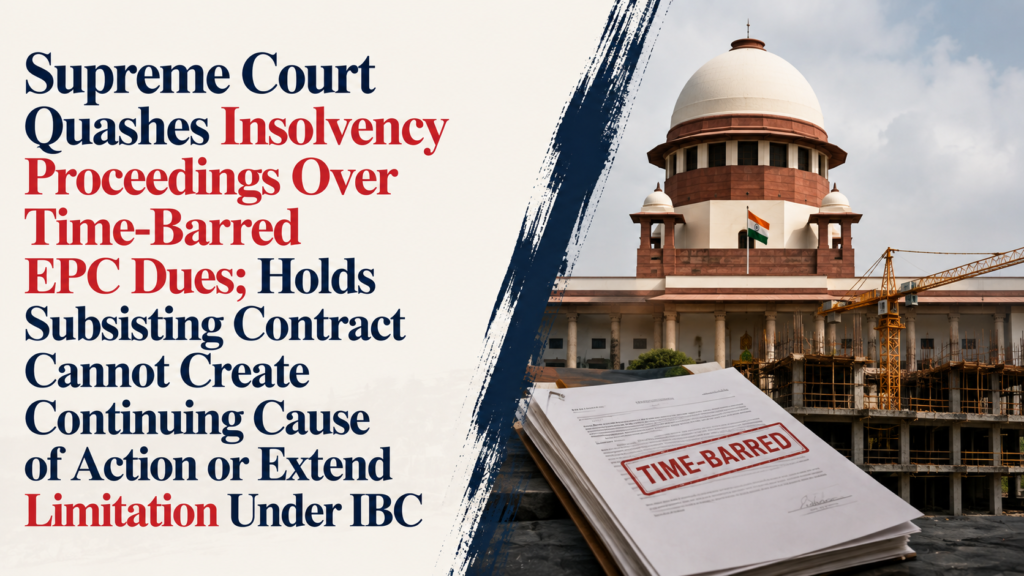
Supreme Court Quashes Insolvency Proceedings Over Time-Barred EPC Dues; Holds Subsisting Contract Cannot Create Continuing Cause of Action or Extend Limitation Under IBC

IBC Cannot Give New Life to Time-Barred EPC Dues: Supreme Court Sets Aside Insolvency Admission but Allows Creditor to Pursue Contractual Remedies
Facts
The dispute arose from an Engineering, Procurement and Construction (“EPC”) contract concerning a 225 MW gas-based combined cycle power station at Bikkavolu, East Godavari District, Andhra Pradesh. Srinivasa Reddy Velagala, the corporate debtor/appellant, had invited an international competitive bid, and Sravanthi Infratech Pvt. Ltd., the respondent/operational creditor, was awarded the project as the lowest bidder. The Letter of Award was issued on 24 December 2010 for ₹827 crore, followed by the EPC agreement dated 9 February 2011. The contemplated completion period was 14 months, and the agreement contained an arbitration clause.
Under the milestone-based payment mechanism, the respondent was entitled to an initial advance of ₹82.7 crore and further payments upon achievement of subsequent milestones. However, the appellant paid only ₹50.15 crore against the amounts claimed to have become payable. The respondent thereafter suspended EPC activities by notice dated 30 July 2011 on account of non-payment.
The respondent subsequently issued legal notices in 2014 and 2015 demanding payment. On 2 July 2018, it issued a statutory demand notice under Section 8 of the Insolvency and Bankruptcy Code, 2016 (“IBC”), claiming approximately ₹1,292.13 crore, and thereafter filed an application under Section 9 on 12 October 2018. The NCLT admitted the insolvency application on 13 December 2019.
The NCLT reasoned that the EPC contract had never been terminated and therefore continued to subsist. It consequently rejected the corporate debtor’s limitation objection. The NCLAT affirmed this approach and upheld the initiation of insolvency proceedings.
The corporate debtor approached the Supreme Court challenging the NCLAT judgment affirming admission of the Section 9 application.
Issues
The Supreme Court formulated four principal issues:
- Whether the EPC contract had been frustrated by efflux of time;
- Whether the monies claimed under Section 9 constituted “operational debt” under Section 5(21) of the IBC;
- Whether there was a pre-existing dispute concerning the respondent’s claims; and
- Whether the Section 9 application concerning the operational debt was barred by limitation.
Petitioner’s Arguments
The appellant/corporate debtor principally contended that the operational debt was time-barred and that the IBC could not be employed to revive a stale monetary claim.
It argued that even assuming the respondent’s legal notice dated 25 July 2014 was treated as the point at which the claim crystallised, proceedings ought to have been initiated within three years under Article 137 of the Limitation Act. Since the statutory IBC demand notice was issued only on 2 July 2018, the claim was hopelessly barred by limitation.
The appellant further contended that there was no valid acknowledgment of liability capable of extending limitation. Reliance was placed upon Babulal Vardharji Gurjar v. Veer Gurjar Aluminium Industries (P) Ltd., Asset Reconstruction Co. (India) Ltd. v. Bishal Jaiswal and Sabarmati Gas Ltd. v. Shah Alloys Ltd. for the proposition that the IBC cannot revive time-barred debts and that limitation ordinarily runs for three years from default.
The appellant also asserted that a pre-existing dispute existed between the parties and relied upon Mobilox Innovations Pvt. Ltd. v. Kirusa Software (P) Ltd. to argue that Section 9 proceedings cannot be maintained where the operational debt was already disputed. It further emphasized that insolvency proceedings cannot be converted into debt-recovery proceedings.
Respondent’s Arguments
The respondent/operational creditor argued that the EPC contract had merely been suspended and never terminated. Suspension could not be equated with termination because the agreement prescribed a specific contractual mechanism for termination.
According to the respondent, the contract remained capable of revival if the appellant discharged its outstanding payment obligations. Consequently, there could be no frustration merely by efflux of time.
On limitation, the respondent argued that the continued subsistence of the EPC contract generated a continuing cause of action, meaning that its claim remained within limitation.
It further contended that milestone payments payable for work performed constituted operational debt under Section 5(21) of the IBC. As regards other claims, the Resolution Professional had already differentiated between operational dues and amounts constituting damages.
On pre-existing dispute, the respondent emphasized that the appellant had never disputed the debt before filing of the Section 9 proceedings and had remained silent despite repeated legal notices. Therefore, there was no genuine pre-existing dispute capable of defeating the insolvency application.
Analysis of the Law
Subsistence and Frustration of the EPC Contract
The Supreme Court held that the EPC agreement had not been frustrated.
Neither party exercised the contractual right of termination. The agreement contemplated specific termination procedures, and termination was not automatic merely because performance remained suspended for a prolonged period.
The Court drew an important distinction between efflux of time and frustration. Efflux of time involves the natural expiry or completion of a contractual period, whereas frustration under Section 56 of the Contract Act results from an unforeseen supervening event rendering performance impossible or unlawful.
The suspension of work caused by non-performance of contractual payment obligations was not such a supervening impossibility. Accordingly, the EPC agreement continued to subsist.
Operational Debt
The Court held that amounts payable under the contractual milestones for goods and services actually supplied under the EPC agreement were capable of constituting operational debt under Section 5(21) of the IBC.
However, it drew a crucial distinction regarding suspension, idling and demobilisation charges. Such claims were in the nature of damages.
The Court held that liquidated or unliquidated damages cannot constitute operational debt unless they have first been assessed and crystallised through adjudication by a competent court or tribunal. NCLT and NCLAT are not forums for adjudicating and quantifying disputed contractual damages.
Pre-Existing Dispute
Applying Mobilox, the Supreme Court held that there was no pre-existing dispute sufficient to bar the Section 9 application.
There was no material showing that the parties were litigating or arbitrating a dispute concerning the particular claims. The appellant had also maintained complete silence despite repeated legal notices from the respondent.
The Court clarified that silence by itself does not necessarily establish absence of a dispute. However, consistent and complete silence extending over approximately seven years could, in the circumstances, constitute strong evidence that the debtor had not actually disputed the creditor’s claims.
Limitation and Continuing Cause of Action
This became the decisive issue.
The Supreme Court categorically rejected the proposition that the continued subsistence of the EPC contract created a continuing cause of action for an earlier payment default.
The Court held that the right to sue accrues when default occurs. An unpaid debt may continue to cause financial consequences, but this does not mean that the legal injury itself continuously renews.
A default under Section 3(12) of the IBC occurs at a singular point in time when a debt becomes due and payable but remains unpaid. Therefore, merely because the underlying EPC contract continued to subsist did not mean that limitation for individual payment defaults continued indefinitely.
Precedent Analysis
The Court considered Mobilox Innovations (P) Ltd. v. Kirusa Software (P) Ltd., (2018) 1 SCC 353, reiterating that a genuine pre-existing dispute concerning the same claim bars initiation of insolvency proceedings by an operational creditor. The dispute need not necessarily have culminated in arbitration or litigation; it may also emerge from the parties’ conduct and correspondence.
The Court relied upon Babulal Vardharji Gurjar v. Veer Gurjar Aluminium Industries (P) Ltd., (2020) 15 SCC 1, particularly for the principle that the IBC was not intended to give a new lease of life to debts already barred by limitation.
The judgment also considered Asset Reconstruction Co. (India) Ltd. v. Bishal Jaiswal, (2021) 6 SCC 366 on acknowledgment of liability and Sabarmati Gas Ltd. v. Shah Alloys Ltd., (2023) 3 SCC 229 on the application of Article 137 of the Limitation Act to Section 9 proceedings.
On frustration, the Court referred to Boothalinga Agencies v. V.T.C. Poriaswami Nadar, reiterating that Section 56 of the Contract Act does not apply to “self-induced frustration”, namely circumstances resulting from a party’s own act or election.
Court’s Reasoning
The Court found that the operational debt had crystallised on 5 January 2012 and 3 February 2012, when the appellant acknowledged the relevant liabilities. The respondent did not initiate proceedings within three years from those dates.
The respondent’s legal notices of 2014 and 2015 could not extend limitation because Section 18 of the Limitation Act requires acknowledgment to emanate from the debtor against whom the claim is made. A creditor cannot extend limitation merely by repeatedly demanding payment.
Since the appellant did not reply with any fresh acknowledgment of liability, there was nothing capable of resetting the limitation clock.
Accordingly, although the Supreme Court accepted that:
- the EPC contract continued to subsist;
- contractual milestone payments could constitute operational debt; and
- there was no pre-existing dispute sufficient to defeat the claim,
the Section 9 application nevertheless failed because it was time-barred.
The Court held that the default occurred more than three years before the insolvency application was filed and that the NCLAT had therefore erred in affirming its admission.
Conclusion
The Supreme Court allowed the appeal and set aside both the NCLAT judgment and the NCLT order admitting the Section 9 application.
The Court held that a subsisting contract does not indefinitely extend limitation for a payment default. An unpaid debt does not constitute a continuing cause of action merely because the underlying contract remains alive.
At the same time, the Court did not extinguish the respondent’s underlying contractual claims. Considering the peculiar circumstances, it granted the respondent liberty to approach the appropriate dispute-resolution forum contemplated by the EPC contract to pursue those claims.
Case Details
Case: Srinivasa Reddy Velagala v. Sravanthi Infratech Pvt. Ltd.
Court: Supreme Court of India
Case Number: Civil Appeal No. 876 of 2021; 2026 INSC 835
Judge: Justice J.B. Pardiwala and Justice Manoj Misra
Date: 12 August 2026
Result: Appeal allowed; NCLT and NCLAT orders admitting the Section 9 IBC application set aside as time-barred; respondent granted liberty to pursue its claims before the appropriate contractual dispute-resolution forum.