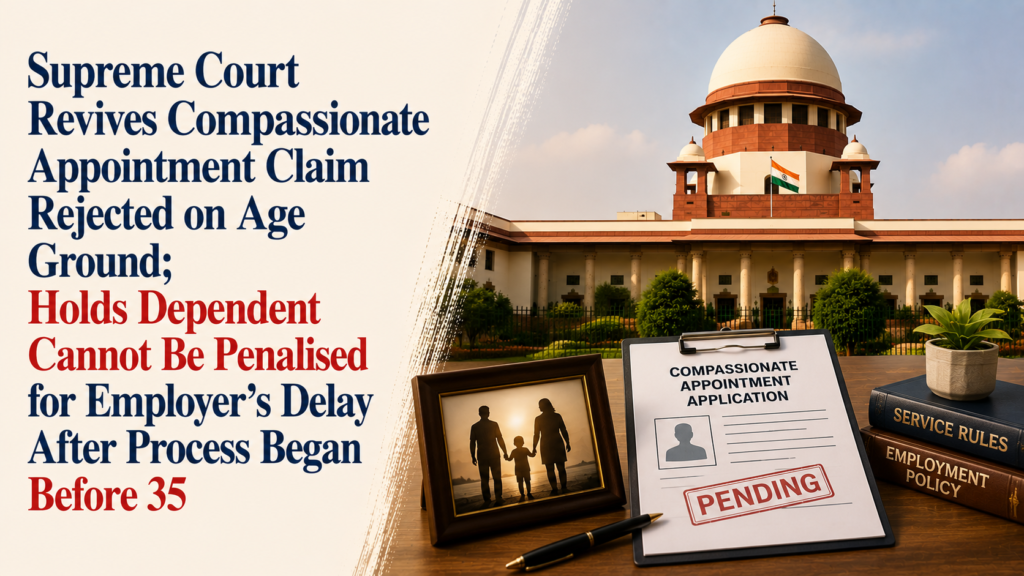
Supreme Court Revives Compassionate Appointment Claim Rejected on Age Ground; Holds Dependent Cannot Be Penalised for Employer’s Delay After Process Began Before 35

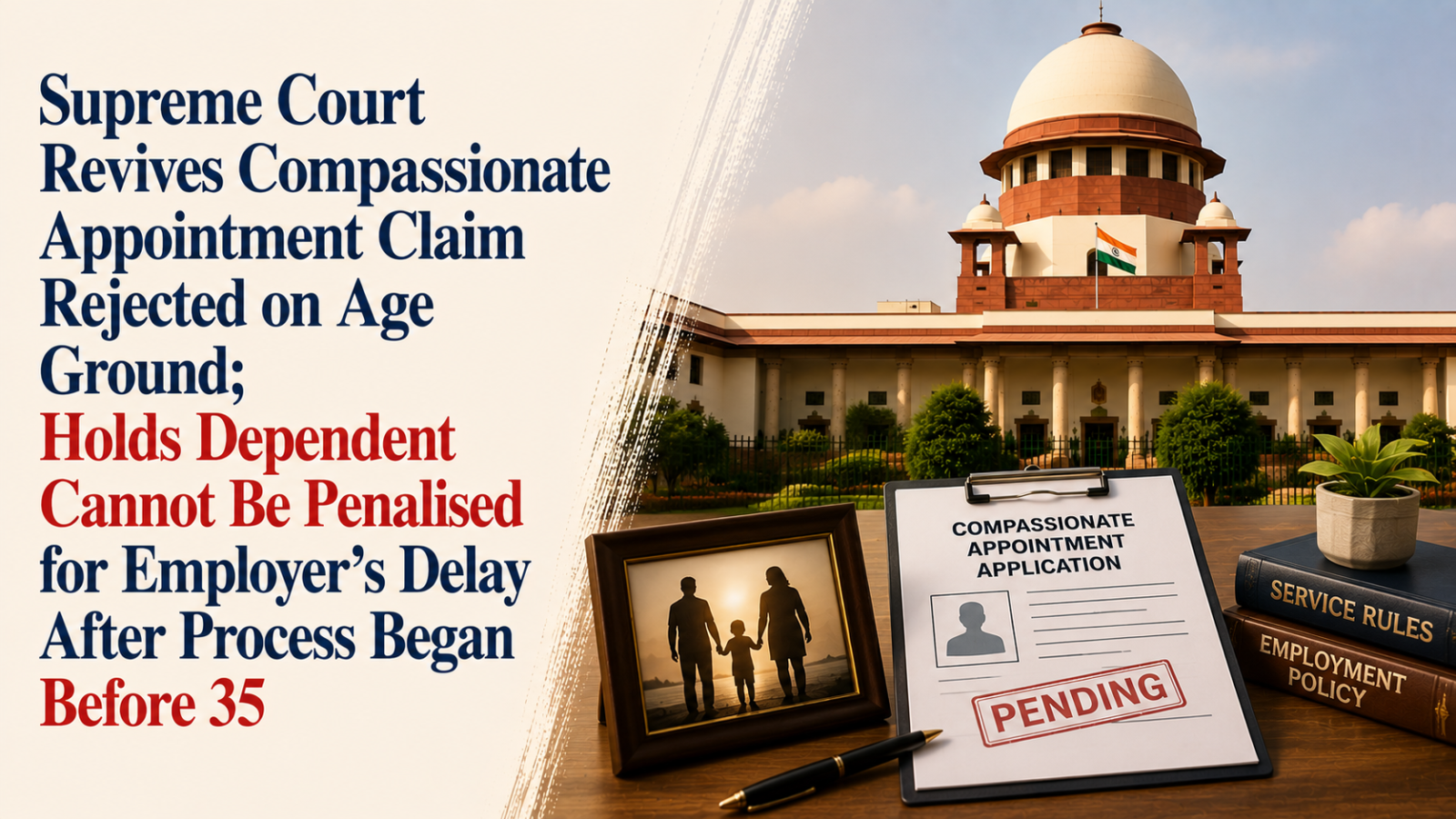
Supreme Court Directs Western Coalfields to Reconsider Deceased Worker’s Son for Compassionate Appointment; Treats Him as Age-Eligible Despite Later Crossing 35
Facts
The appeal arose from the rejection of a claim for compassionate appointment by Western Coalfields Limited (WCL) on the ground that the deceased employee’s son had crossed the maximum permissible age of 35 years under Clause 9.3.4 of the National Coal Wage Agreement-VI (NCWA).
Late Ruspelli Kistaiya had worked as a Dozer Operator with Western Coalfields Limited for nearly 36 years. He died in harness on 17 December 2020.
His son, appellant No. 2, was born on 5 February 1986 and was therefore 34 years, 10 months and 12 days old on the date of his father’s death.
On 3 January 2021, the deceased employee’s widow approached WCL concerning post-death dues and service benefits.
Significantly, on 4 January 2021, WCL itself directed appellant No. 2 to undergo police verification for compassionate appointment.
He turned 35 on 5 February 2021. Police verification was completed on 11 February 2021 and document verification on 25 February 2021.
Thereafter, he submitted the prescribed pro forma application on 28 May 2021, which WCL treated as formally received on 14 June 2021.
Nearly 19 months later, on 3 February 2023, WCL rejected his claim on the ground that he had crossed the maximum age of 35 years prescribed under Clause 9.3.4 of the NCWA.
The widow challenged the rejection before the Bombay High Court, Nagpur Bench.
By judgment dated 26 November 2025, the High Court dismissed the writ petition, holding that age eligibility had to be determined on the date when the claim was considered, by which time appellant No. 2 had crossed 35 years.
The family therefore approached the Supreme Court.
Issues
The principal question before the Supreme Court was:
Where Clause 9.3.4 of the NCWA prescribes an upper age limit of 35 years but does not specify the relevant cut-off date, should age eligibility be determined on the date the employer ultimately considers the application, or when the right to seek compassionate appointment accrued and the appointment process commenced?
The Court also considered:
- Whether WCL’s communication dated 4 January 2021 directing police verification established that the compassionate appointment process had already commenced;
- Whether submission of the formal application on 14 June 2021 alone could be treated as the relevant date for determining age eligibility;
- Whether a dependent who was eligible when the process commenced could subsequently be disqualified because of administrative and procedural delay;
- Whether the COVID-19 disruption between March and June 2021 could fairly be attributed to the applicant; and
- Whether WCL could rely upon its own delay in processing the claim to defeat compassionate appointment.
Petitioner’s Arguments
The appellants argued that Clause 9.3.4 merely prescribed that a dependent should not be more than 35 years old but did not specify the date on which age had to be reckoned.
In the absence of an express cut-off date, they submitted that age should be determined either on:
- the date of death of the employee; or
- at the latest, the date on which the compassionate appointment process commenced.
On both dates—17 December 2020 and 4 January 2021—appellant No. 2 was admittedly below 35.
They relied heavily upon WCL’s communication dated 4 January 2021 directing police verification. According to them, police verification could not have been ordered unless a compassionate appointment claim was already under process.
The formal documents subsequently submitted merely completed procedural requirements and could not retrospectively shift the commencement of the claim to 14 June 2021.
The appellants further argued that WCL could not derive an advantage from its own administrative delay.
The process began in January 2021, but the claim was rejected only in February 2023. Further, the second COVID-19 wave between March and June 2021 severely disrupted administrative functioning.
Making eligibility dependent upon how quickly an employer processes a claim would, according to the appellants, be arbitrary and violative of Article 14.
They relied upon Malaya Nanda Sethy v. State of Orissa, Food Corporation of India v. Kamdhenu Cattle Feed Industries and Canara Bank v. Ajithkumar G.K.
Respondent’s Arguments
Western Coalfields contended that compassionate appointment is not a vested or enforceable right but a concession governed strictly by the applicable scheme.
Clause 9.3.4 prescribed a maximum age of 35 years, and according to WCL, that eligibility requirement could not be relaxed on sympathetic or equitable considerations when the scheme itself contained no relaxation provision.
WCL argued that the appellants’ concept of “initiation of the compassionate appointment process” had no basis in the NCWA.
The communication dated 4 January 2021 directing police verification was characterised as merely a preliminary administrative exercise, rather than initiation or consideration of the claim.
According to WCL, the claim became complete and capable of consideration only when the prescribed application and supporting documents were submitted and acknowledged on 14 June 2021. By then, appellant No. 2 had already crossed 35.
WCL further argued that administrative delay could not create eligibility where none existed and that Article 14 and legitimate expectation had no application because the age criterion had been uniformly applied.
It warned that treating different preliminary steps as commencement dates would create uncertainty in administration of the scheme.
Analysis of the Law
Compassionate Appointment Is Not a Right, but the Scheme Must Be Applied Fairly
The Supreme Court reiterated that compassionate appointment cannot be claimed as a matter of right.
However, it is a welfare measure intended to provide immediate financial assistance to the family of an employee who dies in harness.
Consequently, the applicable scheme must be interpreted fairly and reasonably so that its object is achieved rather than defeated.
The Court therefore rejected an interpretation under which an applicant who satisfied the age criterion when the claim arose could become ineligible merely because administrative processing continued beyond his 35th birthday.
Applicant Was Below 35 When the Claim Arose
The undisputed chronology was crucial.
The employee died on 17 December 2020, when appellant No. 2 was below 35.
The widow approached WCL on 3 January 2021.
On 4 January 2021, WCL itself directed appellant No. 2 to undergo police verification.
He turned 35 only on 5 February 2021.
Thus, both when his father died and when WCL commenced processing his compassionate appointment claim, he satisfied the prescribed age requirement.
Police Verification Proved That the Process Had Commenced
The Supreme Court rejected WCL’s contention that its 4 January 2021 police-verification letter was merely a routine preliminary exercise.
WCL’s own Standard Operating Procedure stipulated that antecedent and police verification had to be obtained before processing a compassionate employment claim.
The Court reasoned that there would have been no reason to order police verification if no claim had been initiated.
Accordingly, WCL’s own conduct established that the compassionate appointment process had already commenced on 4 January 2021, while appellant No. 2 was still below 35.
Formal Application Was a Procedural Requirement, Not the Starting Point
The Supreme Court also rejected WCL’s argument that the claim came into existence only upon receipt of the prescribed formal application on 14 June 2021.
The Court held that an applicant who was fully eligible on the date of death and submitted his formal application within a reasonable period of six months could not be rendered ineligible merely because procedural formalities consumed time.
Such an interpretation would defeat the very purpose of compassionate appointment.
COVID-19 Delay Could Not Be Held Against the Applicant
The Court took judicial notice of the practical circumstances surrounding the application.
Police and document verification were completed in February 2021. Immediately thereafter, the second wave of the COVID-19 pandemic struck between March and June 2021, severely disrupting normal administrative functioning.
The applicant nevertheless submitted the prescribed pro forma on 28 May 2021, which was acknowledged on 14 June 2021.
The Supreme Court held that any delay during this period could not fairly be attributed to the applicant, nor could he be made to suffer for circumstances beyond his control.
Employer Cannot Benefit From Its Own Delay
This was the central legal principle applied by the Court.
Even if 14 June 2021 were assumed to be the relevant date, WCL did not reject the claim until 3 February 2023—approximately 19 months later.
The Supreme Court held that an employer cannot defeat the claim of an otherwise eligible dependent by taking advantage of its own delay in processing the application.
The High Court had incorrectly proceeded on the premise that no significant administrative delay had occurred.
The Supreme Court found this conclusion contrary to the record.
Precedent Analysis
Malaya Nanda Sethy v. State of Orissa & Ors., (2024) 15 SCC 766
This was the principal precedent relied upon and applied by the Supreme Court.
The decision establishes that an otherwise eligible applicant should not suffer because of delay or inaction attributable to the employer.
It also emphasises the need for compassionate appointment applications to be considered expeditiously and preferably within six months from submission of the completed application.
The Court applied this reasoning directly to the present facts, observing that WCL could not obtain a benefit from its own 19-month delay in deciding the claim.
Food Corporation of India v. Kamdhenu Cattle Feed Industries, (1993) 1 SCC 71
The appellants relied upon this judgment in support of their plea of legitimate expectation.
Their argument was that WCL’s decision to commence police verification represented that the compassionate appointment claim had been accepted for processing, and the employer could not later deny that the process had commenced.
The judgment records this reliance, although the Supreme Court ultimately decided the appeal primarily on the interpretation of the scheme, WCL’s own SOP and administrative delay rather than separately deciding the case on legitimate expectation.
Canara Bank v. Ajithkumar G.K., 2025 INSC 184
The appellants also relied upon this recent decision for the proposition that a dependent otherwise satisfying a compassionate appointment scheme should not be denied consideration solely because of age, particularly where delay is attributable to the employer.
Again, while the precedent supported the appellants’ submissions, the Supreme Court’s express analysis centred principally upon Malaya Nanda Sethy and the particular chronology of the case.
Court’s Reasoning
The Supreme Court considered the 4 January 2021 police-verification communication decisive.
WCL’s own SOP provided that police and antecedent verification preceded processing of a compassionate appointment claim.
Therefore, if WCL itself directed the applicant to undergo police verification, it could not subsequently contend that no claim existed at that stage.
The process had plainly commenced on 4 January 2021, when appellant No. 2 was still below 35.
The Court further held that submission of the formal application in May/June 2021 merely completed the necessary procedural requirements. It could not erase or alter the fact that the compassionate appointment process had already begun.
The applicant also acted within a reasonable period, while part of the intervening delay coincided with the unprecedented disruption caused by the second COVID-19 wave.
Most importantly, WCL itself subsequently took approximately 19 months to reject the claim.
The Supreme Court therefore held that allowing WCL to use the applicant’s age at the eventual date of consideration would effectively permit the employer to manufacture ineligibility through its own administrative delay.
Accordingly, the High Court erred in affirming WCL’s decision.
Conclusion
The Supreme Court allowed the appeal and set aside the Bombay High Court, Nagpur Bench judgment dated 26 November 2025.
It did not directly order compassionate appointment.
Instead, the Supreme Court directed Western Coalfields Limited to:
- reconsider appellant No. 2’s claim for compassionate appointment;
- treat him as eligible so far as the age requirement is concerned;
- examine only the remaining eligibility conditions under the applicable scheme; and
- complete reconsideration within eight weeks from receipt of the judgment.
If he is otherwise found eligible, WCL must offer him appointment within four weeks thereafter.
Importantly, the Supreme Court expressly clarified that its judgment was rendered “in the peculiar facts and circumstances of the present case.”
The ruling therefore does not establish an unrestricted proposition that age limits in all compassionate appointment schemes can be ignored. Rather, it protects an applicant who was within the prescribed age when the process had demonstrably commenced and whose claim was later defeated because of procedural and administrative delay.
Case Details
Case: Raspelli Bhagya Kishaiya & Ors. v. General Manager, Western Coalfields Limited & Ors.
Court: Supreme Court of India
Case Number: Civil Appeal arising out of SLP (C) No. 7244 of 2026; 2026 INSC 841
Judge: Justice Aravind Kumar and Justice Vipul M. Pancholi
Date: 12 August 2026
Result: Appeal allowed; Bombay High Court judgment set aside; WCL directed to reconsider compassionate appointment by treating appellant No. 2 as age-eligible within eight weeks and, if otherwise eligible, offer appointment within four weeks thereafter.