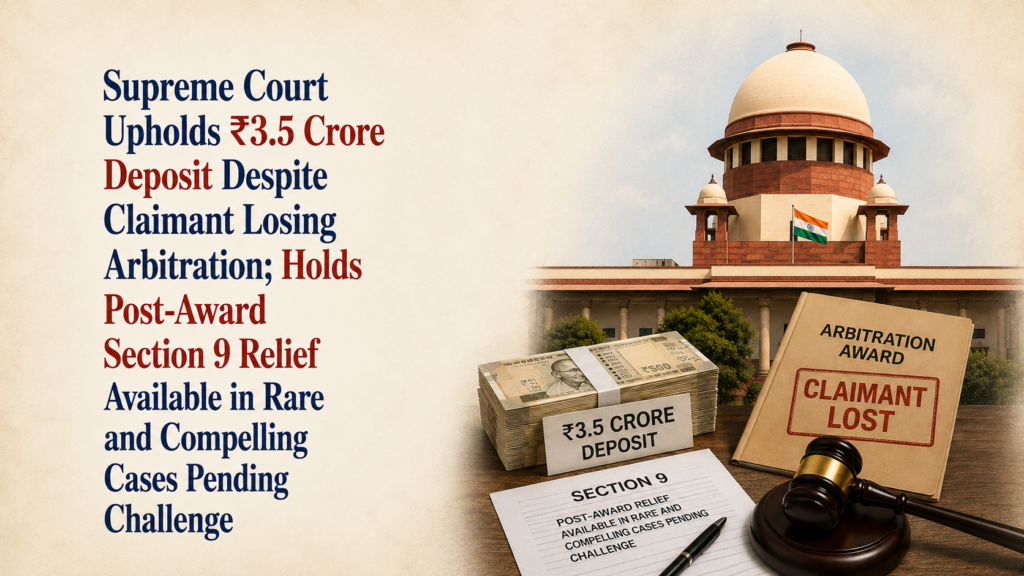
Supreme Court Upholds ₹3.5 Crore Deposit Despite Claimant Losing Arbitration; Holds Post-Award Section 9 Relief Available in Rare and Compelling Cases Pending Challenge

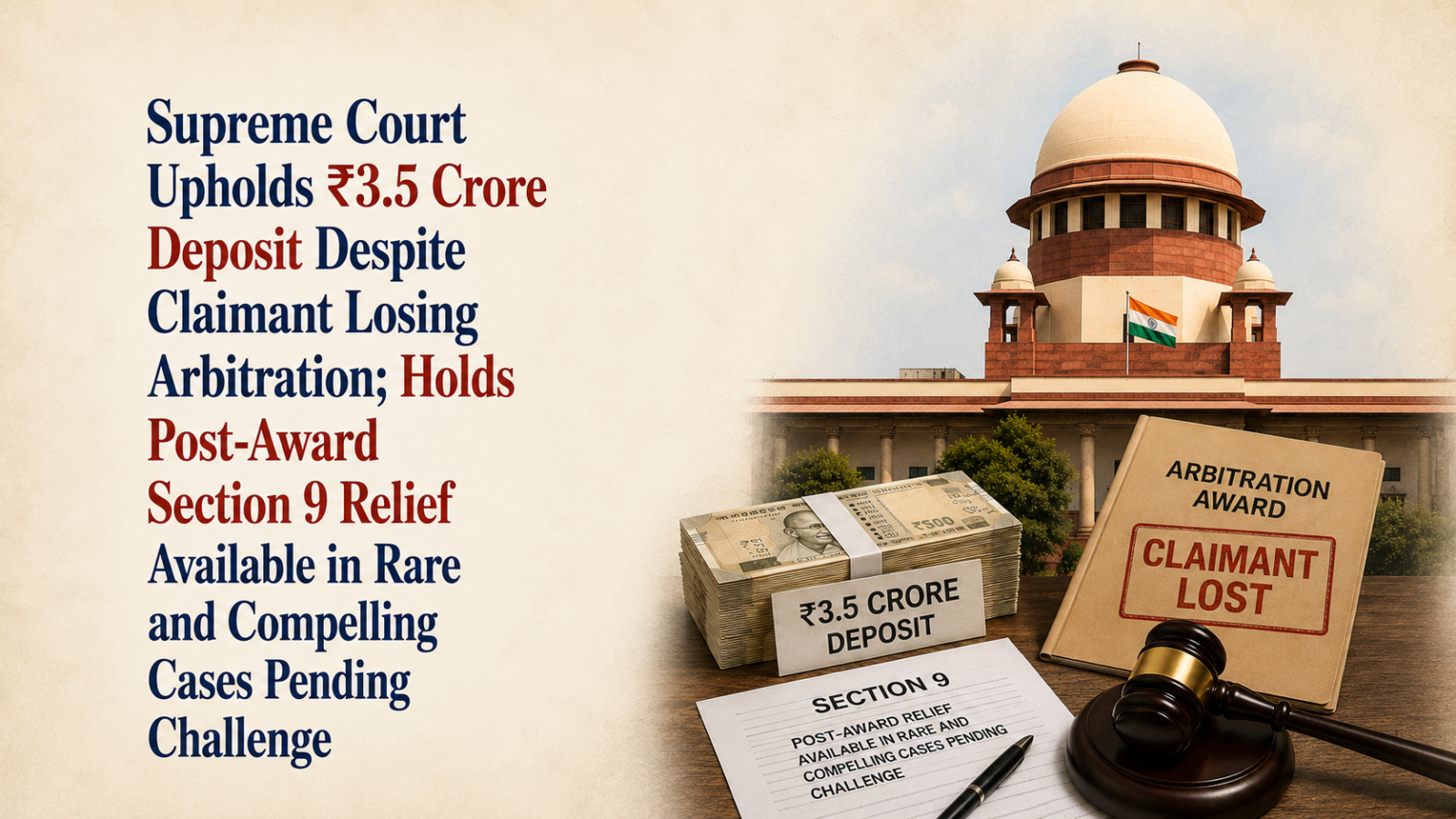
Supreme Court Finds Possible Unjust Enrichment After ₹3.5 Crore Bank Guarantee Encashment; Upholds Interim Deposit Despite Contractor Losing Arbitration
Facts
National Projects Construction Corporation Ltd. (“NPCC”) and Ishvakoo (India) Pvt. Ltd. entered into an MoU dated 16 August 2002 concerning works relating to bus termini and development of the Taj Trapezium Zone Heritage Corridor at Agra. In December 2002, Ishvakoo received a ₹3.5 crore mobilisation advance against bank guarantees furnished by it. Disputes subsequently arose and were referred to arbitration.
In earlier Section 9 proceedings, the Delhi High Court recorded an arrangement under which Ishvakoo was required to keep the bank guarantees alive, while NPCC agreed not to invoke them. NPCC would become entitled to encash the guarantees if, after arbitration, it was found entitled to recover money from Ishvakoo.
Ishvakoo subsequently failed to keep the guarantees alive, and NPCC invoked them for approximately ₹3.5 crore in September 2017. A pre-award Section 9 petition challenging the encashment was disposed of after the High Court found no fault with NPCC’s conduct because Ishvakoo had failed to keep the guarantees alive.
The Arbitrator delivered the award on 5 December 2017 and dismissed Ishvakoo’s claims. Importantly, NPCC had filed no counterclaim. The arbitral proceedings included issues concerning discharge of the bank guarantees and bank charges incurred for keeping them alive.
Ishvakoo challenged the award under Section 34 of the Arbitration and Conciliation Act, 1996. During those proceedings, it ultimately filed a fresh application under Section 9, seeking return/security of the ₹3.5 crore realised by NPCC through the guarantees.
The Delhi High Court directed NPCC to deposit ₹3.5 crore with its Registry, observing, inter alia, that NPCC had made no counterclaim and there was no arbitral finding that the mobilisation advance had not been utilised. Permitting NPCC to retain the amount in the meantime could therefore result in unjust enrichment. The Division Bench affirmed the order.
NPCC appealed to the Supreme Court.
Issues
The principal question was whether the High Court was justified in directing NPCC to deposit ₹3.5 crore under Section 9 pending Ishvakoo’s Section 34 challenge, even though Ishvakoo had lost before the Arbitrator.
The Court consequently considered:
- whether an unsuccessful party or “award debtor” can maintain a post-award Section 9 petition;
- the threshold applicable when such a party seeks interim protection;
- whether directing deposit of money amounted to impermissible final relief or merits review of the award; and
- whether the particular circumstances concerning the bank guarantees justified interim protection.
Appellant’s Arguments
NPCC argued that Section 9 could not be used to grant relief effectively amounting to a final adjudication while the Section 34 challenge remained pending.
It submitted that post-award Section 9 jurisdiction exists principally to protect the fruits of an award pending enforcement. Since Ishvakoo’s claims had been dismissed entirely, it had no award or adjudicated amount in its favour requiring protection.
NPCC further argued that the bank guarantees had already been lawfully encashed and the legality of that encashment stood concluded by the earlier High Court order.
According to NPCC, the High Court had impermissibly undertaken a merits review of the arbitral award at an interlocutory stage. It also contended that the absence of a counterclaim did not affect its right to retain the money and that the requirements analogous to Order XXXVIII Rule 5 CPC had not been established.
Respondent’s Arguments
Ishvakoo emphasised that NPCC had never filed a counterclaim in the arbitration.
It further argued that the award contained no finding that the ₹3.5 crore mobilisation advance had not been utilised and that the issue concerning discharge of the bank guarantees remained unaddressed by the Arbitrator.
Ishvakoo submitted that allowing NPCC to retain the entire amount while its Section 34 challenge remained pending would result in unjust enrichment.
It relied upon the broad remedial powers conferred upon courts under Section 9 to argue that the High Court was competent to secure the amount pending final determination.
Analysis of the Law
The Supreme Court first held that the maintainability of a post-award Section 9 application by an unsuccessful party was no longer res integra.
It relied heavily upon Home Care Retail Marts Pvt. Ltd. v. Haresh N. Sanghavi, 2026 SCC OnLine SC 670, which held that the expression “a party” in Section 9 encompasses any party to the arbitration agreement and is not restricted to the successful award-holder.
An unsuccessful party may require interim protection where refusal would leave it remediless or cause irreversible prejudice while its Section 34 challenge remains pending. However, such relief is exceptional.
The Supreme Court emphasised that the threshold is higher for an unsuccessful party. Post-award Section 9 protection in its favour should ordinarily be granted only in “rare and compelling cases” where it is necessary to prevent irreparable prejudice and preserve the efficacy of Section 34 proceedings.
The usual principles governing interim relief continue to apply:
- a strong prima facie case;
- balance of convenience;
- irreparable harm or prejudice; and
- reasonable expedition in approaching the Court.
Precedent Analysis
Home Care Retail Marts Pvt. Ltd. v. Haresh N. Sanghavi
The Court treated Home Care Retail Marts as directly governing the maintainability question.
That decision establishes that a party which loses in arbitration is not automatically barred from invoking Section 9 after the award. The distinction between a “winning” and “losing” party cannot determine access to Section 9 because the ultimate Section 34 proceedings may alter the parties’ rights.
At the same time, Home Care prescribed a heightened threshold: such intervention should ordinarily be confined to rare and compelling cases.
Essar House Pvt. Ltd. v. ArcelorMittal Nippon Steel India Ltd.
The Court relied on Essar House for the proposition that Section 9 confers wide powers to secure the amount in dispute and that courts are not rigidly bound by the literal requirements of Order XXXVIII Rule 5 CPC.
The Court must nevertheless exercise the power judicially, considering the prima facie case, balance of convenience and whether the applicant approached the Court with reasonable expedition.
Jagdish Ahuja v. Cupino Ltd. and Nimbus Communications Ltd. v. BCCI
The Court approved the principle that Section 9 jurisdiction is broad and that while CPC principles guide the exercise of discretion, the Court is not mechanically or rigidly bound by their text.
The controlling consideration is whether the interim measure promotes the efficacy of arbitration as a dispute-resolution mechanism.
Adhunik Steels Ltd. v. Orissa Manganese and Minerals Pvt. Ltd.
The Court reiterated that traditional principles governing interim injunctions are not alien to Section 9.
Thus, prima facie case, balance of convenience, irreparable injury, and what is “just and convenient” continue to regulate the exercise of Section 9 jurisdiction.
Court’s Reasoning
The Supreme Court concluded that Ishvakoo satisfied even the higher threshold applicable to an unsuccessful party.
Several circumstances were decisive.
First, the original 2005 High Court arrangement contemplated NPCC recovering money through the bank guarantees if the arbitral adjudication established an amount recoverable by it.
Second, NPCC never filed a counterclaim before the Arbitrator.
Third, the Arbitrator appeared to have proceeded without appreciating that the bank guarantees had already been encashed before the award was delivered.
Fourth, there was prima facie no arbitral finding that Ishvakoo had failed to utilise the mobilisation advance. Whether this was ultimately correct remained a matter for determination in the pending Section 34 proceedings.
Fifth, the earlier order finding no fault with the invocation of the guarantees did not preclude the subsequent post-award Section 9 proceedings because the question had materially changed after the award.
Sixth, in the absence of a counterclaim and an arbitral finding regarding non-utilisation of the mobilisation advance, allowing NPCC to retain ₹3.5 crore pending the Section 34 proceedings could prima facie amount to unjust enrichment.
The Supreme Court therefore characterised the matter as precisely the type of “rare and compelling case” contemplated in Home Care Retail Marts. Interim protection was necessary to prevent irreparable prejudice and preserve the effectiveness of Ishvakoo’s Section 34 challenge.
The Court also held that the High Court had exercised its discretion judicially rather than arbitrarily and that securing the ₹3.5 crore amount furthered the efficacy of arbitration.
Conclusion
The Supreme Court dismissed NPCC’s appeal and upheld the Delhi High Court’s direction requiring it to secure the ₹3.5 crore bank guarantee amount.
NPCC was granted four weeks to deposit ₹3.5 crore with the Registry of the Delhi High Court. The amount was directed to be placed in a fixed deposit with a nationalised bank on an auto-renewal basis until disposal of Ishvakoo’s Section 34 application.
Importantly, the Supreme Court clarified that its observations were confined to deciding the Section 9 proceedings. The pending Section 34 challenge must be decided independently on its own merits, uninfluenced by the observations made in the interim proceedings.
Case Details
Case: National Projects Construction Corporation Ltd. v. Ishvakoo (India) Pvt. Ltd.
Court: Supreme Court of India
Citation: 2026 INSC 828
Case Number: Civil Appeal No. 5819 of 2025
Judges: Hon’ble Mr. Justice K. V. Viswanathan and Hon’ble Mr. Justice Alok Aradhe
Date: 11 August 2026
Result: Appeal dismissed; NPCC directed to deposit ₹3.5 crore with the Delhi High Court within four weeks, to remain in an interest-bearing fixed deposit pending disposal of the Section 34 challenge.