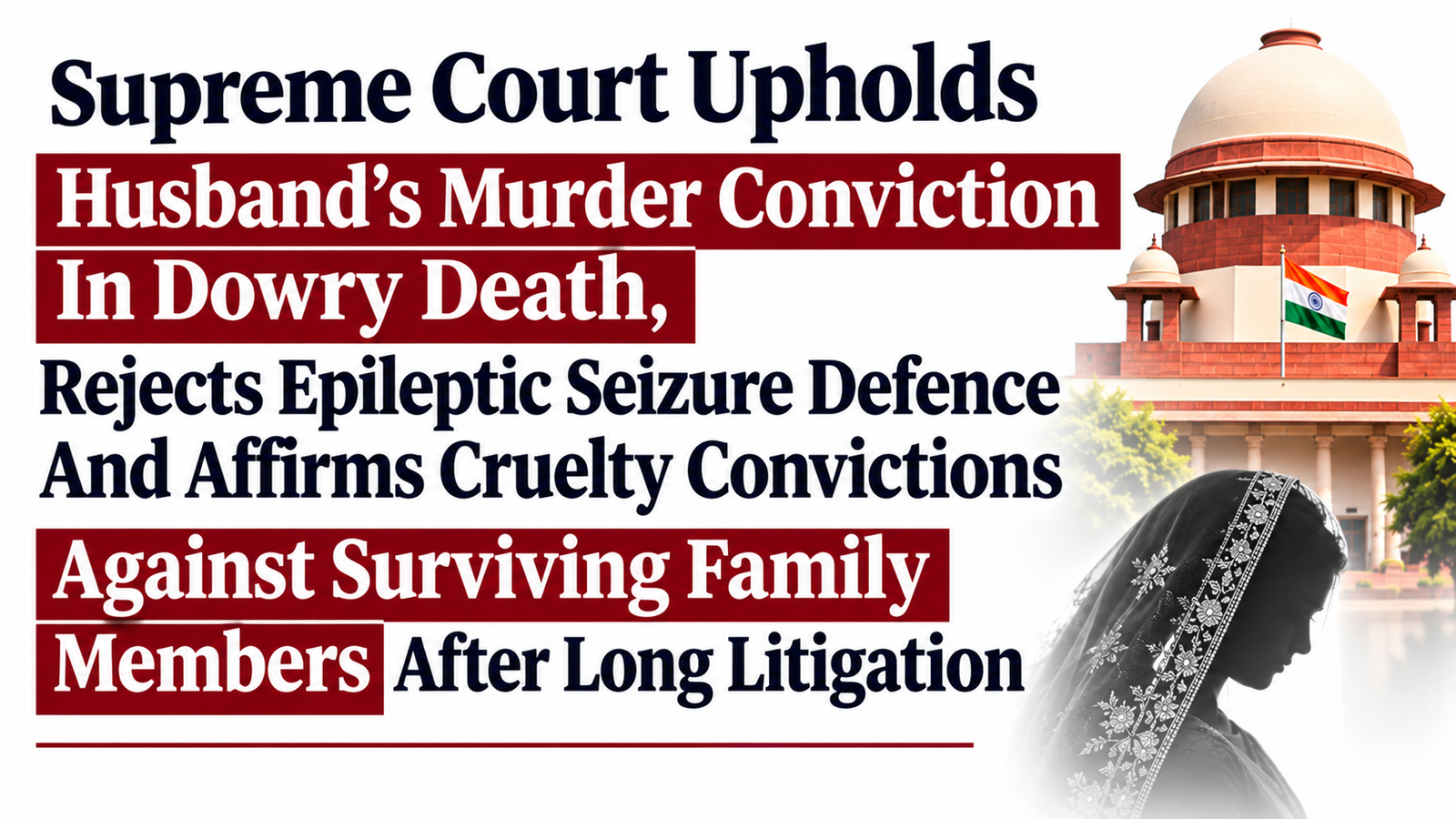
Supreme Court Upholds Husband’s Murder Conviction In Dowry Death, Rejects Epileptic Seizure Defence And Affirms Cruelty Convictions Against Surviving Family Members After Long Litigation

Supreme Court Holds Husband Must Explain Wife’s Fatal Throttling Inside Matrimonial Home, Applies Section 106 Evidence Act And Sustains Dowry Death Convictions In Domestic Homicide
Facts
Vimalbai married Ramkishan Digambar Jadhav on 12 May 1995 and died at their matrimonial home on 1 February 1996, within nine months. The prosecution alleged repeated dowry demands of ₹50,000, a television, a tape deck and an MIDC plot, accompanied by cruelty and starvation. Post-mortem evidence identified asphyxia due to throttling. In 1998, the Sessions Court convicted her husband Ramkishan, father-in-law Digambar and brother-in-law Venkat under Sections 498-A and 304-B read with Section 34 IPC, but acquitted them of murder. On 3 July 2013, the Bombay High Court additionally convicted Ramkishan under Section 302 IPC and sentenced him to life imprisonment. Digambar died during the Supreme Court proceedings; his appeal abated.
Issues
Whether circumstantial and medical evidence proved murder by the husband; whether Section 106 of the Evidence Act required him to explain a death within his exclusive knowledge; and whether cruelty linked to dowry demands soon before an unnatural death supported Sections 498-A and 304-B IPC and the Section 113-B presumption against the surviving appellants.
Petitioner’s Arguments
Ramkishan argued that his wife died accidentally after an epileptic seizure during sexual intercourse and that the circumstantial chain was incomplete. Digambar and Venkat contended that they were implicated merely because of their family relationship, without proof of specific acts of dowry harassment. They sought parity with three female relatives acquitted of all charges by the trial court. The appellants urged the Supreme Court to reverse the Bombay High Court’s findings and acquit them.
Respondent’s Arguments
Maharashtra relied upon the autopsy, which recorded neck injuries, a fractured hyoid bone and death by throttling, directly contradicting the seizure account. The State emphasized that Ramkishan admitted being alone with Vimalbai at the relevant time but offered no credible explanation, attracting Section 106 of the Evidence Act. The State further relied on evidence of sustained demands and mistreatment shortly before death, invoking the dowry-death presumption in Section 113-B.
Analysis of the Law
Section 302 IPC punishes murder; Section 498-A addresses cruelty by a husband or his relatives; and Section 304-B deals with dowry death where an unnatural death within seven years of marriage is preceded by dowry-related cruelty or harassment soon before death. Section 113-B of the Evidence Act provides a rebuttable presumption upon proof of foundational facts. Under Section 106, an accused may have to explain facts especially within personal knowledge, but the prosecution retains the initial burden to prove its case. A demonstrably false account may strengthen, but cannot substitute for, the established incriminating circumstances. Section 34 concerns common intention.
Precedent Analysis
The Supreme Court applied Trimukh Maroti Kirkan v. State of Maharashtra, (2006) 10 SCC 681, which recognizes the evidentiary difficulty of proving offences committed privately inside a home. Once the prosecution establishes relevant incriminating circumstances, a household inmate with special knowledge must provide a cogent explanation under Section 106; silence or a false account can become an additional link. The quoted passage in Trimukh also refers to State of Punjab v. Karnail Singh, (2003) 11 SCC 271. The judgment does not formulate a new general presumption of guilt merely from marriage or co-residence.
Court’s Reasoning
The medical findings included subcutaneous haemorrhage around the larynx, thyroid-cartilage bruising and a fractured left horn of the hyoid bone, excluding the asserted epileptic fit. Ramkishan admitted being with his wife when she died; his disproved explanation completed the circumstantial chain for murder. On dowry cruelty, Vimalbai’s brother (PW-2), the marriage mediator (PW-3), her father (PW-4) and two independent neighbours (PW-5 and PW-6) gave mutually corroborative accounts of demands, beatings, starvation and threats. The Court held that the Section 113-B presumption was unrebutted and affirmed the dowry-death and cruelty convictions; it did not separately undertake an extensive role-by-role discussion of Venkat.
Conclusion
The Supreme Court dismissed Ramkishan’s Criminal Appeal No. 1849/2013 and the surviving challenge in Criminal Appeal No. 962/2014. His life sentence under Section 302 IPC and the convictions under Sections 498-A and 304-B IPC were sustained; Venkat’s convictions under Sections 498-A and 304-B read with Section 34 also stood. Digambar’s appeal had abated upon his death. Bail bonds of the surviving appellants were cancelled, and they were directed to surrender within four weeks, failing which the trial court could take coercive steps, including non-bailable warrants. Pending applications were disposed of.
Case: Ramkishan Digambar Jadhav v. State of Maharashtra (with connected appeal)
Court: Supreme Court of India, Criminal Appellate Jurisdiction
Case Number: Criminal Appeals Nos. 1849/2013 and 962/2014; 2026 INSC 1187
Judge: Justices Sandeep Mehta (author) and Devendra Kumar Upadhyaya
Date: 2 November 2026
Result: Appeals dismissed for surviving appellants; murder and dowry-death convictions affirmed; Digambar’s appeal abated; surrender in four weeks.