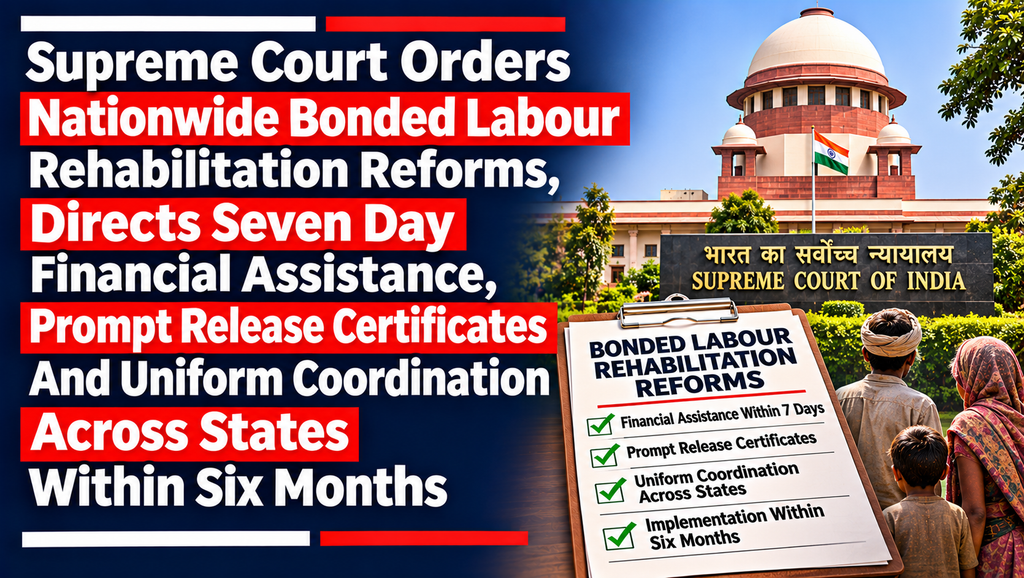
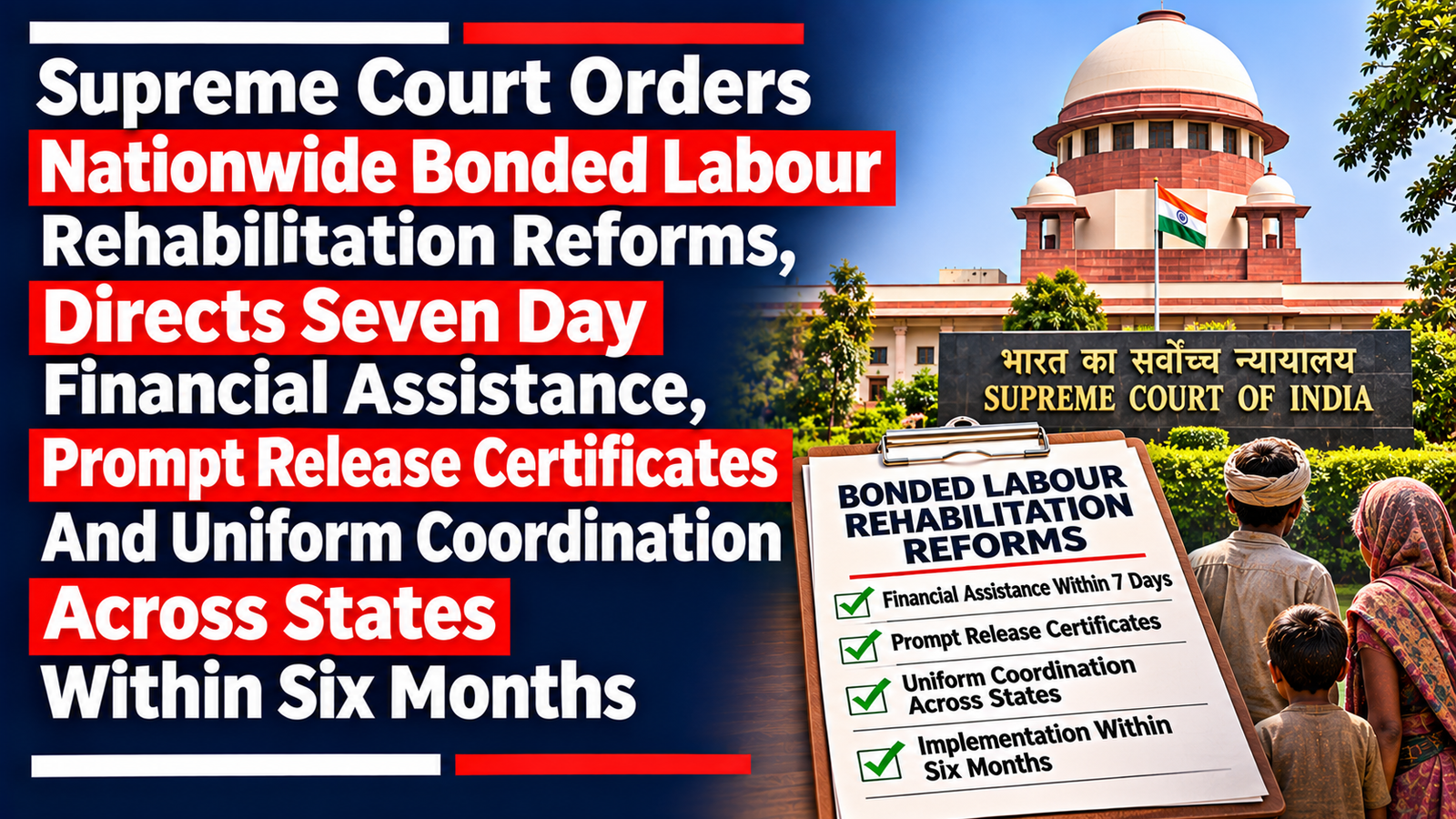
Supreme Court Orders Nationwide Bonded Labour Rehabilitation Reforms, Directs Seven Day Financial Assistance, Prompt Release Certificates And Uniform Coordination Across States Within Six Months

Supreme Court Holds Rescue Alone Cannot End Bonded Labour Obligations, Prescribes Rehabilitation Timelines And Keeps Petitions Pending To Monitor Nationwide Compliance Through Continuing Judicial Oversight
Facts
Surendra Manjhi and other workers were rescued on 28 February 2019 from a brick kiln in Shahjahanpur, Uttar Pradesh, after being taken from Bihar in connection with bonded debts. Although release certificates were issued, rehabilitation assistance was delayed: Manjhi received immediate aid only in 2022, and the petition stated that only 25 of 42 released workers had received ₹20,000 each, leaving 17 unpaid. His Article 32 petition was heard with a 2026 petition filed by the National Campaign Committee for the Eradication of Bonded Labour and others, exposing wider gaps in identification, release, inter-State coordination and rehabilitation. Following earlier directions and consultations, the Union filed a compliance affidavit on 15 May 2026 referring to a revised Standard Operating Procedure (SOP) dated 14 May 2026.
Issues
Whether the constitutional duty to abolish bonded labour ends at rescue or extends to prompt assistance and sustained rehabilitation; how national procedures should address delayed certificates, unpaid benefits and inter-State administrative barriers; and what enforceable timelines and monitoring mechanisms are required while the petitions remain pending.
Petitioner’s Arguments
Manjhi highlighted the prolonged withholding of immediate assistance despite confirmed release, including the position of 17 fellow labourers. The connected petitioners sought uniform, workable procedures for identifying and rescuing bonded labourers, release certificates recognised across State borders, prompt rehabilitation payments, effective Vigilance Committees and accountability for implementation. Their case was that procedural differences should not deprive vulnerable survivors of constitutional and statutory entitlements. Bachpan Bachao Andolan, identified as petitioner No. 2 in the operative discussion, also furnished proposals on the rehabilitation framework.
Respondent’s Arguments
The judgment records a cooperative rather than conventionally adversarial proceeding. The Union of India placed a Ministry status note and its compliance affidavit, describing measures undertaken and the revised SOP; the Attorney General participated in consideration of proposed reforms. Bihar identified practical difficulties caused by Uttar Pradesh release certificates not following the prescribed format. The Court did not record a substantive denial of the State’s rehabilitation obligations, but examined the adequacy of implementation and administrative coordination.
Analysis of the Law
Article 23 prohibits bonded labour and comparable forced labour; Article 21 protects dignified life, while Article 24 provides additional protection for children in hazardous employment. The Bonded Labour System (Abolition) Act, 1976 abolishes the system (Section 4), extinguishes bonded-debt obligations (Sections 5–6), assigns enforcement functions to authorities and District Magistrates (Sections 10–12), and establishes district and sub-divisional Vigilance Committees (Sections 13–14). Read with the Central Sector Rehabilitation Scheme, these provisions impose positive, continuing duties. Crucially, immediate financial assistance, subject to identification and verification, cannot be postponed merely because investigation or criminal proceedings have not concluded. The Court used Article 32 to address systemic enforcement failures without replacing executive functions.
Precedent Analysis
In Bandhua Mukti Morcha v. Union of India, (1984) 3 SCC 161, the Supreme Court treated identification, liberation and meaningful rehabilitation as integral to protecting the constitutional rights of bonded labourers. Neeraja Chaudhary v. State of Madhya Pradesh, (1984) 3 SCC 243, similarly emphasised that release without effective rehabilitation leaves survivors exposed to renewed exploitation. The present Bench applied these authorities to move from recognition of rights to time-bound administrative standards and monitoring. The decision is a set of operative directions in pending public-law proceedings, not a final disposal of the writ petitions.
Court’s Reasoning
Justices Vikram Nath and Aparesh Kumar Singh held that delayed aid can defeat the very purpose of liberation: rescue alone does not secure a durable life of dignity. The Court ordered nationwide implementation of the revised SOP within six months and supplementary Union/NHRC guidelines within three months. Complaints should ordinarily be verified within 24 hours; release certificates should ordinarily issue within 24 hours of determination; and admissible immediate assistance should ordinarily be paid within seven days of certification, subject to verification. Individual rehabilitation plans and measures must begin within 90 days of rescue. The Court required uniform certificates, inter-State nodal officers, functional Vigilance Committees, NAVJIVAN Portal monitoring, monthly State reviews, grievance redressal ordinarily within 30 days, child-sensitive measures, training and at least one year of follow-up.
Conclusion
The Court issued nationwide administrative and financial rehabilitation directions, including a decision within three months on proposed Scheme revisions. Uttar Pradesh and Bihar must jointly verify the 17 workers’ outstanding assistance within one month and pay sums found due preferably within three months, and in any event within six months. The Union must file a compliance affidavit within four months; States and Union Territories must comply within six months and submit affidavits two weeks thereafter. Both Article 32 petitions remain pending for monitoring, to be listed after seven months. The ruling makes clear that statutory freedom from bondage must be accompanied by timely, accessible support—not postponed until criminal prosecution concludes.
Case: Surendra Manjhi & Anr. v. Union of India & Ors. (with connected petition)
Court: Supreme Court of India, Civil Original Jurisdiction
Case Number: W.P. (Civil) No. 511/2022 with W.P. (C) Diary No. 32325/2026; 2026 INSC 1185
Judge: Justices Vikram Nath (author) and Aparesh Kumar Singh
Date: 2 November 2026
Result: Nationwide rehabilitation directions and compliance deadlines issued; both writ petitions retained for monitoring; next listing after seven months.