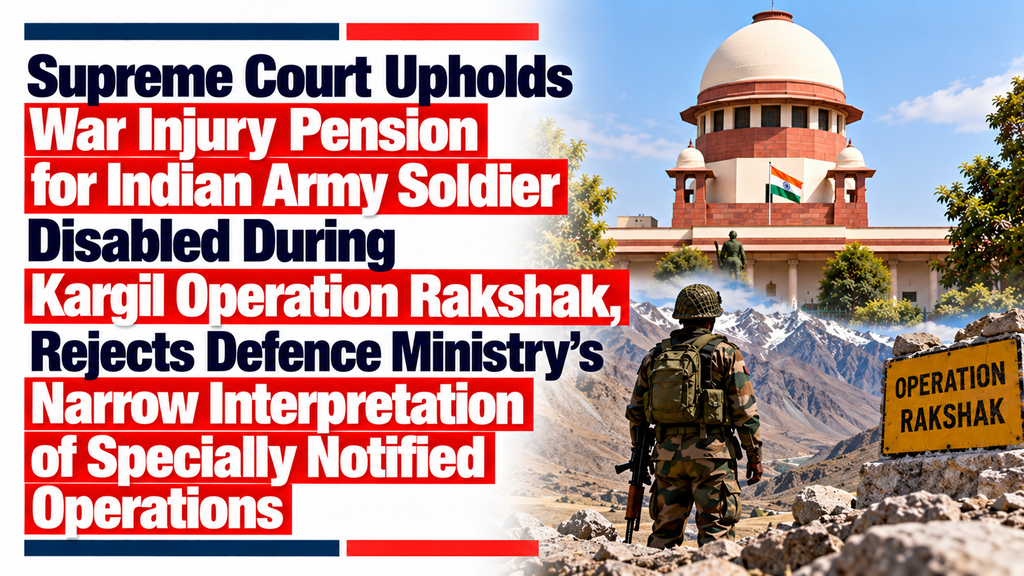
Supreme Court Upholds War Injury Pension for Indian Army Soldier Disabled During Kargil Operation Rakshak, Rejects Defence Ministry’s Narrow Interpretation of Specially Notified Operations

Supreme Court Rules Operation Rakshak Covered by War Injury Pension Policy, Dismisses Union Appeal and Calls for Clearer Government Notifications Defining Eligible Soldiers’ Pension Entitlements
Facts
Narender Kumar joined the Indian Army in December 1996 and served at Kargil under Operation Rakshak from July 2003 to July 2005, when he developed seropositive rheumatoid arthritis. Later spinal conditions were also diagnosed. On discharge in January 2013, the Release Medical Board assessed his three service-aggravated disabilities at 70%, rounded to 75% for life; he received service and disability pension elements. Seeking the higher War Injury Pension for rheumatoid arthritis under Category E(i) of the Ministry of Defence (MoD) policy dated 31 January 2001, he succeeded before the Armed Forces Tribunal in 2024 and the High Court in 2025. The Union appealed.
Issues
Whether illness arising during posting at Kargil under Operation Rakshak falls within “operations specially notified by the Government” in Category E(i), warranting War Injury Pension rather than ordinary Disability Pension; and whether the MoD could exclude ongoing operations through its interpretation.
Petitioner’s Arguments
The Union of India, as appellant, argued that Category E targets deaths or disabilities occurring in war or genuinely war-like events, and that the continuing Operation Rakshak is not a qualifying specially notified operation. It cautioned that including an entire Jammu and Kashmir deployment would make other Category E clauses redundant and potentially confer War Injury Pension on all personnel posted there. The Ministry relied upon paragraph 44 of Army Order 01/2003, which distinguishes ongoing operations for battle-casualty reporting.
Respondent’s Arguments
The soldier submitted that his rheumatoid arthritis originated during Operation Rakshak in Kargil and was accepted by the Release Medical Board as aggravated by military service. Category E(i) did not distinguish one notified operation from another. He referred to Army Order 01/2003, Appendix A, treating certain illnesses attributable to climatic conditions on the Line of Control as battle casualties, and supported the Tribunal’s and High Court’s interpretation.
Analysis of the Law
Paragraph 4.1 of the MoD policy of 31 January 2001, reflected in Regulation 82 of the Pension Regulations for the Army, 2008, separates ordinary service-related disease (Category B) from war-related and analogous contingencies (Category E). Category E(i) covers operations specially notified by Government; unlike clauses (a)–(h), it enables inclusion of further operations as circumstances evolve. The Court held that an unrestrictive pension policy cannot be narrowed by administrative assertions absent language in the policy or a relevant notification. Government retains power to define the eligibility of future notified operations, but must do so clearly.
Precedent Analysis
The judgment turned principally on the text of the 2001 MoD policy and the corresponding pension framework, rather than adopting a separate judicial precedent as determinative. The Court considered competing interpretations of Army Order 01/2003 but declined to rely upon that order because its physical/battle-casualty classifications generated additional confusion. It stressed the settled approach of construing pensionary-benefit provisions liberally and withholding deference where an administrator’s interpretation contradicts plain words or produces arbitrariness or discrimination.
Court’s Reasoning
Operation Rakshak could not be excluded from Category E(i) merely because it was an ongoing operation. The Ministry supplied no policy language or notification establishing such an exclusion, only counsel’s assertion. Once Government specially notifies an operation, the unqualified wording attracts Category E(i) unless the policy or notification indicates otherwise. The Court rejected the attempted reliance on battle-casualty reporting rules and declined to disturb the concurrent finding supporting the soldier’s entitlement. It urged the Ministry to frame clear, identifiable service regulations and to state expressly whether Category E(i) pension benefits apply whenever operations are notified.
Conclusion
The Supreme Court dismissed the Union’s appeal and affirmed the Armed Forces Tribunal and High Court orders granting Narender Kumar War Injury Pension in place of ordinary disability pension for his rheumatoid arthritis. The decision does not dispense with the need to establish the qualifying disability and operation; it rejects an unwritten exclusion of Operation Rakshak. The Court called for clarity in Defence Ministry pension rules and future operation notifications. No new general entitlement to War Injury Pension merely by serving anywhere in Jammu and Kashmir was declared.
Case: Union of India & Ors. v. Narender Kumar
Court: Supreme Court of India
Case Number: 2026 INSC 1166; Civil Appeal arising from SLP(C) Diary No. 27220/2026
Judge: Justice Pamidighantam Sri Narasimha and Justice Alok Aradhe
Date: 28 October 2026
Result: Union appeal dismissed; War Injury Pension upheld under MoD policy Category E(i) for Operation Rakshak disability.