Trademark Suits Must Go to District Court but States Notify Civil Judges as Commercial Courts; Supreme Court Refers Jurisdictional Conflict to Larger Bench

Can High Court Notification Dilute Trademark Act’s District Court Mandate? Supreme Court Says Issue Requires Authoritative Larger Bench Decision
Facts
The dispute arose from Jharkhand, where Civil Judges (Senior Division) have been notified as Commercial Courts under the Commercial Courts Act.
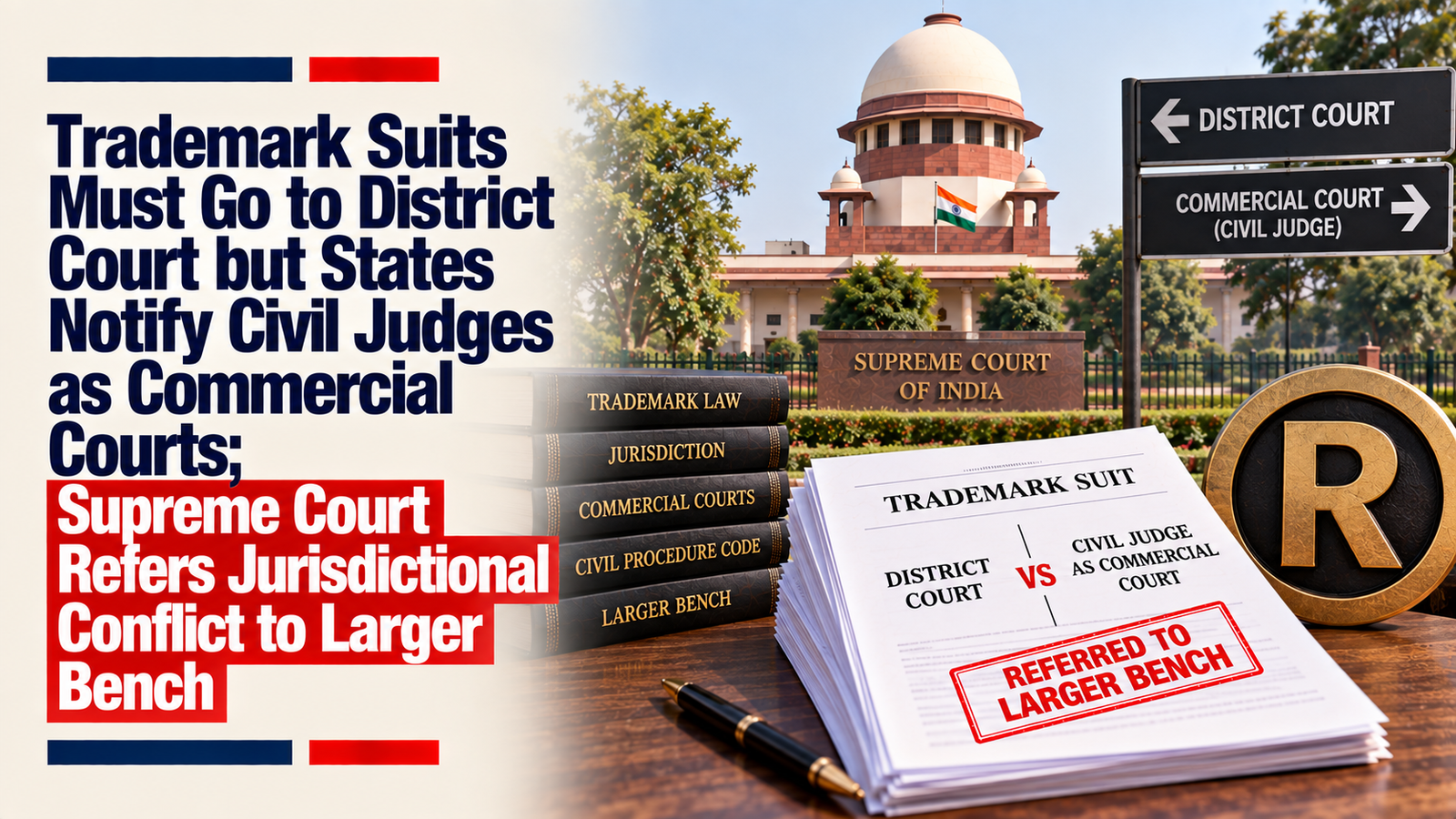
This created a peculiar jurisdictional problem. Section 134 of the Trade Marks Act provides that specified trademark suits cannot be instituted in any court inferior to a District Court having jurisdiction to try the suit.
However, because Civil Judges (Senior Division) have been notified as Commercial Courts in Jharkhand, trademark disputes of the specified commercial value may be required to be instituted before those courts rather than directly before a District Judge.
The Supreme Court therefore framed the central question: does such a notification under the Commercial Courts Act effectively render the restriction contained in Section 134 of the Trade Marks Act otiose?
Appellants’ Arguments
The appellants argued that Section 134 reflects a deliberate legislative decision that trademark infringement and related proceedings should be adjudicated at the level of the District Court.
According to them, this statutory protection cannot be diluted merely through a notification issued under the Commercial Courts Act.
They further argued that routing the original suit through a Civil Judge (Senior Division) would materially alter the appellate hierarchy. An appeal would go to the District Court instead of the High Court, leaving the High Court principally with the more restrictive supervisory jurisdiction under Article 227 or revisional jurisdiction, where ordinary re-appreciation of evidence would not be available.
The intervener supported this position and argued that the Trade Marks Act is the special legislation governing trademark disputes, whereas the Commercial Courts Act covers a much wider class of commercial disputes.
Respondents’ Arguments
The respondents relied on Section 2(1)(c)(xvii) of the Commercial Courts Act, which expressly brings disputes relating to registered and unregistered trademarks and other intellectual property rights within the definition of a commercial dispute.
They argued that the Commercial Courts Act is a later special legislation specifically intended to provide speedy adjudication of commercial disputes.
They also relied upon Section 21, which gives the Commercial Courts Act overriding effect over inconsistent provisions contained in other laws. Therefore, according to the respondents, the subsequently enacted Commercial Courts Act should prevail.
Analysis of the Law
The Supreme Court examined the relationship between the two statutes.
The Court observed that the Commercial Courts Act deals with the wider “genus” of commercial disputes, encompassing the numerous categories listed under Section 2(1)(c).
Trademark and other intellectual property disputes constitute only one “species” within that larger genus.
Section 21 gives overriding effect to the Commercial Courts Act where there is an inconsistency with another law.
However, the Court noted that there may not necessarily be an inherent inconsistency between the two statutes because the Commercial Courts Act itself permits Commercial Courts to be constituted at the District Judge level.
The difficulty specifically arises when a High Court notification designates Civil Judges below the District Judge level as Commercial Courts and those courts are then given trademark jurisdiction.
The Pecuniary Jurisdiction Anomaly
The Supreme Court highlighted a particularly striking consequence of the competing provisions.
In Jharkhand, a Civil Judge (Senior Division) notified as a Commercial Court has pecuniary jurisdiction between ₹3 lakh and ₹1 crore.
This potentially produces the unusual result that:
A trademark suit valued below ₹3 lakh would have to be instituted before the District Court because of Section 134 of the Trade Marks Act.
But a higher-value trademark suit between ₹3 lakh and ₹1 crore could be instituted before a Civil Judge (Senior Division) because it qualifies as a commercial dispute.
The Court specifically highlighted this anomaly while considering the need for authoritative resolution.
Precedent Analysis
The Supreme Court found tension between its earlier decisions.
Kandla Export Corporation v. OCI Corporation
In Kandla Export Corporation, the Court had treated the Arbitration and Conciliation Act as a self-contained special code and held that its specific appellate regime prevailed over the more general appellate provision in the Commercial Courts Act.
The present Bench noted that this supports the proposition that a specialised enactment may retain its specific jurisdictional structure notwithstanding the Commercial Courts Act.
Fun N. Fud v. GLK Associates
The Gujarat High Court had held that merely notifying a Civil Judge (Senior Division) as a Commercial Court would not shift a Section 9 Arbitration Act application away from the Principal District Court where the Arbitration Act itself specifically defines the competent “Court.”
Jaycee Housing v. Registrar General, Orissa High Court
On the other hand, Jaycee Housing held that the Commercial Courts Act, being later in time and containing Sections 3, 10, 15 and 21, could govern jurisdiction over arbitration-related commercial disputes despite the definition of “Court” under the Arbitration Act.
The present Bench expressly identified an apparent conflict between these lines of authority and concluded that the matter required consideration by a Larger Bench.
Court’s Reasoning
The Supreme Court considered it undesirable for the original jurisdiction over trademark and similar statutory disputes to vary from State to State merely because different High Courts have issued different notifications under the Commercial Courts Act.
The Court noted that Kerala had itself subsequently designated District Courts and Additional District Courts as Commercial Courts for disputes arising under statutes such as the Arbitration Act, Copyright Act, Trade Marks Act and Patents Act where the principal civil court of original jurisdiction is statutorily required to adjudicate the dispute at first instance.
The Bench ultimately observed:
“The legislative imprimatur cannot be diluted by the notifications issued by the High Courts.”
However, rather than finally deciding the legal conflict, it directed that the issue be placed before the Chief Justice of India for constitution of an appropriate Larger Bench.
Conclusion
The Supreme Court has not yet held that Civil Judges (Senior Division) lack jurisdiction over trademark infringement suits.
Instead, it has referred the question to a Larger Bench because of the apparent conflict in precedent and the need for a uniform rule across States.
Pending that determination, Commercial Suit No. 11 of 2023 before the Civil Judge (Senior Division)-I, Jamshedpur has been stayed.
Case Details
Case: I.S.D.S. Private Limited & Anr. v. M/s Khemka Food Products Pvt. Ltd. & Anr.
Court: Supreme Court of India
Case: Civil Appeal arising out of SLP (C) No. 6793 of 2026
Bench: Justice J.B. Pardiwala and Justice K. Vinod Chandran
Date: 21 September 2026
Nature: Non-Reportable Order
Result: Jurisdictional conflict referred to Larger Bench; pending Jamshedpur commercial suit stayed.