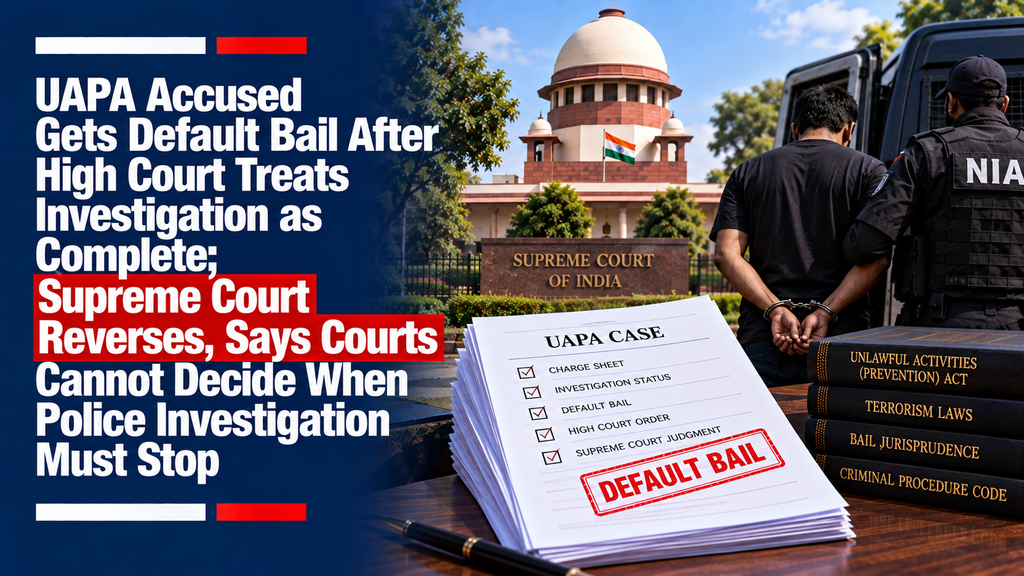
UAPA Accused Gets Default Bail After High Court Treats Investigation as Complete; Supreme Court Reverses, Says Courts Cannot Decide When Police Investigation Must Stop

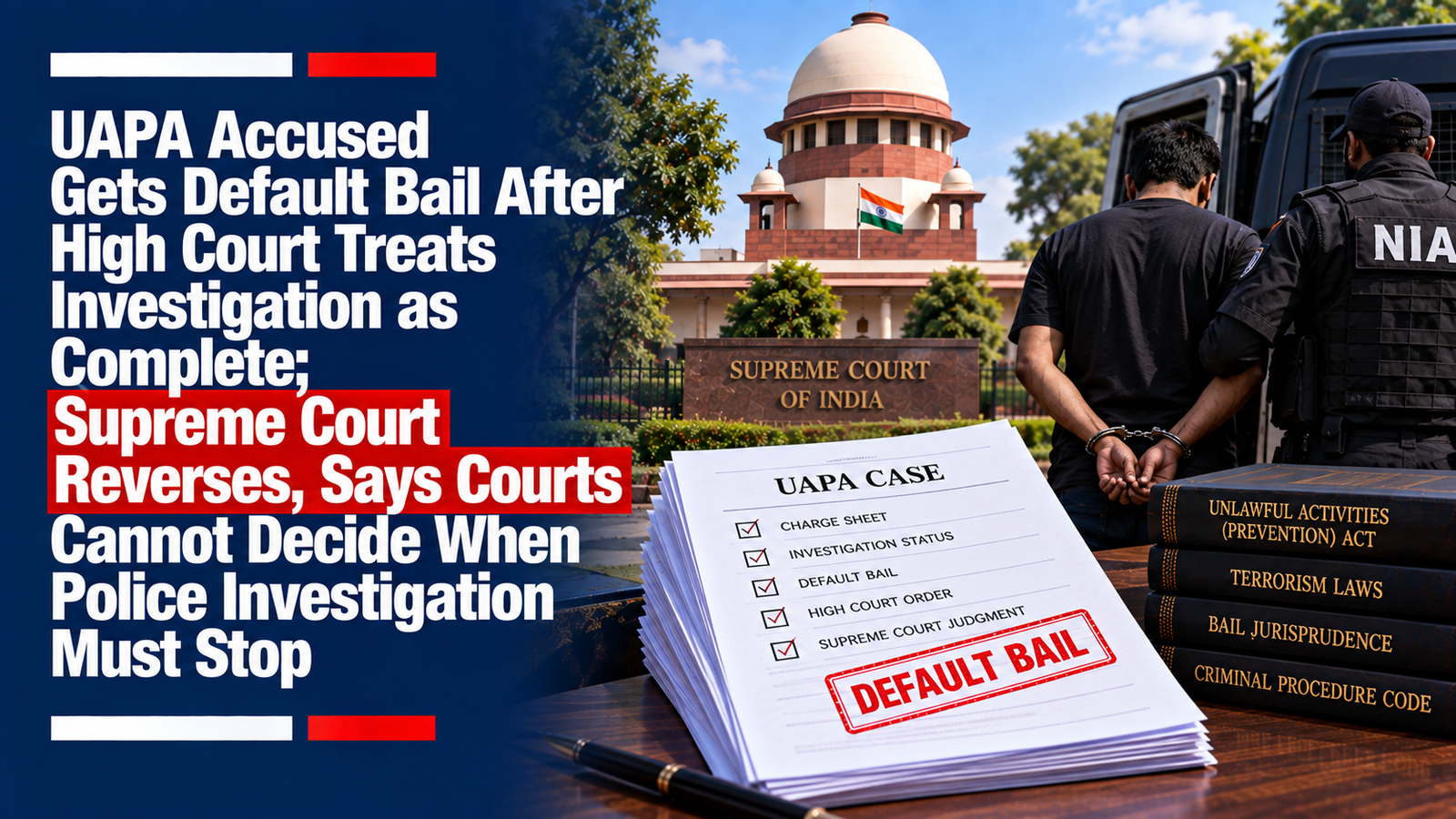
Bombay High Court Grants Default Bail to UAPA Accused; Supreme Court Sets Aside Order, Says Investigation Is Exclusive Domain of Police
Facts
An FIR was registered by the Anti-Terrorism Squad, Mumbai on 21 September 2022 against Momin Moiuddin Gulam Hasan @ Moin Mistri, Asif Aminul Hussain Khan Adhikari and others for offences under Sections 120B, 121A and 153A of the Indian Penal Code and Section 13(1)(b) of the UAPA.
The respondents were arrested on 22 September 2022. After police custody, they were remanded to judicial custody. The initial 90-day period for filing the charge sheet was due to expire on 20 December 2022.
On the Public Prosecutor’s application, the Special Judge first granted an additional 30 days for investigation. A second application seeking another 15 days was moved on 12 January 2023 and allowed on 18 January 2023.
The accused sought default bail, but the Special Judge rejected the application because the prosecution had been granted time until 2 February 2023. The charge sheet was ultimately filed on 2 February 2023.
The Bombay High Court subsequently held the second extension illegal and granted default bail, reasoning substantially that the investigation was already complete and further time had essentially been sought for obtaining sanction under Section 45 of the UAPA.
The State of Maharashtra and ATS challenged that decision before the Supreme Court.
Issues
The principal questions before the Supreme Court were:
- Whether the second 15-day extension granted for filing the charge sheet was valid under Section 43D(2) of the UAPA.
- Whether the prosecution’s statement that there was “enough evidence to file a charge sheet” meant that the investigation had already been completed.
- Whether the High Court could effectively determine that the investigation had concluded and thereby curtail further investigation.
- Whether the accused had acquired an indefeasible right to default bail.
Appellants’ Arguments
The State and ATS maintained that the investigation was not complete.
The second extension application disclosed that voice samples had been sent to the Forensic Laboratory at Kalina, bank accounts were being verified, further evidence concerning similar cases was being collected, foreign donations were under scrutiny, and electronic data analysis remained in progress.
The prosecution therefore required further time to analyse and correlate witness statements, financial records and electronic evidence before submitting a complete charge sheet.
Respondents’ Arguments
The accused relied heavily on the prosecution’s statement in the second extension application that there was “enough evidence to file a charge sheet.”
They contended that this showed that investigation had already been completed. According to them, the remaining issue was essentially obtaining sanction for prosecution.
They therefore argued that further extension under Section 43D could not be used merely to await sanction, and once the valid period expired without filing the charge sheet, their right to default bail crystallised.
Analysis of the Law
The Supreme Court reaffirmed that default bail is an important statutory and constitutional protection.
Section 167(2) read with Section 43D UAPA creates an indefeasible right where the investigating agency fails to complete the investigation within the prescribed or validly extended period, provided the accused applies for release and is prepared to furnish bail.
However, UAPA permits the ordinary 90-day period to be extended up to 180 days where the statutory requirements are satisfied, including a Public Prosecutor’s report showing progress of investigation and specific reasons for continued detention.
The Court emphasised that this extension mechanism cannot be denied mechanically. Courts must balance personal liberty with the investigating agency’s statutory entitlement to complete a complex investigation.
“Enough Evidence” Does Not Mean “Investigation Complete”
This became the central point of the judgment.
The Bombay High Court had relied upon the statement in the prosecution’s application that there was “enough evidence to file a charge sheet” and inferred that investigation was complete.
The Supreme Court rejected that approach.
A sentence in an application or judicial order cannot be isolated from its context. The document must be read as a whole.
The second extension application itself disclosed that voice samples were awaiting forensic verification, bank statements were being examined, electronic data analysis remained underway, foreign funding was being verified and information still had to be analysed and collated.
Therefore, merely saying that sufficient evidence existed to file a charge sheet could not be converted into an admission that nothing remained to be investigated.
Investigation Is the Police’s Domain
The Supreme Court laid down an important proposition:
Investigation of a crime is the exclusive domain of the police, and ordinarily it is not for a court to decide when investigation should stop.
The investigating agency must be permitted to determine the course and manner of investigation. Judicial interference with that statutory function is permissible only in exceptional circumstances or where a statutory bar operates.
The Court relied on King Emperor v. Khawaja Nazir Ahmad and State of Bihar v. J.A.C. Saldanha to reiterate the demarcation between investigation by the executive/police and adjudication by courts.
Electronic Evidence Was Part of Investigation
The Supreme Court specifically noted that the ATS had sought time to analyse material retrieved from mobile phones, computers and other electronic devices.
It had to determine how the recovered material connected the accused with the alleged activities forming the subject matter of the prosecution. Similarly, financial transactions and the flow of money through bank accounts had to be analysed.
The Court treated this analytical exercise as an integral part of investigation—not something that could simply be postponed until after filing an incomplete charge sheet.
Accordingly, the prosecution was entitled to seek reasonable time to prepare a full and complete investigation report.
Sanction Under UAPA
The Supreme Court also found that the High Court had placed excessive emphasis on whether sanction under Section 45 UAPA could independently justify extension.
The Court observed that sanction is not a mechanical exercise. The sanctioning authority must apply its mind to the evidence collected during investigation.
Therefore, complete investigation and proper analysis of the evidence also have relevance to the material ultimately placed before the sanctioning authority.
More importantly, the Supreme Court found that the second extension was not merely an application seeking time to obtain sanction. It contained substantive investigative steps that were still underway.
Thus, according to the Supreme Court, the High Court’s detailed discussion on sanction had taken the case away from the real issue.
Precedent Analysis
The judgment extensively considered the jurisprudence governing default bail, including:
Bikramjit Singh v. State of Punjab — default bail under Section 167(2) is not merely statutory but forms part of the procedure established by law under Article 21.
Sanjay Dutt v. State through CBI — the Constitution Bench explained when the indefeasible right to default bail arises and how it operates before filing of the charge sheet.
State of Maharashtra v. Surendra Pundlik Gadling — relevant to extensions under Section 43D UAPA in complex investigations involving forensic material.
State of NCT of Delhi v. Raj Kumar @ Lovepreet @ Lovely — relied upon by the Supreme Court in examining extensions where investigation, forensic reports and sanctions remained pending.
The Court distinguished the principle protecting an accrued right to default bail from the anterior question in the present case: whether there had actually been a prosecutorial default at all when the second extension itself was legally valid.
Court’s Reasoning
The Supreme Court found that the High Court had incorrectly treated a solitary statement—“enough evidence to file a charge sheet”—as proof that the entire investigation stood completed.
The surrounding material showed precisely the opposite: electronic evidence, forensic verification, financial transactions and other information were still being analysed and collated.
The High Court therefore went wrong in treating the case as one where investigation had finished and the prosecution merely wanted time to obtain sanction.
Since the second extension was supported by continuing investigative requirements, the Special Judge’s order granting another 15 days was valid.
Consequently, the statutory period had not expired when the accused claimed default bail, and no indefeasible right to default bail had accrued on that basis.
Conclusion
The Supreme Court set aside the Bombay High Court’s judgment dated 15 July 2024 and restored the Special Judge’s order dated 18 January 2023 granting the prosecution the second 15-day extension.
The accused’s default-bail application dated 20 January 2023 consequently stood dismissed.
The surviving respondent, Momin Moiuddin Gulam Hasan @ Moin Mistri, was directed to surrender within 30 days, with liberty to seek regular bail if so advised.
Case Details
Case: State of Maharashtra & Anr. v. Momin Moiuddin Gulam Hasan @ Moin Mistri & Anr.
Citation: 2026 INSC 1021
Court: Supreme Court of India
Jurisdiction: Criminal Appellate Jurisdiction
Arising out of: SLP (Criminal) No. 12932 of 2024
Bench: Justice Prashant Kumar Mishra and Justice Shree Chandrashekhar
Judgment by: Justice Shree Chandrashekhar
Date: 21 September 2026
Result: State’s appeal allowed; Bombay High Court judgment granting default bail set aside; second extension upheld; surviving accused directed to surrender within 30 days.