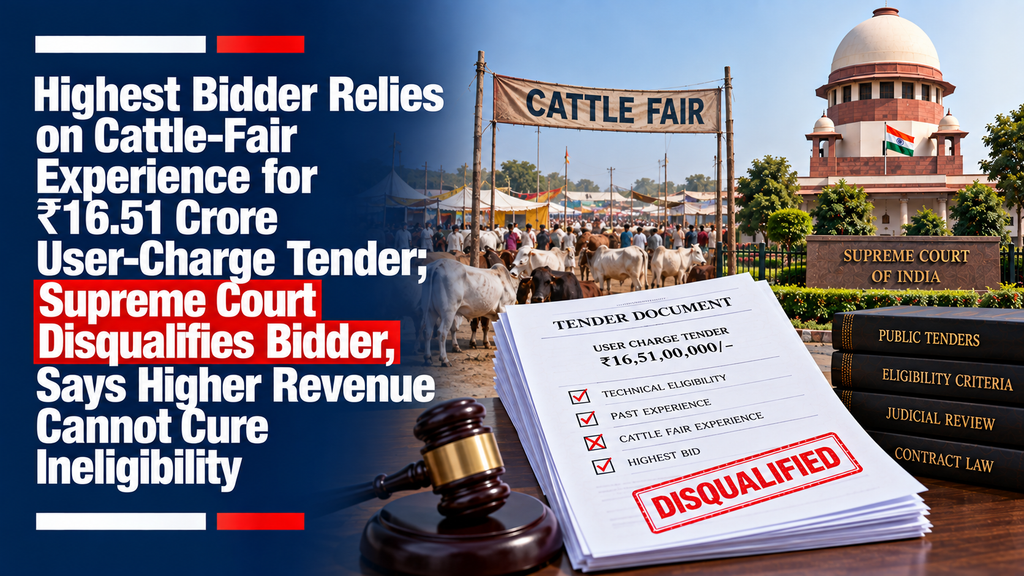
Highest Bidder Relies on Cattle-Fair Experience for ₹16.51 Crore User-Charge Tender; Supreme Court Disqualifies Bidder, Says Higher Revenue Cannot Cure Ineligibility

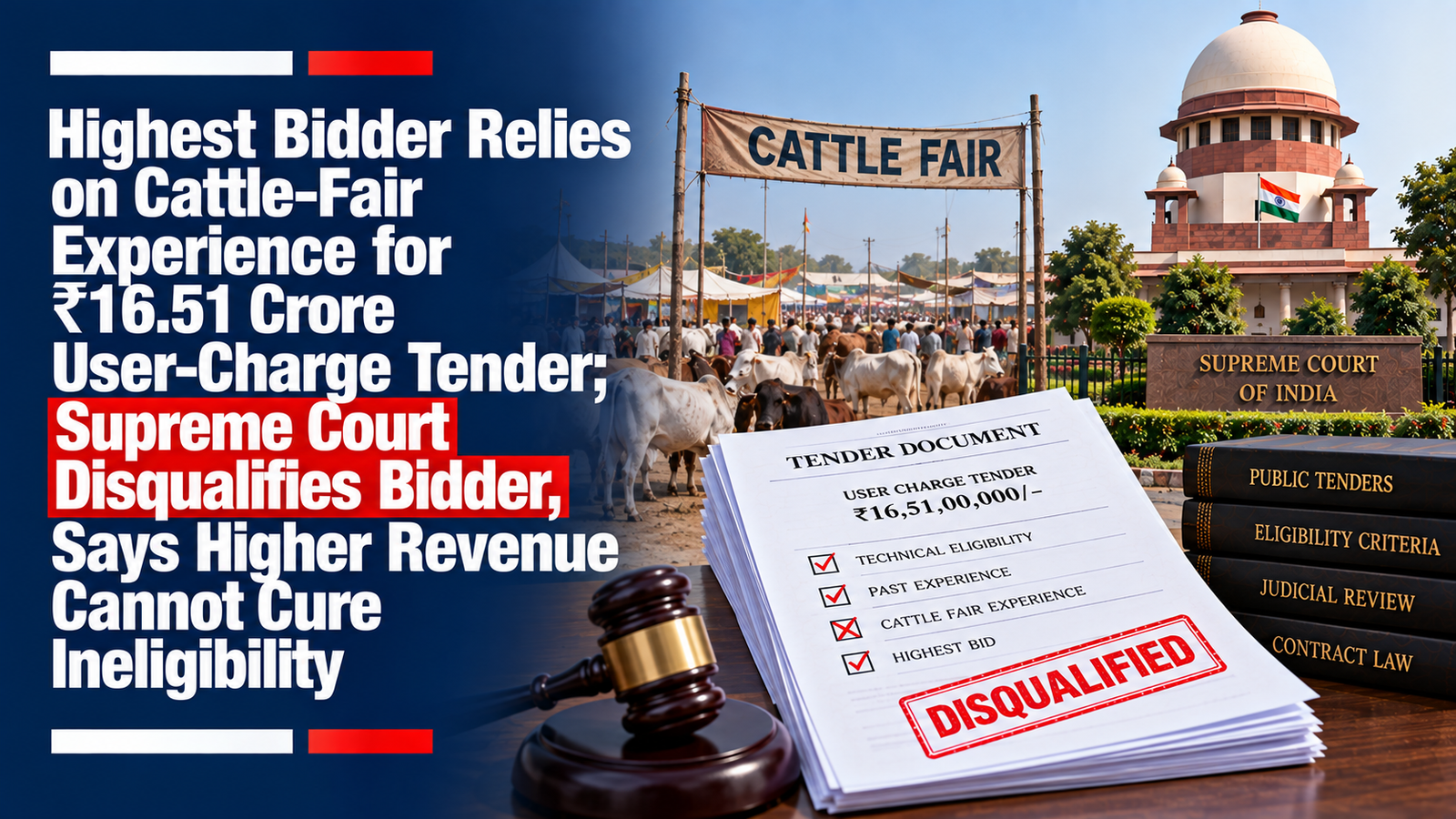
Cattle-Fair Contractor Claims Experience for Government User-Charge Tender; Supreme Court Says Incidental Collection Is Not Equivalent to Specialised Experience
Facts
The Market Committee, Ludhiana issued a tender on 13 February 2026 for recovery/realisation of user charges from vehicles using Mandi infrastructure for a period of twelve months, from 1 April 2026 to 31 March 2027. The reserve price was approximately ₹12.21 crore per annum.
Five bidders participated. Micky Traders (H1) submitted the highest financial bid of ₹16.51 crore, while L.R.Y. Labour Contractor (H2) offered approximately ₹15.03 crore. Micky Traders’ technical bid was accepted and a Letter of Acceptance was issued on 20 March 2026.
H2 challenged Micky Traders’ eligibility. The relevant condition required completion certificates showing successful execution of annual collection of user charges/parking fees in Government, Semi-Government or PSU organisations during the last two years up to 31 December 2025.
Micky Traders principally relied upon experience relating to participation in cattle fairs. The Punjab and Haryana High Court held that it did not satisfy the eligibility requirement, quashed the acceptance of its technical and financial bids and directed the authorities to issue the Letter of Acceptance to an eligible tenderer.
Micky Traders and the Punjab State Agricultural Marketing Board approached the Supreme Court.
Issues
The principal questions were whether the experience requirement was mandatory; whether experience in organising cattle fairs could qualify as experience in collecting user charges or parking fees; whether experience obtained through other firms could be attributed to Micky Traders; and whether the High Court had exceeded the limited scope of judicial review in tender matters.
A further issue was whether Micky Traders’ approximately ₹1.5 crore higher financial offer justified acceptance of its bid in the larger interest of public revenue.
Appellants’ Arguments
Micky Traders argued that the High Court had substituted its own interpretation for that of the tendering authority despite there being no finding of mala fides, irrationality or perversity.
It contended that the requirement should be interpreted purposively rather than technically and did not require one continuous two-year contract ending on 31 December 2025. It further argued that experience of firms in which its proprietor had participated could be attributed to it. Finally, it emphasised that rejection of its substantially higher bid would result in a loss of approximately ₹1.5 crore to public revenue.
The Board similarly argued that courts should defer to the commercial wisdom of the tendering authority and contended that the enlistment instructions were directory rather than mandatory.
Respondent’s Arguments
H2 argued that Micky Traders had not produced the requisite two-year experience certificate.
It submitted that the certificates concerned separate contracts executed through different entities and did not establish either the necessary work, the identity of the bidder or the required period.
Most importantly, it argued that a cattle-fair contract is fundamentally different from a contract for collection of government user charges. The cattle-fair contractor pays rent for the right to operate the fair; it does not perform the specialised function of collecting public user charges on behalf of a government authority.
Analysis of the Law
The Supreme Court reiterated that judicial review of public tenders is deliberately narrow.
Ordinarily, the authority that authors a tender is the best judge of its requirements. Courts do not sit as appellate authorities over technical or commercial decisions merely because another interpretation is possible.
However, that deference has an important limitation: the authority’s interpretation must be one that the actual words of the tender can reasonably bear.
If an interpretation is dehors the tender conditions, patently arbitrary, irrational or perverse, judicial review is permissible. The Court distilled the principle as follows: the authority’s interpretation of its own tender is ordinarily final provided the language chosen can reasonably support that interpretation and it is not unfair, arbitrary or perverse.
Cattle-Fair Experience Was Not Equivalent Experience
This was the central factual finding.
The Court explained that the tender concerned collection of public user charges from a high volume of retail and commercial vehicles over a full year, involving:
- gate management;
- ticket/token systems;
- cash handling and daily reconciliation;
- accounting to the public authority; and
- supervision of collection staff.
The Court characterised this as a specialised, continuous and revenue-facing operation in which collection itself constituted the principal contractual obligation.
By contrast, a cattle-fair contractor is essentially a lessee who pays the authority for use of the fairground. Even if the contractor collects parking or other charges during the fair, those amounts are collected for its own account as an incident of operating the fair.
Accordingly, such incidental collection could not be equated with the specialised responsibility of collecting and accounting for public user charges on behalf of a governmental body.
The Court therefore concluded that Micky Traders’ cattle-fair experience did not satisfy the tender condition.
Experience Certificates Were Also Defective
There was another independent problem.
The experience certificate did not record work performed by Micky Traders. Instead, it referred to work performed during fragmented periods by three differently named entities.
Micky Traders claimed that its sole proprietor, Ravinder Singh, had been a partner in those entities and therefore their experience should be treated as his experience.
But there was no partnership deed, registration certificate or other material establishing the nature, extent or duration of his relationship with those firms.
The Supreme Court held:
“An eligibility criterion cannot be satisfied by an unverified assertion of identity between a bidder and unrelated third parties.”
Approbate and Reprobate
The Court found a further independent ground against Micky Traders.
It had participated in similar tenders at Patiala and Rajpura, containing an identical experience requirement. On both occasions its bids had been declared technically non-responsive for lack of the required experience, and Micky Traders had not challenged those decisions.
The Supreme Court held that having accepted that construction when it resulted in disqualification earlier, the bidder could not subsequently advocate the opposite interpretation merely because it now suited its interests.
A party cannot “approbate and reprobate” regarding the meaning of the same contractual language depending upon which interpretation is commercially advantageous.
Court’s Reasoning
The Court found three independent deficiencies:
First, cattle-fair experience was not equivalent to specialised government user-charge/parking-fee collection.
Second, the certificates relied upon did not establish that the relevant experience belonged to Micky Traders.
Third, Micky Traders’ own conduct in earlier tenders contradicted the interpretation it was now advocating.
Taken together, the Committee’s decision to treat Micky Traders as eligible was patently arbitrary and dehors the tender conditions. Therefore, this was one of the exceptional cases where judicial intervention in a tender matter was justified.
Higher Revenue Cannot Cure Ineligibility
The Supreme Court specifically rejected the argument that Micky Traders should be preferred because its offer was approximately ₹1.5 crore higher.
The Court held:
“Revenue considerations cannot cure ineligibility.”
Financial bids can legitimately be compared only between bidders who first satisfy the prescribed eligibility requirements. Otherwise, every mandatory eligibility condition could effectively be defeated by simply submitting the highest financial bid.
The Court also rejected the Board’s contention that the experience condition was merely directory. The Committee itself had treated the requirement as mandatory for other bidders.
The Court memorably observed that a condition “cannot be mandatory in the abstract and directory only in its application to a favoured bidder.”
Precedent Analysis
The Supreme Court reaffirmed Tata Cellular, Jagdish Mandal, Afcons Infrastructure, Silppi Constructions and Agmatel India on judicial restraint in tender matters: courts examine legality, rationality, procedural fairness and arbitrariness rather than substituting their own commercial assessment.
At the same time, relying particularly on Kimberley Club and Vidarbha Irrigation Development Corporation, the Court emphasised that judicial deference ends where the authority’s interpretation is unsupported by the tender language or effectively condones non-compliance with an essential eligibility requirement.
Conclusion
The Supreme Court found no infirmity in the Punjab and Haryana High Court’s decision.
Both appeals—one filed by Micky Traders and the other by the Board/Committee—were dismissed, with no order as to costs.
Case Details
Case: Micky Traders v. L.R.Y. Labour Contractor & Ors.
Citation: 2026 INSC 1025
Court: Supreme Court of India
Jurisdiction: Civil Appellate Jurisdiction
Arising From: SLP (C) No. 22161 of 2026, with connected appeal arising from SLP (C) No. 23127 of 2026
Bench: Justice K.V. Viswanathan and Justice Alok Aradhe
Judgment by: Justice Alok Aradhe
Date: 21 September 2026
Result: Appeals dismissed; High Court order quashing acceptance of Micky Traders’ bid upheld.