Police Arrest Accused Without Written Grounds and Produce Him Beyond 24 Hours; Supreme Court Bars Automatic Re-Arrest, Makes Prior Judicial Approval Mandatory

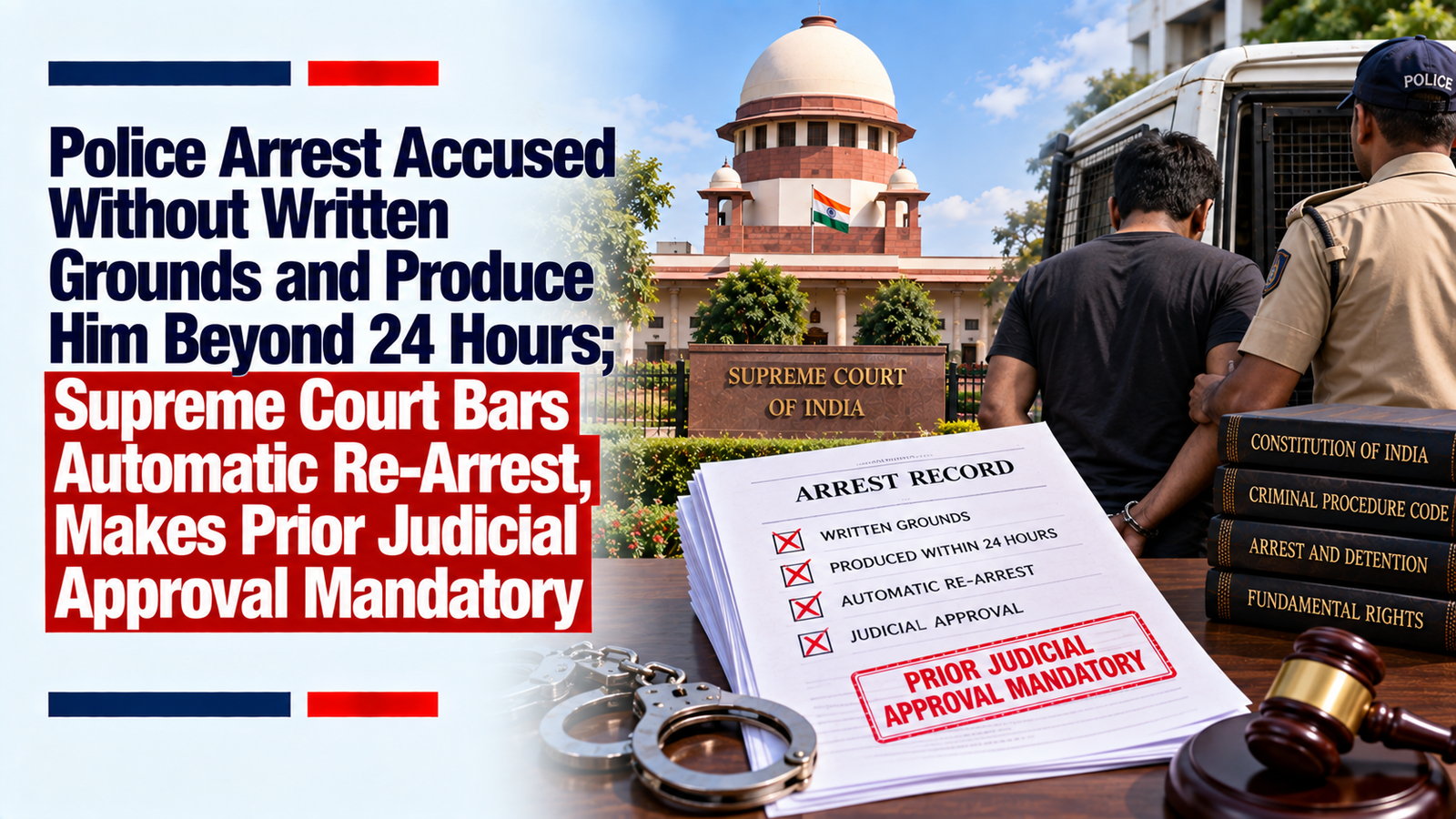
Police Violate Two Constitutional Safeguards During Arrest; Supreme Court Says Seriousness of Crime Cannot Justify Automatic Re-Arrest
Facts
The case arose from FIR No. 73/2026, registered at Mataur Police Station, SAS Nagar, Punjab, against Jaskaran Jeet Singh Deol under Sections 64, 65(1) and 351 of the Bharatiya Nyaya Sanhita, 2023 read with Section 6 of the Protection of Children from Sexual Offences Act, 2012. The allegations concerned physical and sexual abuse of the informant’s minor daughter.
The appellant was arrested at approximately 7:54 a.m. on 17 May 2026 and produced before the Duty Magistrate around noon on 18 May 2026. Significantly, the police had not furnished him the written grounds of arrest.
The Magistrate held the arrest illegal for violation of Article 22(1) of the Constitution and directed his immediate release. However, the Magistrate clarified that the investigating agency could subsequently seek custody in accordance with law after supplying written grounds of arrest and explaining the earlier failure.
The prosecution thereafter sought custody again. The Additional Chief Judicial Magistrate rejected the application because the grounds of arrest had still not been supplied and observed that custody/remand could not be granted in the manner sought.
The appellant approached the Punjab and Haryana High Court seeking protection against re-arrest, custody and issuance of warrants. The High Court dismissed his petition, holding that an illegal first arrest did not grant blanket immunity from a subsequent lawful arrest.
The matter consequently reached the Supreme Court in Jaskaran Jeet Singh Deol v. State of Punjab, raising a question of significant constitutional importance: Can an accused whose rights under both Articles 22(1) and 22(2) were breached be re-arrested for the same offence, and if so, by what procedure?
Issues
- Whether an accused released because his original arrest violated Article 22(1) can simply be re-arrested by the investigating agency.
- Whether detention beyond 24 hours without production before the Magistrate, contrary to Article 22(2), similarly restricts the power of re-arrest.
- Whether re-arrest requires prior judicial scrutiny and approval.
- Whether the seriousness or gravity of the alleged offence can dilute the constitutional safeguards governing arrest.
- What consequences should follow against police officers responsible for unconstitutional arrest and detention.
Appellant’s Arguments
The appellant argued that he suffered two independent constitutional violations.
First, he was not supplied written grounds of arrest, violating Article 22(1).
Second, although arrested at 7:54 a.m. on 17 May, he was produced before the Magistrate only around noon the next day, beyond the constitutionally permissible period of 24 hours.
It was argued that allowing the same police agency to automatically re-arrest a person immediately after a court has released him for unconstitutional detention would substantially dilute Article 22. Otherwise, the police could illegally detain someone, obtain his release because of the violation and simply arrest him again.
Relying particularly upon Mihir Rajesh Shah v. State of Maharashtra, the appellant argued that a fresh custody application had to be placed before the jurisdictional Magistrate, accompanied by the grounds of arrest, the necessity for custody and an explanation for the earlier failure.
Respondent–State’s Arguments
Punjab argued that an unconstitutional first arrest does not create permanent immunity from arrest.
According to the State, the consequence of non-compliance should remain confined to invalidating the defective arrest. It should not extinguish the investigating agency’s statutory power to subsequently arrest the accused in accordance with law.
The State also emphasised the seriousness of the allegations under the POCSO Act and contended that custodial interrogation remained necessary.
It further informed the Supreme Court that disciplinary action had already been initiated: the investigating officer had been suspended, the Station House Officer removed from his post and transferred to Police Lines, and departmental proceedings initiated.
Analysis of the Law
Article 22(1): Written Grounds of Arrest
The Supreme Court strongly reaffirmed that supplying the grounds of arrest is not a mere procedural formality.
The grounds must ordinarily:
- be in writing;
- be supplied to the arrested person;
- be in a language understood by the accused; and
- be furnished as a matter of course and without exception, subject to the limited exigency framework recognised in Mihir Rajesh Shah.
The Court reiterated that where written grounds cannot practically be supplied immediately in exceptional circumstances, they may initially be communicated orally but must thereafter be supplied in writing within a reasonable time and, in any event, at least two hours before production before the Magistrate for remand.
Failure to comply renders the arrest and subsequent remand illegal.
The Court also made an important conceptual distinction: when a person is released because Article 22(1) has been violated, he is not being enlarged on bail. He is being released from an illegal and unconstitutional detention.
Re-Arrest After Violation of Article 22(1)
This is the most significant part of the judgment.
The Supreme Court held that the power to re-arrest cannot simply be left to the discretion of the very authority that committed the constitutional violation.
If the investigating agency still considers custodial interrogation necessary, it must:
- first furnish the accused the written grounds of arrest;
- file an application before the concerned Magistrate;
- specifically explain the reasons and necessity for re-arrest/custody;
- explain why the grounds of arrest were not supplied in the first instance;
- obtain the endorsement of the immediate superior authority; and
- obtain a judicial decision from the Magistrate after observance of natural justice.
The Magistrate should decide the application expeditiously, preferably within one week.
Thus, re-arrest is not absolutely prohibited, but it cannot be automatic or purely executive. It requires judicial imprimatur.
Article 22(2): Production Within 24 Hours
Article 22(2) mandates that every arrested person must be produced before the nearest Magistrate within 24 hours, excluding necessary journey time.
The Court treated this safeguard with equal constitutional seriousness.
Relying on Bhim Singh, Manoj, Khatri and other authorities, it reiterated that detention beyond the constitutionally permissible period without the Magistrate’s authority becomes unlawful.
Most importantly, the Supreme Court held that the same re-arrest procedure applicable to a violation of Article 22(1) must also be followed where Article 22(2) has been breached.
Therefore, after release for unconstitutional detention beyond 24 hours, the police cannot simply take the accused back into custody on their own.
Precedent Analysis
Pankaj Bansal v. Union of India
The Court relied on Pankaj Bansal for the principle that informing an arrested person of the grounds of arrest is a fundamental constitutional protection and that meaningful compliance ordinarily requires written communication.
Prabir Purkayastha v. State (NCT of Delhi)
The Court reiterated that the right to receive grounds of arrest enables the accused to consult counsel, oppose police custody and seek bail. Violation of Article 22(1) vitiates the arrest and remand; subsequent filing of a chargesheet cannot retrospectively validate an unconstitutional arrest.
Vihaan Kumar v. State of Haryana
The grounds must be effectively communicated in a manner and language understood by the arrestee. Once Article 22(1) is violated, the arrest itself stands vitiated.
Mihir Rajesh Shah v. State of Maharashtra
This formed the central foundation of the judgment.
Mihir Rajesh Shah had held that where the schedule for supplying written grounds is breached, the arrest becomes illegal and the accused must be released. If custody is still required, the investigating agency must approach the Magistrate with the reasons and necessity for custody and explain the earlier failure.
The present judgment strengthens that safeguard by requiring superior-authority endorsement and making judicial approval central to re-arrest.
Court’s Reasoning
The Supreme Court rejected the proposition that constitutional violations can be treated merely as technical or procedural defects.
Article 22 safeguards operate irrespective of the gravity of the alleged offence. The seriousness of the accusation cannot furnish a justification for depriving a person of liberty except through constitutionally prescribed procedure.
At the same time, the Court did not grant the appellant permanent immunity from arrest.
Instead, it struck a distinction between:
automatic executive re-arrest — impermissible after such constitutional violations;
and
re-arrest following judicial scrutiny under the prescribed procedure — permissible where custody is genuinely necessary.
The judgment therefore does not say that an accused whose arrest is declared illegal can never again be arrested in that case. It says the police cannot cure their constitutional breach merely by arresting him again on their own.
The Court further directed that, administratively, where an accused is released for violation of Article 22(1), the superior authority considering endorsement of a fresh custody application should transfer the investigation to another officer and initiate departmental enquiry against the erring police personnel.
For Article 22(2) violations, the Court additionally recognised that, depending upon the circumstances, the High Court may award compensation as a public-law remedy, without preventing the accused from separately pursuing private civil remedies.
Conclusion
The Supreme Court set aside the Punjab and Haryana High Court’s order dated 29 May 2026, as well as the impugned observations made by the Magistrate on 18 May 2026.
If the investigating agency considers custodial interrogation of Jaskaran Jeet Singh Deol necessary, it must follow the safeguards laid down in Mihir Rajesh Shah as strengthened by this judgment.
The Court expressly clarified that it had not expressed any opinion on the merits of the allegations against the appellant.
The appeal was accordingly allowed.
Given the wider constitutional importance of the ruling, the Supreme Court also directed that a copy of the judgment be circulated to all Directors General of Police of States and Union Territories, Registrar Generals of High Courts and Directors of State Judicial Academies.
Case Details
Case: Jaskaran Jeet Singh Deol v. State of Punjab
Citation: 2026 INSC 1022
Court: Supreme Court of India
Case: Criminal Appeal No. 4234 of 2026, arising out of SLP (Crl.) No. 11103 of 2026
Bench: Justice Ujjal Bhuyan and Justice Atul S. Chandurkar
Date: 21 September 2026
Result: Appeal allowed; High Court order set aside. Re-arrest after release for breach of Articles 22(1) or 22(2) cannot be automatic and must follow the judicially supervised procedure prescribed by the Supreme Court.