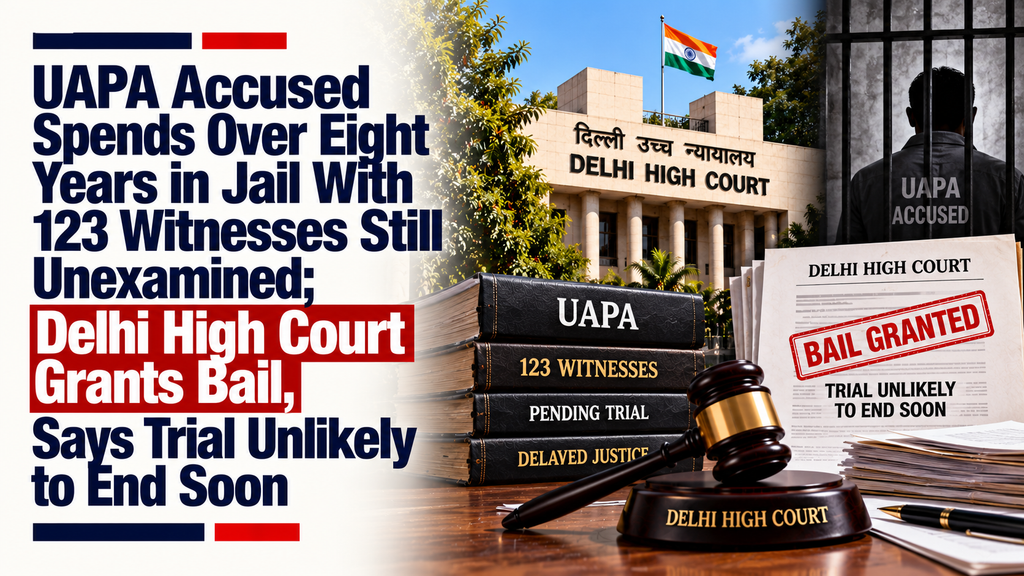
UAPA Accused Spends Over Eight Years in Jail With 123 Witnesses Still Unexamined; Delhi High Court Grants Bail, Says Trial Unlikely to End Soon

Foreign National Status Alone Cannot Justify Continued Detention: Delhi High Court Grants Bail to UAPA Accused After Eight Years
Facts
The Delhi High Court dealt with seven connected criminal appeals filed by Jagtar Singh Johal @ Jaggi challenging orders refusing him bail in multiple NIA cases arising from Punjab. The cases involved allegations under provisions including Sections 120-B and 302 IPC, Sections 16, 17, 18, 18A, 18B, 20, 21 and 23 of the UAPA, and Sections 25 and 27 of the Arms Act.
The prosecution’s case, as recorded by the Court, was that Johal, a UK national, was allegedly associated with members of the Khalistan Liberation Force. One central allegation was that he travelled from the UK to France and allegedly delivered GBP 3,000 to Harminder Singh @ Mintoo, part of which was allegedly given to Hardeep Singh to motivate and recruit him into the KLF. These remained prosecution allegations, not findings of guilt.
Johal had remained in custody since 4 November 2017 — more than eight years. His principal plea was that despite this prolonged incarceration, only 40 witnesses had been examined while approximately 123 witnesses remained.
The appeals had an unusual procedural history. An earlier Delhi High Court judgment dated 18 September 2024 had dismissed five appeals on limitation and two on merits. The Supreme Court subsequently set that judgment aside on 15 July 2026 and remanded all appeals for fresh consideration on merits.
Issues
The principal questions before the High Court were:
1. Whether more than eight years of pre-trial incarceration, coupled with the unlikely early conclusion of trial, justified bail despite Section 43D(5) UAPA.
2. How Article 21 and the constitutional right to speedy trial operate alongside the statutory UAPA bail restrictions.
3. Whether Johal’s acquittal and grant of bail in other proceedings involving similar allegations were relevant.
4. Whether his status as a foreign national and the alleged risk of flight justified continued detention.
5. Whether allegations concerning threats to witnesses could justify denial of bail without material linking those threats to Johal.
Appellant’s Arguments
Johal’s principal argument was prolonged incarceration.
He had spent more than eight years in custody, while only 40 witnesses had been examined and approximately 123 remained. He argued there was no realistic possibility of the trial concluding soon.
He relied upon Union of India v. K.A. Najeeb, Sheikh Javed Iqbal, Gulfisha Fatima and Syed Iftikhar Andrabi to contend that prolonged incarceration and denial of a speedy trial can justify constitutional courts granting bail notwithstanding the UAPA restrictions.
He also pointed out that:
- he had been acquitted on similar allegations by the Additional Sessions Judge, Moga, on 4 March 2025;
- the Punjab and Haryana High Court had already granted him bail in another NIA case containing similar allegations; and
- the Supreme Court had dismissed the NIA’s challenge to that bail order.
On merits, he argued that his alleged role was limited and that he was not alleged to have participated in the actual incidents, purchase of weapons or collection of funds for those incidents in 2016–17.
Respondent’s Arguments
The NIA opposed bail on the ground that charges had already been framed and the allegations involved serious offences relating to terrorism, separatism and targeted killings.
It argued that Section 43D(5) UAPA applied and that the prosecution material disclosed a prima facie case.
The NIA further contended that Johal was a foreign national and therefore a flight risk.
It also referred to complaints regarding witnesses allegedly being threatened and argued that his release could prejudice the trial.
Analysis of the Law
Section 43D(5) UAPA Does Not Completely Displace Article 21
The High Court extensively examined the tension between:
the statutory embargo under Section 43D(5) UAPA
and
the fundamental right to liberty and speedy trial under Article 21.
Relying on the jurisprudence flowing from K.A. Najeeb, the Court noted that statutory restrictions do not completely oust the constitutional courts’ power to grant bail where prolonged incarceration becomes constitutionally unacceptable.
Where the trial is unlikely to conclude within a reasonable period and substantial incarceration has already occurred, the rigours of statutory bail restrictions may yield to constitutional considerations.
But Delay Is Not an Automatic Formula for Bail
Importantly, the Court did not hold that passage of time automatically entitles every UAPA accused to bail.
Referring to Gulfisha Fatima, it noted that the inquiry is contextual.
Courts must consider matters including:
- nature of allegations;
- role attributed to the particular accused;
- stage of proceedings;
- realistic trajectory of trial;
- cause of delay;
- prosecution material; and
- risks associated with release.
Thus, delay simpliciter is not enough; prolonged detention must be assessed against the individual circumstances.
Accused-Specific Assessment Is Essential
The judgment also emphasised that Section 43D(5) requires an individualised assessment.
The Court reproduced the principle that the inquiry must determine whether the particular accused has a real and meaningful nexus with the alleged unlawful or terrorist activity, as distinguished from mere association or peripheral presence.
At the same time, a bail court cannot conduct a mini-trial or finally weigh the evidence.
The Crucial Numbers: 8 Years, 40 Examined, 123 Remaining
This became the decisive factual consideration.
Johal had remained incarcerated for more than eight years.
Yet:
40 witnesses had been examined.
123 witnesses remained to be examined.
Approximately 63 were common witnesses across the connected cases.
The High Court observed that despite repeated Supreme Court directions to expedite the proceedings, the pace had not meaningfully improved and even the protected witnesses had not been examined.
The Court therefore concluded that the trial was “certainly not likely to conclude any time soon.”
Acquittal in Similar Case Had “Strong Persuasive Value”
Another significant circumstance was Johal’s acquittal by the Additional Sessions Judge, Moga, in March 2025.
The NIA argued that the acquittal could not operate as res judicata in separate prosecutions.
The High Court agreed with that legal proposition.
However, it found that because Johal was being implicated as a co-conspirator on similar averments, the acquittal had strong persuasive value for deciding bail.
This is an important limitation: the High Court did not treat the earlier acquittal as conclusively establishing innocence in the present cases.
Foreign National ≠ Automatic Flight Risk
The NIA emphasised that Johal was a foreign national and could abscond if released.
The High Court rejected foreign nationality as a sufficient standalone reason for continued incarceration.
It held that liberty could not be curtailed only on this ground.
Instead, the potential flight risk could be addressed through stringent bail conditions, including surrender of passport and reporting obligations.
Alleged Witness Threats Were Not Linked to Johal
The NIA also argued that witnesses had complained of threats.
The Court found this insufficient to justify continued detention because no material had been produced showing that the threats emanated from Johal or were issued at his behest.
Given the eight-year incarceration and other relevant circumstances, this allegation did not persuade the Court to refuse bail.
Precedent Analysis
Union of India v. K.A. Najeeb
The foundational authority relied upon for the proposition that statutory UAPA restrictions do not completely remove the constitutional courts’ ability to grant bail where prolonged incarceration and an unrealistic trial timeline result in violation of fundamental rights.
Gulfisha Fatima v. State
The Court noted that delay cannot operate mechanically. The inquiry must consider the particular accused’s role, nature of allegations, stage and likely trajectory of trial, reasons for delay and risks upon release.
Syed Iftikhar Andrabi v. NIA
The judgment was discussed in relation to the continuing constitutional force of the principle that where a timely trial is plainly impossible after significant incarceration, constitutional courts may grant bail notwithstanding Section 43D(5).
Tasleem Ahmed v. State
The Court acknowledged that the Article 21–Section 43D(5) interplay had been referred to a larger Bench.
However, the High Court noted that the Supreme Court had clarified that Article 21 unquestionably survives Section 43D(5), while warning against treating lapse of time as an automatic ground for bail.
The High Court further relied upon Union Territory of Ladakh v. Jammu and Kashmir National Conference for the principle that a High Court must apply the law as it presently stands and cannot simply postpone adjudication because an issue has been referred to a larger Bench.
Court’s Reasoning
The judgment turned on the cumulative effect of several circumstances rather than incarceration alone:
More than eight years of custody + 123 witnesses still remaining + trial unlikely to finish soon + previous bail on similar allegations + subsequent acquittal on similar allegations + no demonstrated connection between Johal and alleged witness threats + flight risk capable of being controlled through conditions.
Against that factual background, continued incarceration could no longer be justified merely by relying upon the gravity of the charges or Johal’s foreign nationality.
The Court therefore set aside the orders refusing bail and directed his release in the connected NIA cases.
Bail Conditions
The High Court imposed stringent safeguards, including:
- ₹5 lakh personal bond with two sureties of the same amount;
- surrender of passport;
- use of only one mobile/landline number;
- disclosure of residence, phone number and email to the IO and Trial Court;
- prior intimation before changing residence/contact details;
- appearance before the Trial Court unless exempted;
- no delay of trial;
- no contact, influence or threats to prosecution/protected witnesses;
- no tampering with evidence or electronic material;
- no public statements touching upon merits, evidence, witnesses or trial;
- no activity prejudicing public order or integrity of trial;
- restrictions concerning social-media groups/material described in the order; and
- reporting to the Investigating Officer once every fortnight.
Any breach would permit the prosecution to seek cancellation of bail.
Conclusion
The Delhi High Court allowed the bail challenge and set aside the Trial Court orders refusing bail.
The decision is significant because it reiterates that Section 43D(5) UAPA cannot operate as an indefinite licence for pre-trial incarceration. At the same time, the Court did not formulate an automatic “eight-year rule” or hold that delay by itself overrides the statutory embargo.
The decision was based on Johal’s individual circumstances, particularly more than eight years of custody, the large number of witnesses still remaining, the unlikely early conclusion of trial, similar-case bail/acquittal and the ability to manage flight/witness risks through stringent conditions.
Case Details
Case: Jagtar Singh Johal @ Jaggi v. National Investigation Agency
Court: Delhi High Court
Cases: CRL.A. 493/2023, 538/2023, 539/2023, 540/2023, 541/2023, 569/2024 & 577/2024
Bench: Justice Navin Chawla and Justice Ravinder Dudeja
Reserved: 7 September 2026
Pronounced: 18 September 2026
Result: Orders refusing bail set aside; Jagtar Singh Johal directed to be released on regular bail in the connected NIA cases subject to stringent conditions.