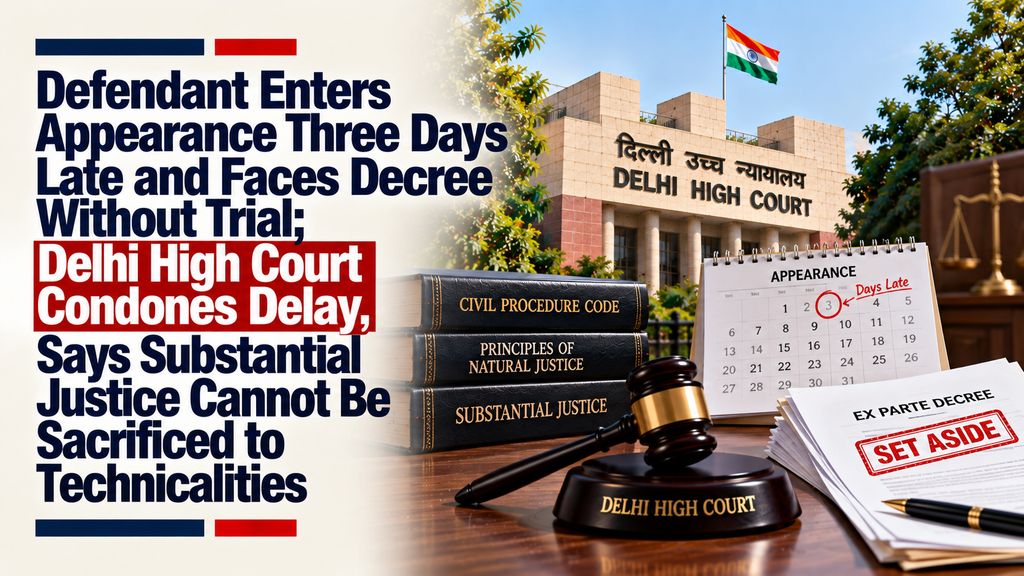
Defendant Enters Appearance Three Days Late and Faces Decree Without Trial; Delhi High Court Condones Delay, Says Substantial Justice Cannot Be Sacrificed to Technicalities

Wrong Understanding of Summons Date Causes Three-Day Delay; Delhi High Court Finds Explanation Bona Fide, Restores Right to Defend Summary Suit
Facts
The dispute arose from a summary recovery suit under Order XXXVII CPC filed by Ramesh Lata against Rishi Raj Sharma for recovery of ₹5,24,667 as rent arrears, together with interest at 18% per annum.
Summons were served upon the defendant on 13 August 2025. Under Order XXXVII Rule 3 CPC, he was required to enter appearance within ten days.
However, the memo of appearance was:
e-filed on 26 August 2025, and
physically filed on 28 August 2025.
This resulted in a three-day delay in entering appearance.
Additionally, a copy of the memo of appearance was not supplied to the plaintiff as contemplated under Order XXXVII Rule 3.
On 4 December 2025, noting the delayed appearance and absence of any application seeking condonation, the Trial Court held that the plaintiff was entitled to judgment under Order XXXVII Rule 2(3) CPC.
The defendant thereafter filed:
- an application under Order XXXVII Rule 3(7) seeking condonation of the three-day delay; and
- an application under Section 151 CPC seeking recall of the 4 December 2025 order.
Both applications were dismissed on 30 July 2026.
The defendant therefore approached the Delhi High Court under Article 227 of the Constitution.
Issues
The principal question before the High Court was:
Should a defendant be completely prevented from contesting an Order XXXVII summary suit on merits merely because he entered appearance three days late, where the delay was attributed to a bona fide misunderstanding regarding the date of service?
The Court also considered:
- what constitutes “sufficient cause” under Order XXXVII Rule 3(7);
- whether later procedural defaults could establish that the original three-day delay was mala fide;
- whether absence of contemporaneous medical documents defeated the condonation plea; and
- whether the severe consequence of an automatic decree should influence the exercise of discretion.
Petitioner’s Arguments
The defendant argued that the Trial Court had failed to balance the brevity of the three-day delay against the drastic consequence of permanently shutting him out from contesting the suit.
His explanation was that he was elderly and had been suffering from hypertension and diffuse cerebral atrophy affecting memory since May 2024.
He believed that the summons had been served on 18 August 2025, whereas they had actually been served on 13 August 2025.
Acting on that understanding, he instructed his counsel, and the appearance was e-filed on 26 August 2025.
According to him, both he and his counsel genuinely believed that the appearance had been filed within the prescribed period.
He relied particularly upon Babu Lal Yadav v. M/s R.S. Yadav & Co., contending that the length of delay is not decisive; the relevant inquiry is whether the explanation constitutes sufficient cause.
Respondent’s Arguments
The plaintiff opposed condonation and argued that the defendant’s overall conduct demonstrated lack of bona fides.
It was emphasised that:
- the memo of appearance was not supplied to the plaintiff;
- the defendant did not participate on 9 October 2025;
- he again remained absent on 4 December 2025;
- complete case papers had already been emailed to him on 6 August 2025;
- his medical documents were from May 2024 rather than the relevant period; and
- even the subsequent applications for recall and condonation were not filed promptly.
Accordingly, the plaintiff argued that this was not an innocent three-day procedural lapse but part of a pattern of delay.
Analysis of the Law
“Sufficient Cause” Must Receive Liberal Construction
The High Court noted that Order XXXVII Rule 3(1) requires the defendant to enter appearance within ten days from service of summons.
However, Order XXXVII Rule 3(7) expressly empowers the Court to excuse delay where sufficient cause is shown.
The Court reiterated that “sufficient cause” should receive a liberal interpretation to advance substantial justice.
Length of Delay Is Not the Controlling Test
Relying upon N. Balakrishnan v. M. Krishnamurthy and Hector M. Mehta v. CRB Capital Markets Ltd., the Court reiterated an important principle:
The length of the delay is not by itself decisive. The acceptability of the explanation is the relevant criterion.
Thus:
- even a very short delay may be refused if unexplained; while
- a substantially longer delay may be condoned if satisfactorily explained.
There is also no presumption that every delay is deliberate.
Later Laxity Cannot Make Earlier Delay Mala Fide
This is one of the most important aspects of the judgment.
The plaintiff relied upon the defendant’s later conduct—failure to supply the memo of appearance and absence on subsequent hearing dates—to establish mala fides.
The High Court separated these defaults.
It held that those events did not directly answer the question of whether the original three-day delay in entering appearance was bona fide.
The Court observed:
“A finding of laxity in later conduct of the petitioner does not retrospectively convert an initial delay of three days into a mala fide one.”
This is the central proposition of the judgment.
Confusion Over Service Date Was Plausible
The defendant’s primary explanation was that he understood the service date to be 18 August instead of 13 August 2025.
The High Court found no material showing that this explanation had been invented as a delaying tactic.
It considered such confusion plausible for a litigant unfamiliar with the special procedural requirements governing an Order XXXVII suit.
Accordingly, the Court found that a three-day delay caused by this misunderstanding did not demonstrate such negligence or inaction as would justify denying condonation.
Weak Medical Evidence Was Not Fatal
The Trial Court had placed considerable emphasis on the fact that the defendant’s medical documents dated back to May 2024 and were not contemporaneous with the August 2025 default.
The High Court agreed that the medical material was deficient.
However, it held that this did not decide the application because the defendant’s primary explanation was miscommunication regarding the date of service.
The medical condition was merely a supporting ground.
Therefore, weakness in the medical evidence did not destroy the principal explanation.
Non-Service of Memo Was a Separate Procedural Lapse
The defendant had also failed to supply the plaintiff with a copy of the memo of appearance.
The High Court did not approve of this omission.
However, it held that the failure was distinct from the specific question whether the three-day delay in entering appearance should be condoned.
Thus, one procedural lapse could not automatically be used to refuse relief concerning another default.
Severe Consequence of Refusing Condonation
The High Court attached considerable importance to what happens if delay is not condoned in an Order XXXVII suit.
Unlike an ordinary procedural default, refusal could result in:
a decree being passed without adjudication of the defendant’s defence on merits.
The Court held that the discretionary power to condone delay exists precisely to prevent a litigant from being foreclosed from putting forward a defence merely because of a procedural lapse where sufficient cause exists.
Given that the delay here was only three days and the explanation was found bona fide, refusal of condonation was considered unjustified.
Precedent Analysis
Babu Lal Yadav v. M/s R.S. Yadav & Co.
The Delhi High Court relied substantially on this judgment for the proposition that condonation under Order XXXVII Rule 3(7) remains a matter of judicial discretion and that substantial justice should not be sacrificed at the altar of technicalities.
The focus must remain upon the explanation offered rather than mechanically counting the number of days.
N. Balakrishnan v. M. Krishnamurthy
Relied upon for the principle that the length of delay is not decisive.
Where there is no mala fide conduct or deliberate dilatory strategy and the explanation is acceptable, courts should ordinarily lean towards condonation.
Hector M. Mehta v. CRB Capital Markets Ltd.
Applied specifically in the Order XXXVII context for liberal interpretation of “sufficient cause” and the proposition that there is no presumption that delay is deliberate.
State of West Bengal v. Administrator, Howrah Municipality
The Court relied upon this decision to reiterate that when the lower court refuses to condone delay, the superior court may examine the cause afresh and arrive at its own conclusion.
The objective is to ensure that a party is not denied an opportunity to advance its case merely because of a procedural lapse where sufficient cause has otherwise been established.
Court’s Reasoning
The High Court effectively separated three different matters:
the initial three-day delay in entering appearance;
the subsequent failure to serve the memo of appearance; and
the defendant’s later non-participation and delay in moving recall/condonation applications.
The Trial Court had substantially relied upon the latter two categories to refuse relief for the first.
The High Court found this approach erroneous.
The precise question under Order XXXVII Rule 3(7) was whether there was sufficient cause for the three-day delay in entering appearance.
The defendant’s explanation—a genuine misunderstanding between 13 August and 18 August as the date of service—was plausible and was not shown to be mala fide.
The later laxity could not retrospectively transform that original short delay into a deliberate default.
Conclusion
The Delhi High Court condoned the three-day delay in entering appearance.
It consequently:
- set aside the Trial Court’s order dated 30 July 2026 refusing condonation;
- set aside the order dated 4 December 2025 holding the plaintiff entitled to judgment under Order XXXVII Rule 2(3);
- permitted the defendant to file his application for leave to defend;
- imposed ₹10,000 costs payable to the plaintiff within one week; and
- directed the Trial Court to proceed with the summary suit in accordance with law.
Importantly, the High Court did not grant leave to defend itself and did not decide the merits of the ₹5.24 lakh recovery claim. It merely restored the defendant’s opportunity to file the leave-to-defend application, which the Trial Court must consider in accordance with law.
Case Details
Case: Rishi Raj Sharma v. Ramesh Lata
Court: Delhi High Court
Case No.: CM(M) 1819/2026, CM APPL. 55072/2026 & 55073/2026
CNR: DLHC010382692026
Judge: Justice Ajay Digpaul
Reserved: 1 September 2026
Decided: 18 September 2026
Result: Petition allowed in substance; three-day delay condoned, orders shutting out the defence set aside, and defendant permitted to apply for leave to defend subject to ₹10,000 costs.