Company Denies Issuing Purchase Orders, Later Seeks to Admit Three Orders Worth ₹43 Lakh; Delhi High Court Rejects Contradictory Amendment as Afterthought

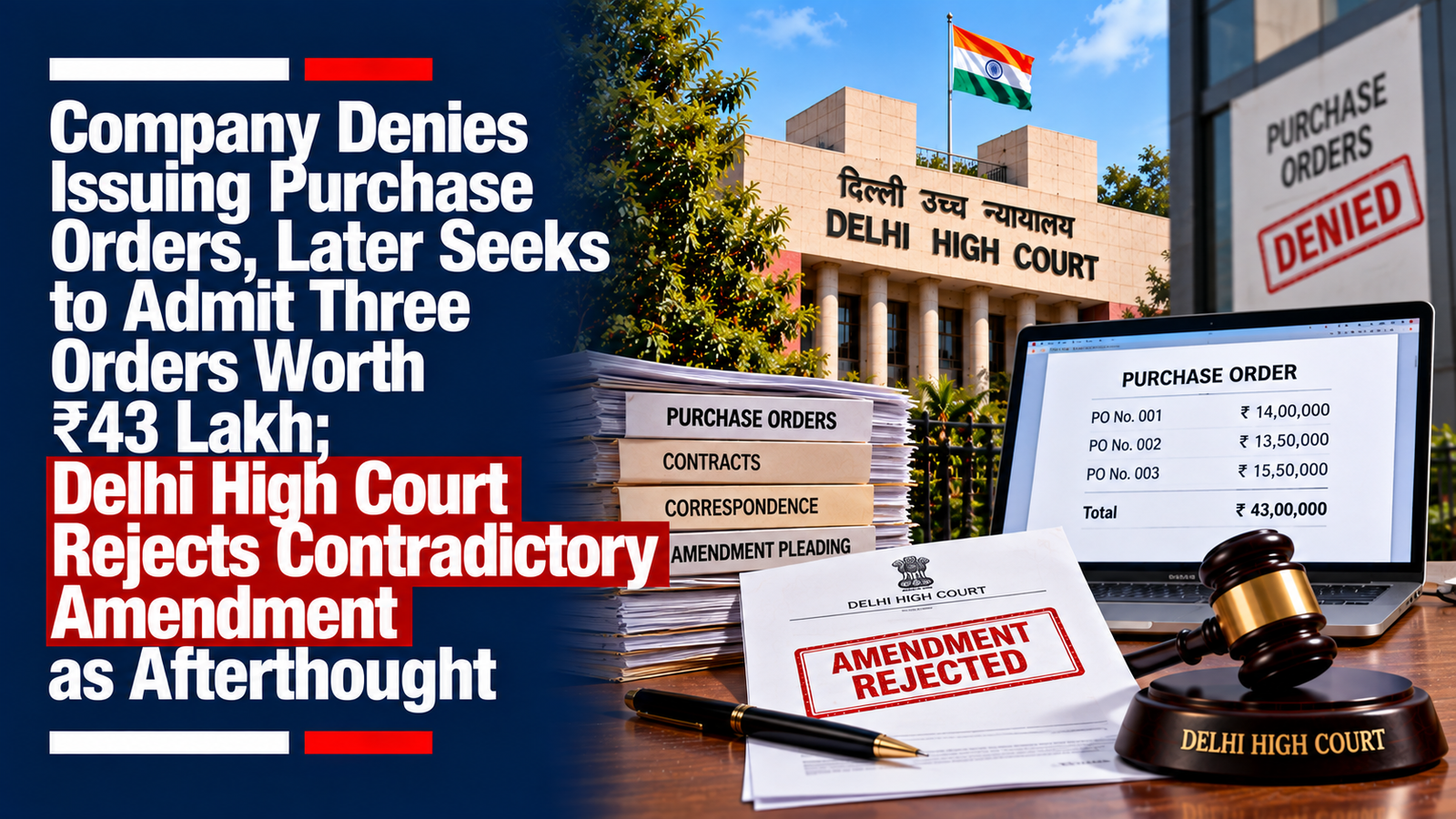
Corporate Entity Claims It Discovered Its Own 2016 Purchase Orders Years Later; Delhi High Court Calls Explanation Unconvincing, Rejects Amendment
Facts
The Delhi High Court considered a petition filed by M/s Holisticc Construction Pvt. Ltd. against M/s Floritech Buildcon Pvt. Ltd., challenging the Commercial Court’s refusal to permit amendment of its written statement under Order VI Rule 17 CPC. The judgment was delivered on 18 September 2026.
Floritech claimed that it had supplied Kota stone, granite and sandstone to Holisticc Construction but had not received payment. It consequently instituted a commercial recovery suit for ₹17,42,216 with pendente lite and future interest at 24% per annum.
In its original written statement filed on 26 July 2021, the defendant categorically asserted that no amount was payable.
More importantly, its pleadings and affidavit of admission/denial denied receipt/existence of the relevant invoices and purchase orders.
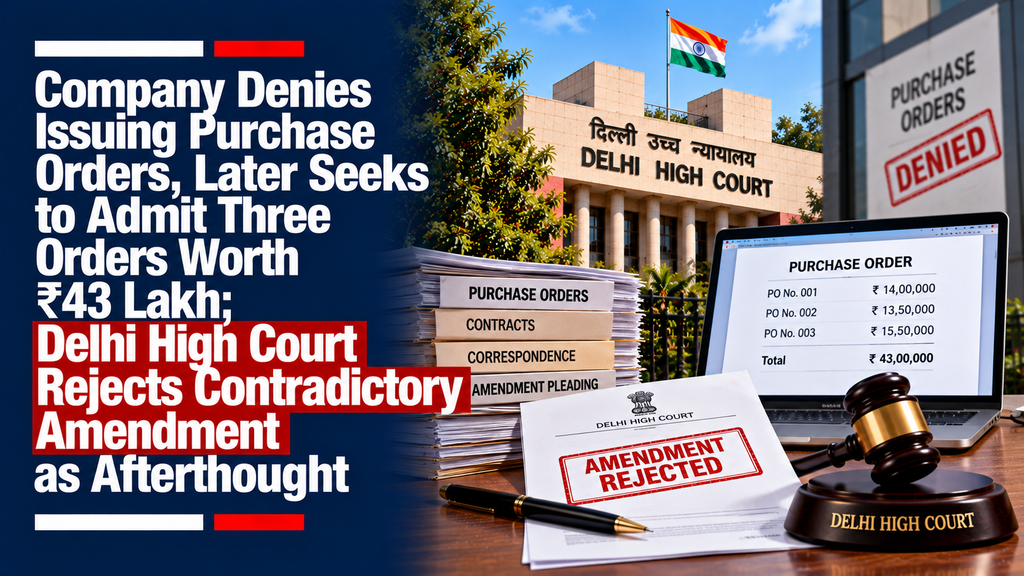
However, on 5 February 2024, the defendant sought amendment of its written statement to introduce an entirely different factual plea: that it had actually issued three purchase orders—two dated 21 December 2015 and one dated 27 January 2016—aggregating to ₹43,36,162, whereas the plaintiff had placed invoices worth ₹76,20,362 on record.
The Commercial Court rejected the amendment. Holisticc Construction then approached the Delhi High Court under Article 227.
Issues
The principal question was:
Can a defendant amend its written statement to introduce a factual defence that directly contradicts and retracts a categorical stand already taken in its original written statement and affidavit of admission/denial?
The Court also considered whether the liberal principles governing amendment of pleadings justified the amendment when it was sought before commencement of trial, and whether the explanation that the company’s own old purchase orders were discovered only subsequently constituted sufficient justification.
Petitioner’s Arguments
The petitioner argued that the Trial Court had adopted an excessively technical approach.
When the amendment application was filed, trial had not commenced and no evidence had been recorded. Therefore, according to the petitioner, allowing the amendment would not have caused prejudice to the plaintiff.
It argued that it was neither introducing new facts nor attempting to fill lacunae, but merely seeking to crystallise the actual dispute regarding the number and value of purchase orders.
Reliance was placed on Rajesh Kumar Aggarwal v. K.K. Modi for the principle that amendments necessary to determine the real controversy should ordinarily be permitted where they cause no prejudice.
Reliance was also placed on Time Warner Entertainment Co., LP v. A.K. Das to contend that even delay and laches need not defeat an amendment necessary for complete justice.
Respondent’s Arguments
Floritech argued that the petitioner had unequivocally denied the transactions, purchase orders and invoices both in its written statement and affidavit of admission/denial.
It therefore could not subsequently reverse its position and admit that purchase orders existed.
The respondent further argued that there was no credible explanation for why the proposed defence had not been taken when the original written statement was filed.
Analysis of the Law
Amendments Are Liberally Considered — But the Rule Is Not Absolute
The High Court acknowledged the settled principle that courts ordinarily adopt a liberal approach towards amendments of pleadings so that the real controversy between the parties can be adjudicated.
However, the power remains discretionary.
A party has no absolute or vested right to have every proposed amendment allowed merely because it is sought before trial or because it may have some bearing on the controversy.
Alternative Pleas vs Mutually Destructive Pleas
This distinction became central to the judgment.
A defendant may ordinarily raise alternative pleas.
But an alternative plea cannot be used to completely destroy a categorical factual position already adopted.
Relying on Gautam Sarup v. Leela Jetly, the High Court reiterated:
A categorical admission may be explained or clarified, but cannot simply be resiled from; alternative pleas cannot be mutually destructive.
The Court therefore distinguished between:
explaining an existing stand, and
replacing the existing stand with an inconsistent factual case.
The petitioner’s amendment fell into the latter category.
Court’s Reasoning
1. Original Defence Was Unequivocal
The original written statement did not merely dispute the amount claimed.
It specifically denied that tax invoices had ever been issued and stated that no amount was payable.
The affidavit of admission/denial went further and denied the existence of purchase orders.
The Court therefore treated the original defence as categorical rather than ambiguous.
2. Proposed Amendment Was Not a Clarification
The proposed amendment sought to plead that the defendant had actually issued three purchase orders totalling ₹43,36,162.
According to the High Court, this was not an elaboration or clarification of the existing defence.
It was an attempt to “completely retract” the earlier categorical denial and establish an altogether new factual case.
3. Company’s Explanation Was “Wholly Unconvincing”
The petitioner attempted to explain the approximately three-year delay by saying that the relevant purchase orders came to its knowledge later.
The High Court was not persuaded.
It observed that it was unreasonable for a corporate entity to remain unaware of its own purchase orders while preparing and filing its written statement.
The Court further held that inadvertence in checking or verifying one’s own records cannot itself justify amendment.
4. Earlier Amendment Judgments Were Distinguishable
The petitioner relied upon Rajesh Kumar Aggarwal and Time Warner Entertainment.
The High Court distinguished them because those cases involved amendments necessitated by subsequent developments.
Here, there was no subsequent event.
The three purchase orders dated back to 2015–2016 and were the petitioner’s own documents, available even before institution of the suit.
The Court similarly distinguished Dinesh Goyal v. Suman Agarwal (Bindal) because that case involved an amendment necessary to determine a dispute concerning a will in a partition suit. Here, the defendant was attempting to retreat from its own prior denial.
Precedent Analysis
Gautam Sarup v. Leela Jetly
This was the central authority.
The Supreme Court had recognised that although an admission may sometimes be explained or clarified, a categorical admission cannot simply be withdrawn by setting up a mutually destructive alternative case.
The Delhi High Court applied that principle directly.
Rajesh Kumar Aggarwal v. K.K. Modi
The principle favouring amendments necessary for determining the real controversy was acknowledged but distinguished because the amendment there arose from subsequent developments.
Time Warner Entertainment Co., LP v. A.K. Das
Similarly distinguished because the amendment there became necessary due to a subsequent development and was therefore allowed notwithstanding delay.
Dinesh Goyal v. Suman Agarwal (Bindal)
Distinguished because the proposed amendment in that partition dispute was necessary to adjudicate the question concerning a will; it did not involve a litigant attempting to reverse its own categorical factual denial.
Conclusion
The Delhi High Court held that Order VI Rule 17 CPC cannot be used to substitute an entirely new and mutually destructive factual defence for a categorical stand already taken in the written statement.
The Court found no jurisdictional error, perversity or patent illegality in the Commercial Court’s decision warranting supervisory interference under Article 227.
Accordingly, the petition and pending applications were dismissed.
Importantly, the High Court expressly clarified that it had not expressed any opinion on the merits of the underlying recovery dispute.
Case Details
Case: M/s Holisticc Construction Pvt. Ltd. v. M/s Floritech Buildcon Pvt. Ltd.
Court: Delhi High Court
Case No.: CM(M) 3094/2024 & CM APPL. 43964/2024
CNR: DLHC010462782024
Judge: Justice Ajay Digpaul
Reserved: 7 September 2026
Decided: 18 September 2026
Result: Petition dismissed; refusal to permit amendment of the written statement upheld.