Man Gets Life for Murder Based on ‘Last Seen’ and Alleged Confession; Delhi High Court Acquits Him, Finds Witness Conduct Unnatural and Evidence Incomplete

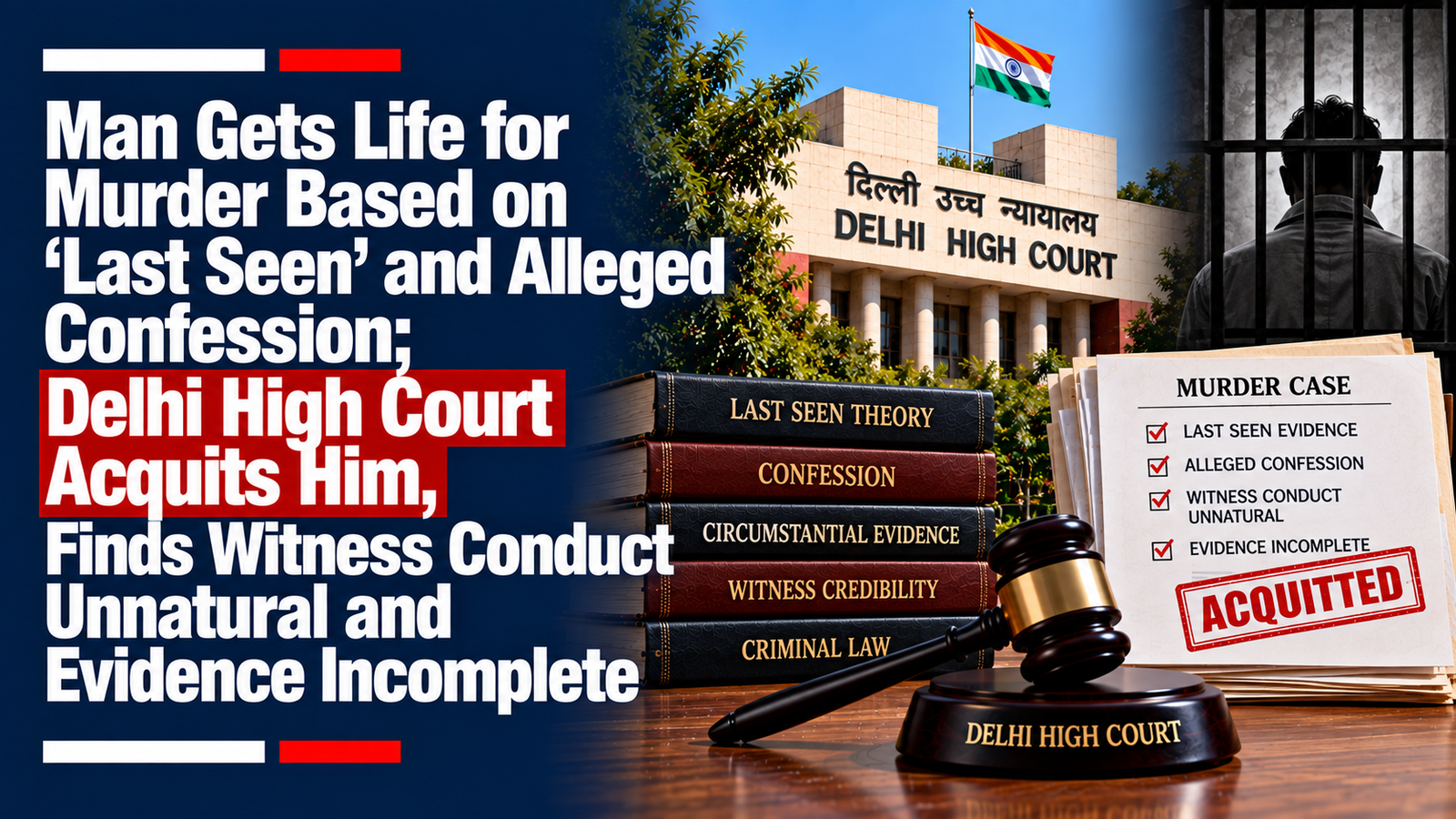
Friends Find Victim Unconscious in Pool of Blood but Leave Without Helping; Delhi High Court Finds Conduct Unnatural, Sets Aside Murder Conviction
Facts
The appeal was filed by Inam Singh @ Bhura challenging his conviction dated 18 October 2002 by the Additional Sessions Judge for murder under Section 302 IPC and the sentence dated 1 November 2002 imposing life imprisonment with a fine of ₹100. The case arose from FIR No. 529/2000 registered at Police Station Najafgarh. The Delhi High Court pronounced its judgment on 18 September 2026.
According to the prosecution, on the evening of 26 October 2000, Diwali, Ram Kishan, Jai Bhagwan, the appellant and deceased Munshi Ram gathered at Ram Kishan’s room and consumed liquor. At about 9:20 p.m., Ram Kishan and Jai Bhagwan allegedly left, leaving the appellant and deceased alone.
When they allegedly returned around 12:40 a.m., the room was bolted from inside. The appellant opened it and the deceased was allegedly found unconscious in a pool of blood. The appellant was alleged to have stated that a quarrel had occurred and that he had hit the deceased with an iron pipe.
The deceased subsequently succumbed to his injuries. The prosecution examined 15 witnesses, with the Trial Court principally relying on the “last seen” evidence of PW-6 Jai Bhagwan and PW-12 Ram Kishan and the alleged extra-judicial confession.
Issues
The principal issues before the High Court were whether:
- the “last seen together” circumstance was sufficient to establish the appellant’s guilt;
- the conduct and testimony of PW-6 and PW-12 were sufficiently reliable;
- the alleged extra-judicial confession could safely be relied upon;
- the alleged hand-pump cylinder/iron pipe was satisfactorily connected to the murder;
- Section 106 of the Evidence Act could be invoked against the appellant for failing to explain what happened after he was allegedly left alone with the deceased; and
- the prosecution had established a complete chain of circumstances excluding every reasonable hypothesis of innocence.
Appellant’s Arguments
The appellant argued that the conviction rested entirely on circumstantial evidence and that the Trial Court had wrongly elevated the “last seen” circumstance into proof of murder.
A major attack was directed at the conduct of PW-6 and PW-12. Despite allegedly discovering the deceased unconscious and bleeding heavily, they neither took him to hospital nor informed the police. Instead, according to their versions, they left the premises.
The appellant further contended that there was no corroborative evidence proving Jai Bhagwan’s claimed DTC duty, such as duty records, depot records, route details or travel evidence.
It was also argued that:
- there was no proved motive;
- the alleged weapon was not satisfactorily established;
- the time gap did not eliminate intervention by another person;
- the witnesses’ conduct was unnatural;
- the alleged confession was unsafe to rely upon; and
- the five golden principles governing circumstantial evidence under Sharad Birdhichand Sarda were not satisfied.
Respondent’s Arguments
The State defended the conviction, contending that the prosecution had established an unbroken chain of circumstances.
It relied particularly upon the fact that the appellant and deceased were allegedly left alone, that the room was bolted from inside when PW-6 and PW-12 returned, and that the deceased was found seriously injured immediately thereafter.
The prosecution also relied upon the appellant’s alleged extra-judicial confession, medical evidence showing fatal head injuries caused by a hard and blunt object, and recovery of the hand-pump cylinder alleged to have been used in the assault.
Analysis of the Law
Last Seen Is a Circumstance, Not Conclusive Proof
The High Court reiterated that the last-seen theory assumes significance only where the interval between the accused and deceased being last seen together and the discovery of death is so narrow that intervention by another person becomes practically impossible.
Crucially, however, last seen by itself does not necessarily establish that the accused committed the crime. Some additional corroborative material connecting the accused to the offence is ordinarily necessary.
Section 106 Cannot Cure Gaps in the Prosecution Case
The Court also dealt with the accused’s failure to explain how or when he parted company with the deceased.
It held that Section 106 of the Evidence Act does not shift the prosecution’s primary burden. An adverse inference can operate only after the prosecution first establishes circumstances giving rise to a reasonable inference against the accused.
Thus, last seen plus an inadequate explanation may generate suspicion, but cannot, without sufficient supporting material, automatically become proof of murder.
Court’s Reasoning
1. Conduct of the Two Principal Witnesses Was Unnatural
This was one of the strongest factual reasons for interference.
The High Court found it difficult to accept that Ram Kishan would leave his own room in the middle of a Diwali drinking gathering merely to accompany Jai Bhagwan on his bus duty.
Even more significant was their alleged conduct after returning.
According to them, the deceased was lying unconscious in a pool of blood. Yet instead of taking him for treatment or contacting the police, they left.
The Court regarded the differences in their accounts of where they went thereafter as substantive rather than minor inconsistencies.
2. No Independent Corroboration of Jai Bhagwan’s Bus-Duty Story
The prosecution could have produced objective evidence concerning Jai Bhagwan’s DTC duty—duty records, depot records or other material—but did not.
That missing corroboration became significant because the prosecution depended upon the claim that Jai Bhagwan and Ram Kishan had left the room together, leaving only the appellant and deceased behind.
3. Alleged Murder Weapon Was Not Properly Connected to the Death
The prosecution relied on the cylindrical portion of a hand pump as the alleged weapon.
However, the High Court found two serious deficiencies:
the object was not shown to the post-mortem doctor to obtain an opinion whether it could have caused the injuries; and
there was no forensic evidence demonstrating the presence of blood on it.
The Court considered these important missing links in the circumstantial chain.
4. Extra-Judicial Confession Was Unsafe
The prosecution relied on the alleged statement made by the appellant to PW-6 and PW-12 regarding the quarrel and assault.
But once the Court found that the two witnesses themselves were not completely reliable, their account of the alleged confession also became unsafe.
The Court reiterated that an extra-judicial confession is inherently a weak form of evidence and must be approached with considerable care, particularly where the surrounding circumstances create doubt about its truthfulness.
5. Circumstantial Chain Was Incomplete
The Court ultimately applied the five golden principles—often described as the “panchsheel” of circumstantial evidence—from Sharad Birdhichand Sarda.
The circumstances must not merely suggest that the accused may have committed the offence. They must lead to the conclusion that the accused must have committed it, excluding reasonable hypotheses consistent with innocence.
The prosecution failed that standard.
Precedent Analysis
The Court relied substantially upon Anand Jakkappa Pujari @ Gaddadar v. State of Karnataka (2026) for the proposition that last-seen evidence requires corroboration and cannot automatically establish authorship of the crime.
In Manoj alias Munna v. State of Chhattisgarh (2025), the Supreme Court’s treatment of Section 106 was applied: the accused’s failure to explain facts within special knowledge may become an additional link, but it cannot substitute the prosecution’s burden of proving guilt beyond reasonable doubt.
The Court also relied upon Sahadevan v. State of Tamil Nadu and Ramanand @ Nandlal Bharti v. State of Uttar Pradesh on the evidentiary weakness of extra-judicial confessions, particularly when the circumstances or witnesses create doubt.
Finally, Sharad Birdhichand Sarda and Jabir v. State of Uttarakhand governed the ultimate test: every circumstance and every link must be proved, forming a chain incompatible with innocence.
Conclusion
The Delhi High Court found that the prosecution had established circumstances capable of creating suspicion, but not the complete and conclusive chain required for a conviction based exclusively on circumstantial evidence.
The Court held that the Trial Court had erred both in law and on facts in convicting Inam Singh under Section 302 IPC.
Accordingly:
The murder conviction dated 18 October 2002 was set aside.
The life sentence dated 1 November 2002 was set aside.
Inam Singh @ Bhura was acquitted of the charges.
The criminal appeal was allowed.
Case Details
Case: Inam Singh @ Bhura v. State (NCT of Delhi)
Court: Delhi High Court
Case No.: CRL.A. 326/2003
Bench: Justice Navin Chawla and Justice Ravinder Dudeja
Reserved: 21 July 2026
Pronounced: 18 September 2026
Result: Appeal allowed; Section 302 IPC conviction and life sentence set aside; appellant acquitted.