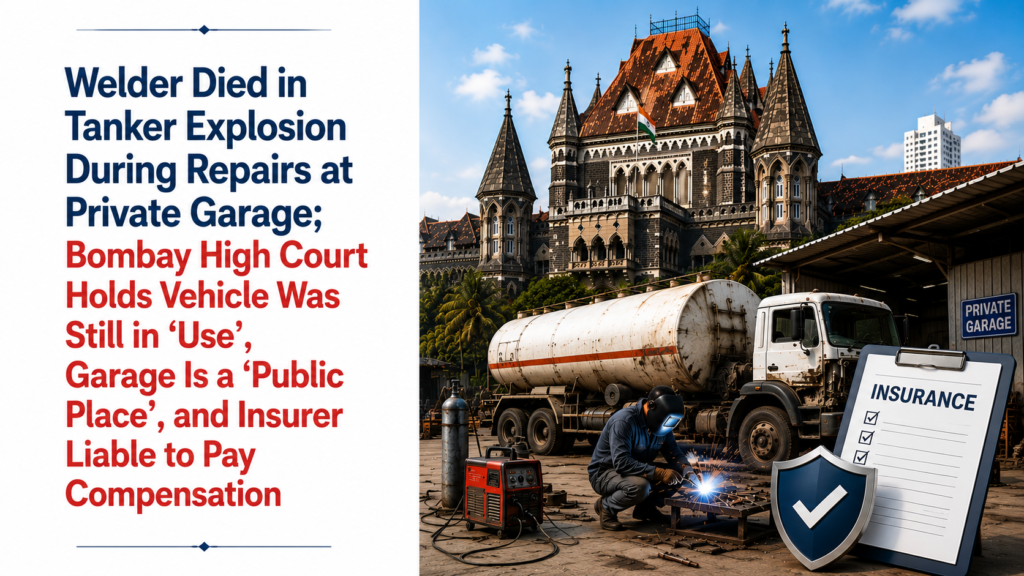
Welder Died in Tanker Explosion During Repairs at Private Garage; Bombay High Court Holds Vehicle Was Still in ‘Use’, Garage Is a ‘Public Place’, and Insurer Liable to Pay Compensation

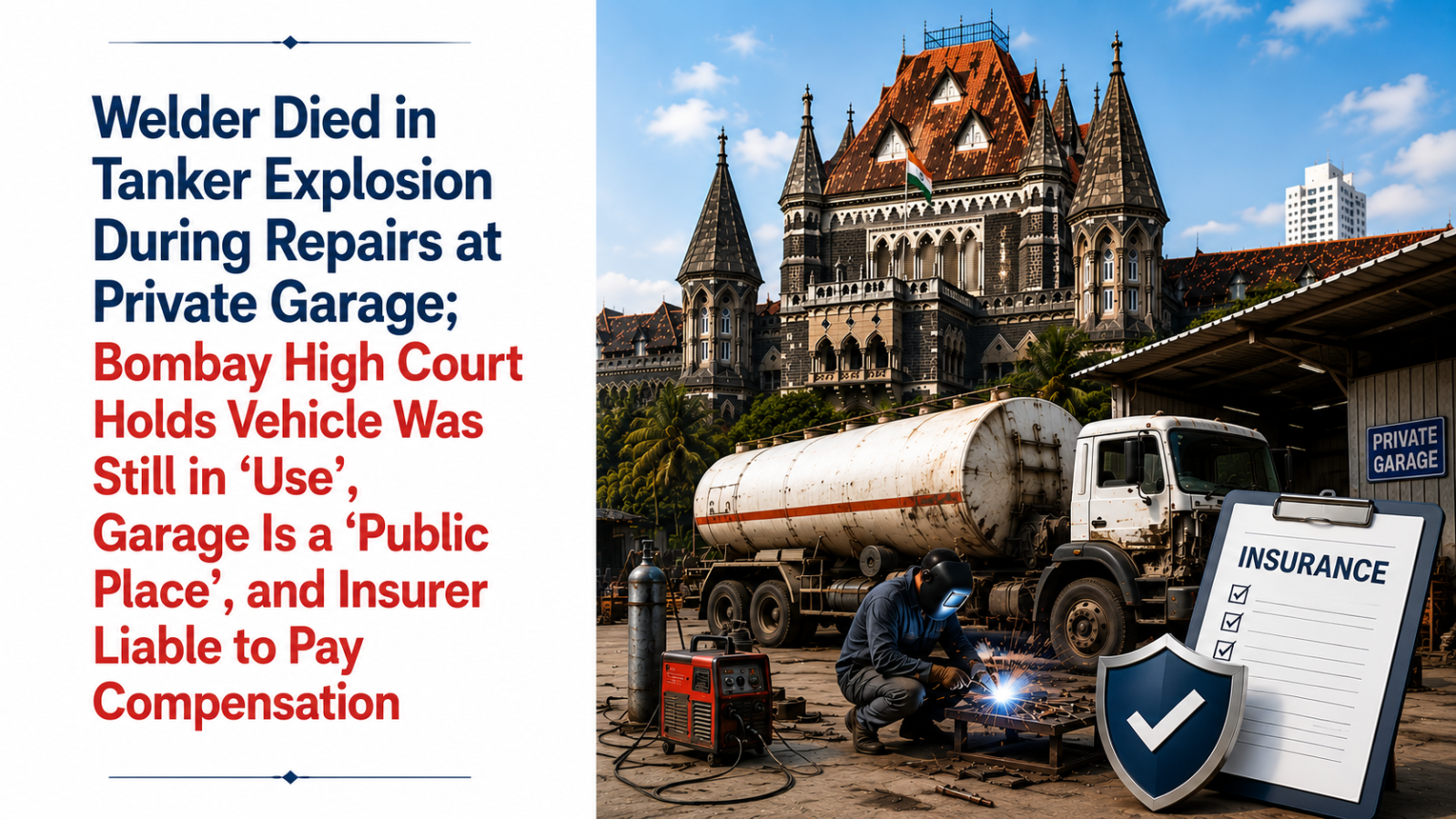
Bombay High Court Rules Vehicle Undergoing Repairs Remains in ‘Use’; Insurance Company Cannot Escape Liability for Fatal Garage Explosion.
Facts
The appeal arose from an award of the Motor Accident Claims Tribunal directing The New India Assurance Co. Ltd. and the vehicle owner to pay compensation of ₹8,26,000 with interest for the death of Shafiq Atikurrahaman, a welder employed at Om Sai Servicing Garage, Chembur. On 19 May 2015, a motor tanker was brought to the garage for repairs. While the deceased was carrying out welding work on the tanker, a sudden explosion occurred, allegedly because residual fuel or combustible gas had not been removed from the tank before welding commenced. The blast caused fatal injuries to the welder, following which an FIR was lodged against the garage owner. The deceased’s dependants filed a claim petition under the Motor Vehicles Act seeking compensation. The Tribunal allowed the claim, prompting the insurer to file the present appeal.
The insurance company challenged the award principally on three grounds: first, that a vehicle stationed in a garage for repairs was not being “used” within the meaning of the Motor Vehicles Act; second, that a private garage was not a “public place” so as to attract Section 147; and third, that negligence lay with the deceased and the garage owner, thereby absolving the insurer of liability.
Issues
- Whether a motor vehicle stationed in a garage for repairs is still in “use” under the Motor Vehicles Act.
- Whether a private garage falls within the definition of a “public place” under Section 2(34) of the Motor Vehicles Act, 1988.
- Whether negligence could be attributed to the deceased instead of the vehicle owner or garage owner.
- Whether the insurer remained liable to indemnify the vehicle owner for compensation payable to the deceased’s dependants.
Appellant’s Arguments
The insurer argued that the tanker was stationary in a private garage solely for repair work and therefore was not in “use” at the time of the accident. Since Section 147 requires the accident to arise out of the use of a motor vehicle in a public place, the insurer contended that liability under the policy was not attracted. It further submitted that a private garage was not a “public place” within the meaning of Section 2(34), and therefore the statutory requirement for third-party liability was absent.
The insurer also argued that negligence lay with the deceased welder and the garage owner for carrying out welding operations without adequate precautions. It relied upon Minu B. Mehta v. Balkrishna Ramchandra Nayan and Surender Kumar Arora v. Manoj Bisla to contend that negligence must be proved before compensation can be awarded and that, on the facts, no liability could be fastened upon the insurer.
Respondents’ Arguments
The claimants contended that the expression “use of a motor vehicle” is of wide import and includes situations where the vehicle is stationary for repairs. They argued that repairs are an integral part of the vehicle’s operation and that the statutory scheme of the Motor Vehicles Act warrants a beneficial interpretation in favour of accident victims.
The respondents further submitted that a repair garage is a “public place” because members of the public routinely access it for repair and servicing of vehicles. They relied on Shivaji Dayanu Patil, Pandurang Chimaji Agale, Guru Govekar, and other authorities to argue that the insurer remained liable to indemnify the owner where a third party suffers injury arising out of the use of the insured vehicle.
Analysis of the Law
Justice Jitendra Jain undertook an extensive examination of the expressions “use of a motor vehicle” and “public place” under the Motor Vehicles Act. The Court held that the expression “use” cannot be confined only to a moving vehicle. A vehicle taken to a garage for repairs remains in continuous use because repairs are an integral and necessary incident of its operation. A restrictive interpretation would defeat the beneficial object of compulsory third-party insurance. The Court also referred to provisions dealing with stationary vehicles under the Act to reinforce that a stationary vehicle continues to be regulated under the statutory scheme.
On the question of “public place”, the Court reaffirmed that the definition is concerned with access rather than ownership. A privately owned garage into which members of the public may enter for repairs is nevertheless a public place for the purposes of Section 2(34). The Court further applied principles of bailment under Sections 150 and 151 of the Indian Contract Act, holding that when a vehicle is entrusted for repairs, the owner continues to bear responsibility through the relationship of bailor and bailee, and the insurer must indemnify that liability absent proof of breach of policy conditions.
Precedent Analysis
- Shivaji Dayanu Patil v. Vatschala Uttam More (1991) 3 SCC 530 – Held that “use of a motor vehicle” extends to stationary vehicles and should receive a broad interpretation consistent with the beneficial object of the Motor Vehicles Act.
- Guru Govekar v. Filomena F. Lobo (1988) 3 SCC 1 – Held that when a vehicle is entrusted for repairs, the repairer uses the vehicle on behalf of the owner and the insurer remains liable for third-party claims arising during repairs.
- Cholamandalam MS General Insurance Co. Ltd. v. Priyanka K. Mayekar, 2022 SCC OnLine Bom 3789 – Followed extensively to hold that a repair garage is a public place and a vehicle under repair remains in use.
- Pandurang Chimaji Agale v. New India Life Insurance Co. Ltd., 1988 SCC OnLine Bom 29 – Full Bench decision holding that “public place” includes private places where members of the public have access, whether regulated or unrestricted.
- Minu B. Mehta v. Balkrishna Ramchandra Nayan (1977) 2 SCC 441 and Surender Kumar Arora v. Manoj Bisla (2012) 4 SCC 552 – Distinguished as negligence had been established on the facts and therefore did not assist the insurer.
Court’s Reasoning
The Court rejected each of the insurer’s contentions. It held that the tanker remained in “use” notwithstanding that it was stationary in the garage because repairs are inseparable from the normal operation and movement of a motor vehicle. Interpreting “use” narrowly would undermine the legislative purpose of compulsory insurance against third-party risks. The Court also observed that provisions regulating stationary vehicles demonstrate that the Act contemplates continued legal obligations even when a vehicle is not in motion.
On the issue of “public place”, the Court emphasised that the decisive consideration is whether members of the public have access to the premises, not whether the premises are privately owned. Since members of the public routinely visit garages for repairs and servicing, a garage falls within Section 2(34). The Court relied upon a consistent line of authorities from the Supreme Court and several High Courts recognising garages, workshops, factory premises and similar locations as public places for the purposes of the Motor Vehicles Act.
Regarding negligence, the Court found no error in the Tribunal’s conclusion that responsibility lay with the vehicle owner and the garage owner rather than the deceased. The insurer had failed to produce any evidence showing that the owner had warned the garage about residual fuel or complied with the duties of a bailor. Applying Sections 150 and 151 of the Indian Contract Act, the Court held that the vehicle owner remained liable for the consequences arising from entrusting the vehicle for repairs. Since the insurer had also failed to prove any breach of policy conditions, it was bound to indemnify the owner and satisfy the compensation awarded by the Tribunal.
Conclusion
The Bombay High Court dismissed the insurer’s appeal and affirmed the MACT award. It held that a vehicle undergoing repairs remains in “use” for the purposes of the Motor Vehicles Act, that a repair garage is a “public place” under Section 2(34), and that the insurer remained liable to indemnify the vehicle owner for the death of the welder. The judgment reinforces the beneficial interpretation of compulsory third-party insurance provisions and broadens protection for victims of accidents arising during vehicle repairs.
Case Details
- Case: The New India Assurance Co. Ltd. v. Atikurrahaman Lais Mohammad & Ors.
- Court: Bombay High Court
- Case Number: First Appeal No. 246 of 2021
- Judge: Justice Jitendra Jain
- Date: 28 July 2026
- Result: Appeal dismissed; MACT award of ₹8,26,000 with interest upheld against the insurer and vehicle owner.