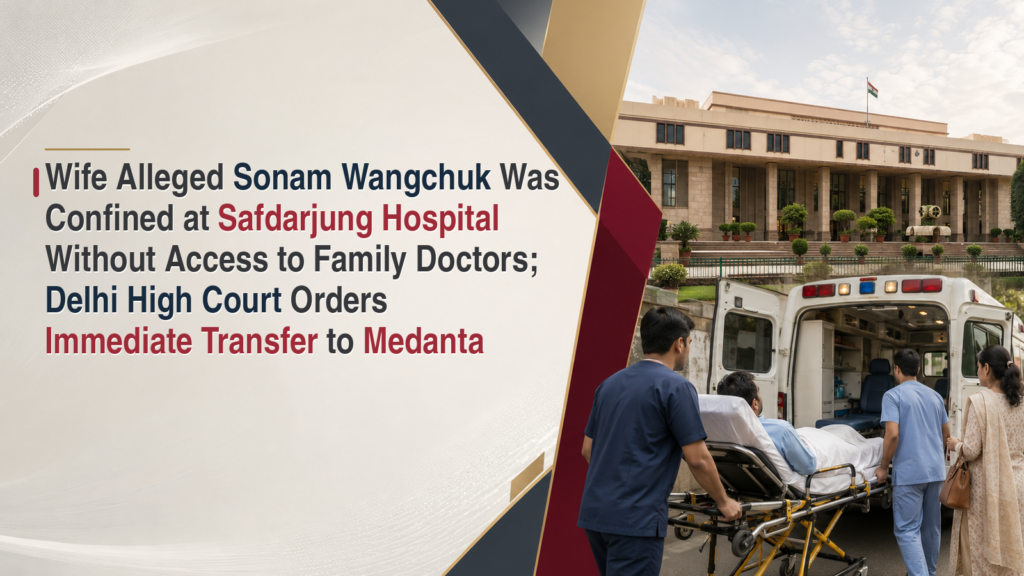
Wife Alleged Sonam Wangchuk Was Confined at Safdarjung Hospital Without Access to Family Doctors; Delhi High Court Orders Immediate Transfer to Medanta

Doctors Flagged Sonam Wangchuk’s Low White-Blood-Cell Count and Potassium Levels; Delhi High Court Orders Continuous Monitoring at Hospital of His Choice
Facts
Gitanjali J. Angmo filed a writ petition before the Delhi High Court concerning the hospitalisation of her husband, Sonam Wangchuk, at Vardhman Mahavir Medical College and Safdarjung Hospital, New Delhi.
She alleged that Sonam Wangchuk had remained confined at Safdarjung Hospital for approximately 20 days:
- In isolation;
- Without access to his lawyers;
- Without adequate access to the doctors who had previously examined him; and
- Without her receiving complete and contemporaneous medical records.
The writ petition sought the following reliefs:
- A declaration that his continued confinement at Safdarjung Hospital was illegal, unconstitutional and contrary to Articles 19 and 21 of the Constitution of India.
- His immediate release or discharge from the alleged confinement.
- Immediate, unrestricted and continuous access for Gitanjali J. Angmo and her lawyers.
- Permission to shift him to a hospital or medical centre of his and his wife’s choice.
- Complete and accurate medical reports in physical or digital form, with continued real-time access to subsequent reports.
- A restraint against administering medication, fluids or any medical intervention without Sonam Wangchuk’s informed consent or, if he was unable to give consent, without the consent of his wife as his next of kin.
Single Judge’s Order
On 19 July 2026, the Single Judge issued notice in the writ petition but found that no case for immediate interim relief had been established at that stage.
The Single Judge directed the respondents to file their status reports and replies.
The Single Judge also ordered that:
- All decisions regarding Sonam Wangchuk’s medical condition must follow strict medical protocols;
- His safety must remain the primary consideration; and
- The medical team must continuously monitor his vital signs.
Gitanjali J. Angmo challenged the refusal of interim relief before a Division Bench through a Letters Patent Appeal.
Division Bench’s Preliminary Directions
On 20 July 2026, the Division Bench directed that all pathological reports relating to Sonam Wangchuk be placed before the Court.
These included reports based on samples analysed by:
- Safdarjung Hospital;
- The All India Institute of Medical Sciences, New Delhi; and
- A private pathological laboratory.
The Court directed the Director of Safdarjung Hospital to file the reports through a sworn affidavit and to place all medical and health bulletins issued regarding Sonam Wangchuk on record.
Gitanjali J. Angmo was also directed to produce reports obtained from the private laboratory.
The Court requested the presence of:
- Doctor Nikhil Tandon, Director In-charge of the All India Institute of Medical Sciences;
- Doctor Akshay Kumar, Additional Professor of Emergency Medicine at the All India Institute of Medical Sciences; and
- The private doctor who had been advising Gitanjali J. Angmo.
Medical Review Before the Court
On 21 July 2026, the Court examined:
- Safdarjung Hospital’s reports;
- Reports from the All India Institute of Medical Sciences;
- Reports from Oncquest Laboratories;
- Blood and urine sample analyses;
- Medical and health bulletins;
- The affidavit of the Director of Safdarjung Hospital;
- Statements attributed to Sonam Wangchuk; and
- A communication dated 20 July 2026 from the officiating Medical Superintendent of Safdarjung Hospital.
The Court interacted with:
- Doctor Nikhil Tandon;
- Doctor Akshay Kumar; and
- Doctor Satish Lamba, who appeared on behalf of the appellant.
The doctors expressed concern primarily regarding:
- A low Total Leucocyte Count, meaning a low white-blood-cell count; and
- The potassium level in Sonam Wangchuk’s blood.
There was medical consensus that he required constant and continuous monitoring by qualified experts.
Gitanjali J. Angmo stated that her husband wished to receive treatment at Medanta Hospital, Gurugram.
The Solicitor General of India informed the Court that the respondents had no objection to his hospitalisation at Medanta Hospital.
Issues
- Whether Sonam Wangchuk’s continued treatment at Safdarjung Hospital amounted to illegal or unconstitutional confinement.
- Whether his alleged lack of access to his wife, lawyers and private doctors violated Articles 19 and 21 of the Constitution.
- Whether his medical condition required independent assessment by experts from outside Safdarjung Hospital.
- Whether complete medical reports and health bulletins should be furnished to his wife.
- Whether Sonam Wangchuk should be permitted to shift to a hospital of his choice.
- Whether patient autonomy and the right to health required the Court to facilitate treatment at Medanta Hospital.
- Whether his wife should be granted continuing access during hospitalisation.
- What safeguards were necessary in light of the doctors’ concerns over his blood-test results.
- Whether the appeal and underlying writ petition could be disposed of after the Government agreed to his transfer.
Appellant’s Arguments
Gitanjali J. Angmo
The appellant contended that her husband’s continued confinement at Safdarjung Hospital violated his fundamental rights under Articles 19 and 21 of the Constitution.
She argued that:
- He had remained isolated at Safdarjung Hospital for approximately 20 days.
- He was denied adequate access to his wife.
- His lawyers were not permitted proper access.
- Doctors who had previously treated or examined him were unable to freely monitor his health.
- Complete and accurate medical records were not being supplied on a continuous basis.
- He should be permitted to choose the institution where he wished to receive treatment.
- His preferred institution was Medanta Hospital, Gurugram.
- No medication, fluid or medical intervention should be administered without informed consent.
- The health concerns reflected in private laboratory reports required urgent independent assessment.
- His low Total Leucocyte Count and potassium levels required continuous specialist monitoring.
The appellant requested his immediate transfer to Medanta Hospital and unrestricted access during his hospitalisation.
Respondents’ Arguments
Union of India and Government Authorities
The respondents participated in the medical-review process and placed an affidavit of the Director of Safdarjung Hospital on record.
They produced:
- Pathological reports;
- Medical records;
- Health bulletins; and
- Information regarding the treatment being provided.
Senior doctors from Safdarjung Hospital and the All India Institute of Medical Sciences assisted the Court.
The Solicitor General of India ultimately informed the Court that the respondents had no objection to Sonam Wangchuk being shifted to Medanta Hospital.
The dispute concerning the transfer was therefore resolved with the Government’s consent, subject to continued treatment and medical monitoring.
Analysis of the Law
Article 21 and Right to Medical Care
Article 21 of the Constitution protects life and personal liberty. Its protection includes the right to:
- Timely medical care;
- Safe and appropriate treatment;
- Human dignity;
- Meaningful access to medical information; and
- Protection against avoidable risks to health and life.
Where serious medical concerns are raised, a constitutional court may examine whether the treatment arrangements adequately safeguard the patient’s life and dignity.
Patient Autonomy and Choice of Hospital
The Court did not announce an unrestricted rule that every hospitalised person has an absolute right to demand transfer to any institution.
Its direction was based on the particular circumstances:
- Concerns emerged from multiple pathological reports;
- Senior doctors agreed that constant monitoring was required;
- Sonam Wangchuk and his wife selected Medanta Hospital;
- Medanta was capable of providing the required treatment; and
- The Government raised no objection.
In these circumstances, the Court held that shifting him to the hospital of his choice would fulfil the requirements of his rights under Articles 19 and 21.
Independent Medical Evaluation
The Court did not rely exclusively on the report of one hospital.
It directed production of:
- Safdarjung Hospital reports;
- All India Institute of Medical Sciences reports;
- Private laboratory reports; and
- Periodic health bulletins.
It also personally interacted with doctors from the All India Institute of Medical Sciences and the appellant’s private doctor.
This ensured that the judicial decision was based on an informed medical consensus rather than competing assertions by the parties.
Family Access
The Court recognised the importance of the spouse’s access to a hospitalised patient.
It directed that, in addition to the normal medical protocol followed at Medanta Hospital, Gitanjali J. Angmo must be permitted to visit her husband whenever she desired.
This direction addressed her allegation that she had been denied adequate access during his earlier hospitalisation.
Continued Treatment and Patient Cooperation
The Court balanced patient choice with the need for continued medical treatment.
It directed that:
- Medanta Hospital’s Director must constitute a team of qualified doctors;
- The team must continuously monitor Sonam Wangchuk’s condition;
- Medication must be administered according to established medical norms and protocols; and
- Sonam Wangchuk must follow the treatment plan and advice of the attending medical team.
The order therefore did not permit discharge from medical supervision. It transferred responsibility for treatment to the chosen hospital.
Precedent Analysis
The judgment did not rely upon or discuss any separate reported precedent.
The Division Bench decided the matter directly on:
- The medical reports placed before it;
- The opinions of senior doctors;
- The Government’s lack of objection to transfer;
- The urgency of the health concerns; and
- The protections contained in Articles 19 and 21 of the Constitution.
The ruling is therefore primarily fact-specific. It recognises that constitutional courts may intervene to protect medical autonomy, patient safety and family access, but it does not establish an absolute right to transfer to any hospital in every case.
Court’s Reasoning
The Delhi High Court relied upon the following considerations:
- Medical reports had been obtained from Safdarjung Hospital, the All India Institute of Medical Sciences and a private laboratory.
- The Court examined these reports rather than relying solely on the submissions of either side.
- Senior doctors personally appeared and assisted the Court.
- The doctors expressed concern regarding Sonam Wangchuk’s low Total Leucocyte Count and potassium levels.
- There was a consensus that he required constant and continuous medical monitoring.
- He was then undergoing treatment at Safdarjung Hospital.
- Medanta Hospital was identified as the hospital of his choice.
- The Government had no objection to the proposed transfer.
- The transfer would safeguard his rights under Articles 19 and 21.
- A specialist medical team at Medanta could ensure continued treatment.
- His wife’s access could be protected through a specific judicial direction.
- Sonam Wangchuk was also required to cooperate with and follow the treatment advised by the Medanta medical team.
- Since the transfer and access issues had been resolved, both the appeal and the underlying writ petition could be disposed of.
The Court did not return a final finding that the earlier confinement at Safdarjung Hospital was illegal.
Conclusion
The Delhi High Court directed that Sonam Wangchuk be shifted immediately from Safdarjung Hospital to Medanta Hospital, Gurugram.
It further directed that:
- The Director of Medanta Hospital must constitute a team of doctors with appropriate expertise;
- The medical team must constantly monitor his condition;
- Necessary medication and treatment must be administered in accordance with established medical protocols;
- Sonam Wangchuk must follow the doctors’ treatment plan and advice; and
- Gitanjali J. Angmo must be allowed to visit her husband whenever she desires, in addition to access permitted under normal medical protocols.
The Court disposed of:
- The Letters Patent Appeal;
- All pending applications; and
- With the parties’ consent, the underlying writ petition.
The hearing scheduled in the writ petition for 24 July 2026 was cancelled.
Case Details
Case: Gitanjali J. Angmo v. Union of India and Others, 2026:DHC:5796-DB
Court: High Court of Delhi at New Delhi, Division Bench
Case Number: Letters Patent Appeal Number 539 of 2026
Applications: Civil Miscellaneous Application Numbers 45648, 45649 and 45650 of 2026
Underlying Matter: Writ Petition (Civil) Number 9770 of 2026
Judges: Chief Justice Devendra Kumar Upadhyaya and Justice Tejas Karia
Date: 21 July 2026
Result: Sonam Wangchuk ordered to be shifted immediately from Safdarjung Hospital to Medanta Hospital, Gurugram, for continuous specialist monitoring; his wife granted access to visit him whenever she desires. Appeal and underlying writ petition disposed of.